


FW
US apparel consumption shrinks by 50 per cent: AAFA
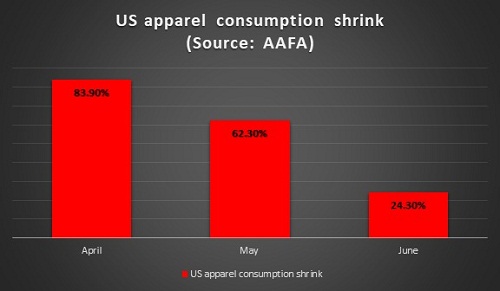
Consumption of apparels in one of the biggest consumer market – the US -- has shrunk by 50 per cent. Nate Herman, Senior Vice-President –Policy, American Apparel & Footwear Association (AAFA) informs, retail sales declined 83.9 per cent in April, 62.3 per cent in May and 24.3 per cent in June. Fashion consumption is headed for a 50 per cent decline to around $200bn, except trade recovers sharply during the coming winter and Christmas holidays.
US’ worsening relationship with China is hitting American apparel brands and retailers as they import the majority of their readymade garments (RMG) from China. AAFA executives say China has failed to ramp up purchases of US cotton and textiles to roughly $1billion a year from to $600 million before the January deal. Other hot-points like intellectual property (IP) theft are distancing the two countries greatly. Many Chinese companies have been able to register a trademark that is a near copy of a US rival brand and have been continuously doing over the previous six months, in spite of Beijing’s pledges that it would stop these activities.
The recent development of sanctions against China’s Xianjing Production and Construction Corporation (XPCC) over serious right abuses in the Xinjiang Uyghur Autonomous Region (XUAR) by the US Department of Treasury’s Office of Foreign Assets Control (OFAC) has boosted claims of rights abuses against the Uyghur ethnic communities by China’s apparel industry.
There are rising calls for limiting import of apparels that include cotton and yarn from Xianjing, adds Herman, noting that this could dent apparel makers’ capability to make cheap goods.
Sri Lanka to increase rural garment production in five years
The Sri Lankan government aims to increase garment production in rural areas in the next five years. The plans are to launch a program that will recruit 10,000 people for producing handloom textiles. It also plans to set up 200 villages and provide equipment for this purpose. Sri Lanka will also restrict its textile and readymade garment imports, and raise import tax on textiles. The government plans to revise the Rs 100 per kilo tax imposed on imported cloth and increase it to Rs 185 ($1).
Another plan is to modernize small handloom textile schools and encourage students to turn entrepreneurs. The government also aims to stop import of readymade garments to Sri Lanka in future and to manufacture more in the country. It plans to hoist a national flag made in Sri Lanka in every home on February 4, 2021, and use Buddhist flags made from local raw materials for the Vesak festival.
COVID-19 disruptions allow Bangladesh to reinforce industry position: Experts
Disruption caused by the coronavirus pandemic enables Bangladesh to reinforce its position as a leading apparel exporter, said experts at a virtual discussion organized by HSBC, Bangladesh Garments Manufacturers and Exporters Association (BGMEA) and Serai, a new technology subsidiary of HSBC on September 09.
Experts says Bangladeshi manufacturers can innovate new ways of production in order to expand their business and adapt to market shifts. Attended by garment makers and exporters, HSBC customers, regulators, international buyers and officials took part, the discussion focused on Bangladesh's apparel industry, global apparel demand landscape and technological penetration under the current context. It brought together industry leaders from across the apparel ecosystem to discuss how demand is changing, why Bangladesh is such a unique destination and how the industry can thrive in this new environment. The program began with short speeches and a discussion between Mahbub ur Rahman, CEO and Managing Director, HSBC; Rubana Huq, President, BGMEA and Vivek Ramachandran, CEO, Serai.
It also included presentations by Kanaiya Parekh, expert partner in retail, performance improvement, customer strategy & marketing and results delivery practices at Bain and Company, and Ramachandran
India: Remove anti-dumping duty on VSF, urges CITI, industry stakeholders
The Confederation of Indian Textile Industry (CITI), along with other industry bodies have urged the government to remove anti-dumping duty on viscose staple fiber (VSF) imports to enable the sector to achieve global competitiveness. Noting that the Ministry of Textiles has set a target of $350 billion market size for the growth of the Indian textiles and clothing (T&C) industry by 2025, CITI said this cannot be achieved until the country boosts its textile exports, especially those of man-made fiber (MMF) sector.
The industry has been facing stagnation for many years, mainly due to the lack of availability of basic raw materials of MMF/filament yarn at internationally competitive prices. Hence, various segments of VSF value chain, viz the Apparel Export Promotion Council (AEPC), the Bhiwandi Powerloom Weavers Federation (BPWF), the Confederation of Indian Textile Industry (CITI), the Clothing Manufacturers Association of India (CMAI) etc. have urged the government to remove anti-dumping duty on import of viscose staple fiber.
They say despite being the second largest producer of MMF in the world, India has only 20 per cent share in total T&C exports while China's share of MMF products stands at 80 per cent. The Indian textile industry is not in a position to fully capture the market opportunities compared to Vietnam, Indonesia, Thailand, Bangladesh, Pakistan, etc, mainly due to the expensive price of VSF which is the second most important basic raw material for the MMF textile value chain.
Simon Property Group, Brookfield Property Partners to save JC Penney from bankruptcy
American mall owners Simon Property Group and Brookfield Property Partners are about to finalize an $800 million deal to rescue the embattled department store chain JC Penney from bankruptcy. They will pay roughly $300 million in cash and assume $500 million in debt,
Wells Fargo has also agreed to give Penney $2 billion in revolving credit once the transaction is completed, leaving the retailer with $1 billion in cash Penney plans to seek approval from the bankruptcy judge for this rescue deal early next month.
Meantime, the hedge funds and private equity firms that have financed Penney’s bankruptcy are set to take ownership of some stores and the retailer’s distribution centers, in exchange for forgiving some of Penney’s $5 billion debt load. Penney’s lenders, led by H/2 Capital Partners, are going to own those assets in two different real estate investment trusts, or REITs.
Hit hard by the COVID-1 pandemic, leading to mounting debts, Penney filed for Chapter 11 bankruptcy protection in May. It had nearly 850 locations at the time.
Dozens of other retailers, including the department store chains Neiman Marcus, Stage Stores and Lord & Taylor, have filed for bankruptcy protection during the COVID-19 crisis. Some retailers have not found buyers to rescue them. Lord & Taylor, the oldest department store operator in the nation, and the home goods chain Pier 1 Imports are in the process of liquidating.
Technical textile market to reach $220.37 billion by 2022
The technical textile market is projected to reach $ 220.37 billion by 2022, at a CAGR of 5.89 per cent. The market has grown exponentially in the last few years, and this trend is expected to continue. Based on process, the woven segment is expected to be the fastest-growing during the forecast period. This growth can be attributed towards factors such as easy production and low cost. Woven technical textiles find wide application in various sectors such as construction, clothing, automobiles, and others. Thus, with the growing demand for technical textile in these industries, the demand for the woven segment will also increase. Additionally, advancements in weaving technology such as 3D weaving are also expected to drive the technical textile segment during the forecast period.
Based on application, the mobiltech segment is expected to grow at the highest CAGR between 2017 and 2022. Mobiltech covers technical textile used in automobiles, aircraft, railways, and shipbuilding such as nylon tire cord fabrics, seat covers, seat belts, cabin filters, tufted carpet, upholstery, and others. The automobile sector has been improving its existing market share and creating innovative products through new developments, consequently increasing the demand for technical textile. Therefore, the growth in the automobile sector will drive the market for technical textile during the forecast period.
The Asia Pacific region is estimated to account for the largest share of the technical textile market in 2017; due to rapid urbanization and increase in disposable incomes in the emerging economies of China, India, and Indonesia. Among all countries in this region, the market in China is projected to grow at the highest CAGR during the forecast period. The North American market is expected to grow at the second-highest CAGR between 2017 and 2022, with the US registering the highest growth rate in the region.
SBG adds Welspun to bedding and bath categories
Scott Brothers Global (SBG), the home, lifestyle and entertainment company founded by designers and twin TV hosts, Drew and Jonathan Scott, is delving deeper into soft home by adding to its existing bedding and bath categories with Welspun USA.
The Scott Brothers launched the Scott Living collection in 2014, and since then, they have continued to build the brand by partnering with leading manufacturers in the industry and expanding their distribution outlets. Today, their products are available in major retail outlets across the U.S. and Canada, with over $1 billion in cumulative retail sales.
Recently, SBG announced a new furniture partnership with Home Meridian International, a license that will include brands and products specifically designed for brick-and-mortar retail stores as well as e-commerce channels. In the same vein, SBG is now collaborating with Welspun on two home furnishing lines and several new categories, including sheets, towels, quilts and blankets, which will launch across all channels in the second quarter of 2021.
SBG and Welspun began working together in 2017 to produce fashion bedding for QVC. Through the expanded partnership, SBG and Welspun plan to reach new consumers with products available across more channels.
Welspun will be dedicating space to the Scott Living collection in its highly elevated, two-story virtual showroom at market. The space has prominent positioning within this presentation; however due to COVID-19 restrictions and protocols, Welspun will not be offering a traditional in-person showroom experience.
Prada’s China sales post strong recovery: Bain & Company
According to Bain & Company, Italian luxury goods group Prada's sales in China have recovered strongly since shops reopened there and to date have risen well above last year's levels. The appetite of Chinese customers for luxury goods remained very strong despite the fallout from the coronavirus pandemic, which has tipped the global economy into recession and frozen international travel.
The industry's overall sales are expected to decline by up to 35% in 2020, but luxury groups are betting on a strong rebound in mainland China to limit the damage.
To date, the Prada Group's sales in China have already largely exceeded the levels of 2019, showing double-digit growth since the beginning of the year. the recovery in China had accelerated since the end of March, with sales growth of up to more than 60 per cent in following months. Prada's sales for China Valentine's Day, which this year fell on August 25, hit an all-time record.
The Asia Pacific region accounted for 44 per cent of Prada's sales in the six months to June.
Chinese shoppers were responsible for 37 per cent of global luxury goods purchases in 2019, according to consultancy Bain, with the bulk of the shopping done when travelling abroad.
ITA to procure new machine from Karl Mayer
ITA Construction Composites plans to procure a high-performance wrap knitting machine Biaxtronic Co from Karl Mayer.
The new machine platform comes with new features which open up new research avenues for ITA and its research partners. The possibility to feed in base substrate will allow ITA to fundamentally research applications in the field of geotextiles. The installed Karl Mayer Command System “KAMCOS” includes an ethernet interface for integration into an existing network, which fulfils the requirements for research topics in the field of Industry 4.0, inline quality control, sociology, networking of the process chain etc. The newly developed electronic guide bar control system and the possibility to vary process parameter inline will improve the product quality substantially and help in producing locally adapted tailored textiles.
ITA thrives on the development of new innovative technologies and products, which mainly result from bilateral research projects between industry and universities. Thus, with the acquisition of the Biaxtronic Co, ITA is looking forward to undertake collaborative projects with national and international partners in the coming years. ITA plans to unveil the machine on January 21.
his acquisition of the machine is funded by the Deutsche Forschungsgemeinschaft (DFG, German Research Foundation) and the state of North Rhine-Westphalia, project number INST 222/1264-1 FUGG. ITA extends its gratitude towards the DFG and the state of North Rhine-Westphalia for their financial support.
Century 21 to file for Chapter 11 bankruptcy
The discount department store chain Century 21 has filed for Chapter 11 bankruptcy protection and is closing all of its remaining 13 stores, joining the dozens of other retailers that have been pushed to the brink during the coronavirus pandemic.
The decision stemmed from its insurance providers declining to pay roughly $175 million due in policies to protect Century 21 from the losses it has suffered throughout the coronavirus pandemic.
The company will be removing to the bankruptcy court a lawsuit currently pending in New York against several of its insurance providers for failing to compensate the company for its losses.
The American Property Casualty Insurance Association has said that pandemic outbreaks are “uninsurable.” Insurance regulators approved exceptions for viruses after the SARS outbreak.
Century 21, known for its great deals on clothes and accessories, opened its first location in 1961 in downtown Manhattan in New York, and also has locations in New Jersey, Pennsylvania and Florida.
It’s going-out-of-business sales have commenced at all of its shops and online. Proskauer Rose is serving as Century 21′s legal counsel. BRG is its financial advisor, with Brian Cashman leading as Century 21′s chief restructuring officer. Hilco Merchant Resources is facilitating the going-out-of-business sales.











