FW
Vietnam’s market expansion to Northern Europe, Australia can help avoid trade restrictions
 Aiming to achieve $39 billion in exports this year, the Vietnamese garment and textile industry has moved away from high-end apparels to mid-range and convenient products, says Vu Duc Giang, Chairman, Vietnam Textile and Apparel Association. Enterprises in the country are increasingly moving to making protective clothing and knitwear, adds Le Tien Truong, Chairman and Board of Directors, Vietnam National Textile and Garment Group in a Saigaon Online report.
Exporters focus on sustainability
Exporters are also focusing on sustainable apparels products that help minimize waste generation, enhance recyclability, and reduce the use of fossil energy. They are opting for chemical-free, environment-friendly fabrics that do not generate wastewater. The three development strategies being adopted include: review of ll changes in consumer demands in key markets; adopting green production technologies; developing products along with their brands. These strategies help exporters build a more sustainable market especially with the advantages Vietnam’s FTAs offer in terms of tax rates and competitiveness for garment and textile products.
It has become important for Vietnamese exporters to quickly adapt to these market changes as the pandemic had broken many raw material supply chains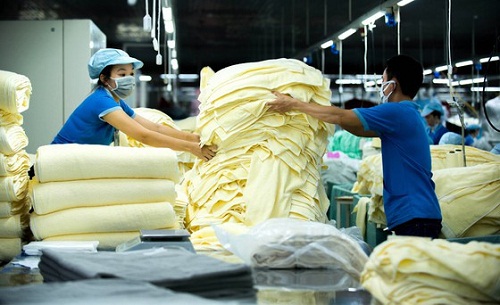 and resulted in bankruptcies to major global apparel brands. Exporters also need to reduce their production times as they may face logistic difficulties.
Avoid trade restrictions
Vietnam’s exporters also need to avoid being investigated for improper trade practices and imposed restrictions. As per the American Apparel and Footwear Association, the US government is currently investigating the possibility of imposing new punitive tariffs on imports, including garment and textile products, from Vietnam. In November last year, the US Department of Commerce (DOC) also initiated an anti-dumping investigation on polyester-textured yarn (PTY) exported from Vietnam.
As per Do Thang Hai, Deputy Minister of Industry and Trade, such trade restrictions on Vietnam’s exports are likely to affect domestic trade in international markets. Hence, domestic enterprises need to collaborate to prevent foreign enterprises from changing the origin of their products. The government needs to attract investments in domestic industries through preferential trade policies that would help it to reduce competitive pressure in the export markets.
Duc Giang also recommends enterprises to negotiate and sign strategic cooperation agreement with the US to increase export advantages in the garment and textile industry. Trade counselors also advise Vietnamese apparel and textile enterprises to expand their export market share to Northern Europe and Australia.
The import tariffs in these markets are extremely preferential as they have signed FTAs with Vietnam. Vietnam’s imports form a modest proportion of their total imports from around the world. Hence, Vietnam has an opportunity to increase its share in these markets avoid trade restrictions from being imposed on the country.
COVID-19 Lessons: Retailers are more prepared for future calamities
 COVID-19 has taught apparel retailers some very important lessons and that is: shifting retail online can be lucrative. Many retailers like China’s JD.com and India’s Arvind shifted operations to online platforms and emerged successfully from this crisis. Similarly, SMEs either ventured online on their own or joined large retailers such as Amazon and Flipkart, as a seller on their marketplace, thus gaining access to a slarge pre-existing customer base.
The pandemic also highlighted the importance of having delivery partners for retailers. Many offline stores entered logistics partnerships during COVID-19 due to acute manpower shortage. For example, Indian stores tied up with Zomato to supply groceries to consumers. Some retailers tapped RWAs to make bulk deliveries to housing societies.
New delivery concepts
Another strategy adopted by brick-and-mortar outlets included deploying third party carriers to ensure product delivery. However, this increased
transportation costs for retailers. Hence, retailers have now decided to use the concept of ‘crowd sourcing’ in tandem with GPS technology and real-time notifications and get customers to be present in stores to make the last mile delivery.
The pandemic also encouraged retailers to introduce stringent measures to restore their consumers’ confidence. Brick and mortar stores launched new initiatives such as home delivery services, continuous sanitization of all outlets and warehouses, regular employee health checkups and doorstep e-payment facility. They also made masks and gloves mandatory for all employees coming in contact with the merchandise and introduced social distancing measures in their stores and warehouses.
Testing facilities at stores
Retailers also introduced testing facilities for customers using thermal scanners at entry points. They also deployed hand sanitizers, masks, gloves and shoe covers at their stores and ensured regular sanitization of handles and buttons, fumigation of the store area and provision of UV sterilization and sanitization tunnels. Some of the other measures taken by them included stocking FMCG goods at multiple points in large format stores, making pre-packs available for quick checkouts, restricting customer entries, allotting special timings for senior citizens, introducing a token system, one way aisles and self-checkouts at stores.
These initiatives coupled with a move to online platforms are making survival easy for brick and mortar stores. Hence, it is important for them to not forget the lessons learnt from the pandemic and be prepared for future calamities.
PRGMEA appeals for duty-free import of fabrics under DTRE
Pakistan Readymade Garments Manufacturers & Exporters Association (PRGMEA) has appealed the government to allow duty-free import of fabric under a simple and easy procedure instead of ‘Procedure of Duty Tax Remission for Exports’ (DTRE).
AdeebIqbalSheikeh, Vice-Chairman and North Zone Head, PRGMEA suggested the government to review its textile policy to remove hurdles hindering exports and to enable the textile sector to attain the exports targets. It urged the government to abolish all duties on the import of fabrics in line with the import relaxation provided on import of cotton yarn, as value-added garment sector is facing severe shortage of basic raw material of fabrics, which may lead to a drastic decline in value-added textile export.
PRGMEA also wants duty-free import of fabric, as the cotton prices find no respite from an unabated spike with the industrial input trading at season’s highest rates because its muted local production continues to widen demand and supply gap,Sheikeh added.
GOTS certified facilities increase by 34 per cent in 2020
GOTS certified facilities increased by 34 per cent in 2020 to 10,388. 16 GOTS Approved Certification Bodies report that over three million people in over 72 countries were working in GOTS certified facilities. Tops 10 countries for certified facilities during the year included India (2,994), Bangladesh (1,584), Turkey (1,107), China (961), Germany (684), Italy (585), Portugal (449), Pakistan (391), USA (167) and Sri Lanka (126). GOTS approved chemical inputs increased by 13 per cent to 25,913.
The exceptional increase shows decision makers value GOTS as an important tool to drive sustainable transformation in a comprehensive way - from field to fashion. Using organic fibers and processing them under strict GOTS criteria definitely provides a credible and strong base for market players to be successful in the future, says GOTS Managing Director Claudia Kersten.
GOTS version 6.0, implemented from March 1, 2021, includes stricter social and environmental criteria. Certified Entities will now have to calculate the gap between wages paid to 'Living Wages' and will be encouraged to work towards closing this gap.
Bangladesh appeals against Indonesia’s safeguard duty on apparel exports
Bangladesh has appealed against Jakarta's imposition of safeguard duty on export of apparel items to Indonesia. On February 23, the committee on safeguards of the World Trade Organization (WTO) issued a notification on the duty imposition.
As per this notification, Jakarta imposed a safeguard duty ranging from $0.44 to $11.29 per piece on readymade garments (RMG) from Bangladesh, China, Vietnam and Singapore. The RMG items include top garments (casual), top garments (formal), bottom garments, suits, ensembles and dresses, outwear, babies' garments and clothing accessories, and headwear and neckwear.
Opposing this imposition, Hafizur Rahman, Director General-WTO Cell, Commerce Ministry, said a Bangladesh delegation comprising representatives of commerce ministry, Bangladesh Trade and Tariff Commission, and Bangladesh Garment Manufacturers and Exporters Association (BGMEA) took part in a hearing in November last year.
Indonesia's textile association appealed to the Safeguards Committee saying the country's RMG import was hurting the domestic apparel makers. Subsequently, the Indonesian Safeguards Committee conducted an investigation in 2017-2019 and came up with the measure.
Philippine garment factories expect new orders worth $500 million
Global fashion brands are expected to grant Philippine garment factories new orders worth $500 million as they start transferring production orders from troubled Myanmar to the Philippines and other Asian countries. Robert Young, President, Foreign Buyers Association of the Philippines (FOBAP) informs, the group has been securing relocated garment and apparel production export orders and inquiries on fresh buying import program from buyers like Zeeman Europe, Walmart, TJ MAx USA, and Hudsons Canada, among others. The association estimates orders worth $200 million to have been booked and FOBAP projects double in quantity in the coming three to four months.
New orders mostly comprise simpler and basic babies’ playwear, men’s athletic and sporting outfit, ladies’ dresses, and intimate apparel. He expects the orders to take total garment and hard goods exports to about $1.7 billion to $2 billion this year. Young estimates 10,000 to 20,000 jobs will be created in factories located in Metro Manila and Cebu.
To capture projected total export orders from top global fashion brands, Young urged the government to further support export activities, such as easing of the coronavirus quarantine and over restrictive pandemic regulations while still following the required health protocol amid the pandemic.
Pakistan to introduce new textile policy to maintain current growth tempo
As per Asad Umar, Federal Minister for Planning, Development and Special Initiatives, Pakistan aims to introduce a new textile policy that will help the country maintain its current growth tempo. He said the textile boom, being witnessed in Faisalabad, clearly indicates the city was the main beneficiary of government's policies.
He dismissed allegations that the previous textile policy was not implemented in true letter and spirit and added that its positive results were reflected in the textile boom. He said, the government’s new textile policy aims to stabilize the gains of present policy. The government is focusing on strengthening the manufacturing sector with Chinese cooperation in the second phase of China-Pakistan Economic Corridor (CPEC).
He said government’s subsidy would benefit the textile sector immensely. He requested FCCI President Hafiz Ihtasham Javed to prepare a comprehensive report on the problems faced by the business community along with their solutions so that they could be incorporated into the budget for next fiscal year.
Javed said that if electricity and gas subsidies were withdrawn, industrialists would lose their competitive edge in the international market. He urged the government to take immediate remedial steps or else Pakistan would lose its hard-earned foreign markets.
Build a more sustainable fashion supply chain, report urges Brazil
A new report says, Brazil needs to build a more sustainable fashion supply chain in key cotton, polyester and viscose production process to counter rising pollution and deforestation. The study, ‘Fashion Threads: Systemic Perspectives for a Circular Fashion,’ reveal, emissions from the country’s cotton farming and production chain have reached critical levels while textile waste has risen to 330 tons daily in some parts of Sao Paulo State.
This is making Brazil a key contributor to global fashion emissions, says the report, funded by Dutch advocacy group Laudes Foundation, formerly the C&A Institute, and prepared by circular fashion and green consultancies Regenerate, Modefica and Brazilian think tank Fundação Getulio Vargas. To fix the problem, the authors recommend that the bulk of cotton, polyester and viscose production, and other synthetic fabrics, be replaced with alternative and more environmentally friendly alternatives and urges Brazil to promote circular fashion or recycling to extend a product’s life cycle.
The authors also recommend polyester production to be increasingly replaced by recycled polyester such as PET plastic bottles, production of which has been increasing but not enough to make a positive impact. Circular fashion should become a higher priority with the government providing recycling bins, such as those used in other countries, and enacting laws to minimize or ban textile manufacturing waste, says Larrissa Roviezzo, Manager, Regenerate Fashion. Producers should also invest in new recycling facilities while designers should be encouraged to dream up products with reusable fabrics, she adds.
Digital Premiere Vision records over 30,000 sessions
Textile/apparel trade show Première Vision Paris has reported that its Digital Show session, staged on the event’s e-marketplace on February 15-19, recorded over 30,000 sessions (number of user interactions). The number of product data sheets accessed was 175,000, up from 138,000 last September.
The show’s organizer stated that industry professionals from 110 countries attended the session. The largest national contingents came from France, the UK and Italy, followed by those from the USA, Spain, Turkey, Germany, Portugal, the Netherlands and South Korea. Visitors viewed about 460,000 web pages, as opposed to 376,900 the previous season. Crucially, average visit time rose from 9’ 50’’ to 20’ 55’’.
The increase in visit time was chiefly due to the nine online forums held, and the 11 trend-forecasting articles published. Additionally, the event featured 13 digital talks with industry panellists, including the presentation of a study by the Première Vision chair at the French Fashion Institute (IFM), which focused on the sourcing upheavals triggered by the Covid-19 crisis.
The debates were followed live by 7,260 viewers, with 10,175 viewers watching the repeats, compared to 4,140 and 6,214 viewers respectively for the September 2020 session. Digital Show's latest edition was held on the show organiser’s revamped website, now the event's central hub. All the various PV shows (Fabrics, Yarn, Leather, Accessories, Design and Manufacturing) have gradually been included on the website. Also, the individual manufacturers’ pages, now 1,560 in total, with 50,000 products on display, have been redesigned to contain more information.
SACTWU welcomes textile rebates
IndustriALL Global Union affiliate the Southern African Clothing and Textile Workers Union (SACTWU) welcomed the textile rebates published in the South Africa Government Gazette as a breakthrough that will save garment and textile jobs as well as boost manufacturing at small, medium, and micro-sized enterprises (SMMEs).
The 5 February notice states that there will be duty free imports for woven fabrics. SACTWU says this policy shift will promote growth in the textile and garment manufacturing sectors. Further, it will stimulate local procurement and increase the sector’s contribution to the industrialization of the country.
This will save jobs in an economy where unemployment is high. According to Statistics South Africa’s 2020 4th Quarterly report unemployment is 32, 5 per cent, and as high as 42, 5 per cent if you consider the expanded unemployment rate that includes discouraged job seekers.
The R-CTFL masterplan, launched by the Department of Trade, Industry and Competition, aims to develop the textile and garment value chain. The value chain includes spinning, woven, dyeing, knitted, and finishing of natural and synthetic fibre inputs and leather tanning.
Cut-make-trim, design houses, garment, and household textile manufacturers, as well as leather and shoe manufacturers are also part of the value chain. Locally sourced and imported products are also included while retail deals with domestic and international markets.
The social dialogue partners that took part in the negotiations are the National Clothing Retail Federation (NCRF) representing garment retailers, Apparel and Textile Association of South Africa (ATASA), the South African Apparel Association (SAAA), and Apparel Manufacturers of South Africa (AMSA) representing garment manufacturers, and the Textile Federation (Texfed) representing textile mills.