


FW
Turkey to finalize future textile investments at TME 2021
The Turkish textile industry will finalize its future investments during the upcoming TME 2021 Fair. To be held from September 08-11, 2021, the fair will bring the entire textile world together on 250,000 sq m. To be held alongside the Techstart 2021, TME 2021 will help Turkish Textile manufacturers meet buyers from Uzbekistan, Bangladesh, Egypt, Pakistan and Indonesia.
According to the export figures announced during the pandemic process, Turkey’s textile exports grew by 42 per cent in the first quarter of 2021 compared to the same period of the previous year. Its investments in new machines helped textile manufacturers increase production by 34 per cent to over $ 1.5 billion dollars. TME 2021 will inspire the fashion industry with its trendy areas and discussion panels. It will be an important platform for brands to share their collections on an international arena. The product groups to be exhibited at the exhibition will include international participants set by a selection committee of industry professionals.
Pakistan to produce cotton in Balochistan with help from China
Pakistan is planning to produce cotton in Balochistan with China’s support, says Asim Bajwa, Chairman, China-Pakistan Economic Corridor (CPEC). As per Global Village Space, cotton will be planted on 4 million acres in Sindh where sowing on 13 per cent area has already been completed. Punjab government is giving subsidy to farmers on cotton seed and fertilizers under its subsidy program. The Punjab Seed Council has also approved 15 new cotton varieties.
Pakistan’s cotton imports in 9MFY21 have crossed its total imports for last year. The country imported cotton worth $704 billion in FY20. Nasim Usman, Chairman, Karachi Brokers Forum predicts the total import by the end of the current fiscal may reach $3 billion.
There has been a massive decline in Pakistan’s cotton production from over 14 million bales in 2012 to 5.6 million bales this year which has compelled importers to book 7 million bales for this season. From being the largest producer of cotton, Pakistan has slipped to being the fifth largest in the world and the third largest cotton consumer.
Bestseller report ensures responsible production in Myanmar
An independent report commissioned by the Danish fashion company Bestseller ensures its adherence to responsible production processes in Myanmar. The report was put together by independent lawyer Jonas Christoffersen, who previously spent 11 years as the director of the Danish Institute for Human Rights. The report affirms Bestseller has lived up to its corporate social responsibility in accordance with the highest international standards in relation to its activities in Myanmar.
The report also underlines the people of Myanmar are plagued by extreme poverty and international companies have a clear responsibility to continue to secure jobs in the country. It recommends Bestseller should its resume its activities in Myanmar as soon as possible as the country needs foreign investment and trade.
The report further says, Bestseller has lived up to the UN’s recommendations with regards to conducting responsible business in Myanmar. It has fostered decent working conditions in the country and lived up to the highest international standards for corporate social responsibility. The brand has also abided to the EU’s sanctions – including those that the EU enacted recently.
Bestseller has conducted business in Myanmar for many years and has completed many social programs there. The brand conducts regular due diligence on the over 30 Myanmar-based factories that are part of its supply chain. This work ensures trade unions can operate effectively, all wages are paid and other central rights are protected.
Xinjiang apparel firms explore domestic sales channels amid global crackdown
The crackdown on Xinjiang apparel firms has encouraged them to explore domestic sales channels within China. As per a Global Times report, China Colored-Cotton Group is focusing on the domestic market like an agricultural enterprise which is cooperating with Alibaba's Tmall to expand domestic market sales.
Similarly, a public cotton company in Xinjiang that engages in cotton picking, gathering, cleaning, processing, embossing and packaging invested in independent research and development of new products and domestic procurement. It has introduced a cotton picker that is 30-40 percent more efficient than ordinary machines, and costs less than two-thirds of the price of its American counterparts, while the performance is almost the same.
Xinjiang machine-picking rate has exceeded 90 per cent, reveals ata released by the Department of Agriculture and Rural Affairs of Xinjiang. The rate is expected to reach 88 per cent in whole Xinjiang this year, said the agriculture ministry. China produced 5.91 million tons of cotton in 2020, of which Xinjiang produced 5.16 million tons, accounting for 87 per cent. China's demand for cotton reached about 8 million tons last year, as per statistics from China Cotton Industry Association.
Demand for TPU Evolution coated yarn by CoatYarn increases
Brescia based CoatYarn is seeing increased demand for TPU Evolution coated yarn, used by leading brands in multiple applications, including protective garments, accessories, outerwear, sportswear and shoe uppers, bags, suitcases, and indoor and outdoor furniture.
As per Cristina Parimbelli, Sales and Marketing, Coat Yarn, TPU Evolution is a solvent-free, 100 per cent Italian made yarn whose coloring process doesn’t require any water use. TPU Evolution is used in knitted and protective garments, accessories, outerwear, sportswear and shoe uppers, technical industrial wear, bags, suitcases, indoor and outdoor furniture. It is also used in heavier industry and automotive sectors, adds Parimbelli.
Available in many versions and counts, TPU Evolution generates different results on the fabric processed, depending on the type of finishing. After the finishing process, the easy-to-cut fabric guarantees the dimensional stability of the product, as well as optimum breathability before reaching the waterproof stage.
TPU Evolution is UV stable and is said to enhance colors. According to CoatYarn it is ‘sensationally soft’ to the touch, and shows excellent resistance to abrasion, hydrolysis, microbial attack, solvents, oils and fats. It is also thermally mouldable.
Founded in 2019, CoatYarn is a coated yarn producer and a sister company of Expotex, a technical textile distributor, which has been active in the textile field for over 30 years. The company aims to make its products as sustainable as possible and is always on the lookout for new ways to reduce its ecological footprint.
Bangladesh to extend Alliance and Accord agreements internationally
Bangladesh plans to extend its Alliance for Bangladesh Worker Safety and the Bangladesh Accord on Fire and Building Safety agreements internationally. Both agreements were set up in the aftermath of Rana Plaza with a five-year remit to significantly improve the safety conditions in around 2,300 garment factories. The Accord, which was extended, ends its tenure in May 2021. Its technical responsibilities have transitioned to the national RMG Sustainability Council (RSC), which was set up last year, but brands and retailers have no legally binding obligation to it.
Michelle Russell, Apparel Correspondent, GlobalData says, it is important to continue progress made by Alliance and Accord agreements and use them as a blueprint for other garment producing countries where worker safety is threatened.
One such country is Pakistan where 295 garment workers died when the Ali Enterprise textile factory in Karachi was gutted by a fire in September 2012. This year alone, 28 workers died in a garment factory in Morocco following flooding. The factory did not meet the necessary health and safety conditions. While in Egypt, at least 20 workers lost their lives in a fire at an unlicensed leather factory.
According to the Bangladesh Garment and Manufacturers Export Association (BGMEA), since the RSC took over in September last year, it has completed 1,821 inspections in 904 factories, and conducted ‘ICU Deep Dives’ in 202 factories. Without the full resources of the Accord during the pandemic, the RSC also reportedly performed 75 factory certifications independently.
Cotton production to reach 360 lakh bales in 2020-21
As per April estimate released by the Cotton Association of India (CAI), cotton production in the 2020-21 season is estimated to reach 360 lakh bales of 170 kg each. The total cotton supply for the months of October 2020 to April 2021 is estimated to reach 469.37 lakh bales which consists of the arrivals of 336.37 lakh bales, imports of 8 lakh bales each and the opening stock of 125 lakh bales at the beginning of the season.
Further, the CAI has estimated cotton consumption during the months of October 2020 to April 2021 to reach 190 lakh bales of 170 kgs. each while the export shipments upto April 30. 2021 are estimated at 50 lakh bales.
Stock at the end of April 2021 is estimated at 229.37 lakh including 95.00 lakh bales with textile mills and the remaining 134.37 lakh bales with the CCI, Maharashtra Federation and others (MNCs, traders, ginners, MCX, etc. including the cotton sold but not delivered).
The CAI Crop Committee has estimated the total cotton supply till end of the cotton season 2020-21 at the same level at 496.00 lakh bales upto September 30. 2021. The total cotton supply consists of the opening stock of 125 lakh bales at the beginning of the cotton season on October 01, 2020, crop for the season estimated at 360 lakh bales and the imports of 11 lakh bales The imports estimate for the previous cotton season 2019-20 was of 15.50 lakh bales
The domestic consumption estimated by the CAI has been reduced by 15 lakh bales to 315 lakh bales from its previous estimate of 330 lakh bales. The exports for the season have been estimated by CAI at 65 lakh bales which are higher by 5 lakh bales than 60 lakh bales estimated previously.
Devan Chemicals launches two new bio-based textile finishes
Textile innovator Devan Chemicals has launched two new bio-based textile finishes. One is a softener and the other is a quick-dry finish. Both are derived from vegetable oils and are in line with the company’s latest innovations on bio-based chemistry.
The first, Passerelle Soft NTL is a durable softness technology based on vegetable ingredients. The technology is wash durable and can be used with natural fibers like hemp, cotton, but is also fit for synthetic fibers like rPES, PA.
The second, Passerelle Quick-Dry NTL is a moisture management technology that has a high wicking and evaporation capability which helps to evaporate water/sweat easier and faster. The technology is also > 60% (28 days) biodegradable according to OECD 301B.
Since 2019, Devan Chemicals has launched Bio-flam, bio-based PCM’s, a natural antimicrobial and plant-based fragrance under SceNTL brand name. The company aims to reduce the carbon footprint of the global textile industry and continue innovating its product range through bio-based and sustainable chemistry.
Kornit Digital partners Asos, Fashion-Enter for new technology
Digital textile printing specialist Kornit Digital plans to implement Kornit Presto technology in partnership with UK fashion e-tailer Asos and its supplier Fashion-Enter. As per Spin off International, the direct-to-fabric printing technology will enable Fashion-Enter to rapidly deliver test-and-repeat small product runs on behalf of Asos.
The technology will help Kornit Digital imprint designs on multiple fabrics at the push of a button, through a lower-impact production process that has zero water waste and accelerates production speeds by cutting out typical dyeing processes. It will also allow Fashion-Enter to develop an in-house new microfactory concept providing an interconnected fashion world, which shall have the capacity to eliminate waste, risks, limitations, and pollutants from current outdated batch production.
Simon Platts, Responsible Sourcing Director, Asos says, the technology will help the company reduce fashion impact across its supply chain. It will also enable it to expore the full potential of this technology, enhance its ability to react quickly and establish more efficient and lower-impact production processes.
China’s cotton exports under scanner as US looks to diversify sourcing
 International cotton trade is becoming more complicated for China with the US keeping a close watch on its exports. The CCF Group reports, these days China’s cotton exports are being closely monitored by the US for their purchase invoice, certificate of origin and declaration of noncompulsory labor importers. The value of China’s cotton textiles and apparels exports to the US was already declining before COVID-19. The pandemic in 2020 soured this value further. Now, the US’ sanctions against Xinjiang are expected to compound the crisis.
US’ moves to other sourcing destinations
With imports worth $45-47 billion, the US has been one of the major importers of Chinese cotton textiles and apparels every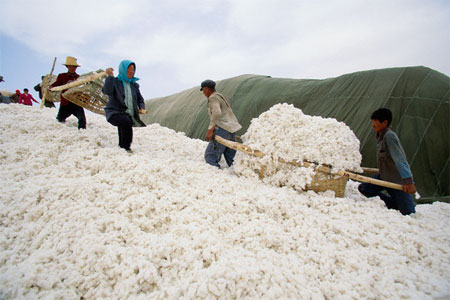 year. In 2020 however, the country drastically declined its cotton imports from China and moved to other sourcing destinations such as India, ASEAN, Pakistan and Bangladesh. Currently, exports from these countries account for over 80 per cent of US cotton textile and apparel imports. The US has also banned import of cotton fabrics containing Xinjiang cotton. This may not only affect China’s exports but also those of Bangladesh and ASEAN countries such as Vietnam, Cambodia and Indonesia as these do not have a complete textile and apparel industry chain. They are highly dependent on intermediate links and feedstock imports, of which China is a major source.
Exports to RCEP members grow
In the first quarter of this financial year, China’s trade with other 14 RCEP member countries grew by 22.9 per cent year-on-year to 2.67 trillion yuan. It accounted for 31.5 per cent of its total foreign trade value. China’s exports during the quarter grew by 27.5 per cent to 1.25 trillion yuan while imports grew 19 per cent to 1.42 trillion yuan. Its trade with ASEAN, Japan and South Korea increased by 26.1 per cent, 20.8 per cent and 19.5 per cent respectively. Of these, export of textiles and apparel increased by 27.9 per cent while those of mechanical and electrical products grew by 28.7 per cent to 659.85 billion yuan.











