


FW
Global organic cotton production to rise 48 per cent
Global production of organic cotton is set to increase 48 per cent in 2020-21, says the 2021 Organic Cotton Market Report by Textile Exchange. As per Sourcing Journal, most of this growth will stem from India and Turkey with increased demand leading to a spurt in prices of organic cotton in India.
Largest volume of organic cotton fiber was harvested globally during the 2019-20 crop year. Around 249, 153 ton of organic cotton was grown by 229,280 farmers during the year. The crop spanned 588,425 hectare of certified organic land in 21 countries, reveals a Sourcing Journal report. It accounted for almost 1 percent of the global cotton harvest in the season.
The top seven organic cotton-producing countries during the year were: India, China, Kyrgyzstan, Turkey, Tanzania, Tajikistan and the US. Together, they accounted for 95 per cent of global organic cotton production. Two new countries, Uzbekistan and Myanmar, joined the lineup and at least another three countries are expected to join in the next few years. The biggest contributors to global growth were: Tanzania and Kyrgyzstan, followed by Uganda, the U.S., Pakistan, India and Turkey.
The rate of land conversion to organic cotton was the most in India followed by Turkey, Tajikistan and Tanzania.
Sateri participates in Infinited Fiber Company’s new funding round
As part of its collaboration with Infinited Fiber Company, Chinese viscose producer Sateri participated in the company’s latest €30 million funding round completed on June 30. The new funding round was announced as a part of the company’s plans to build a flagship factory in Finland for its regenerated textile fibre Infinna. To be operational in 2024, the factory will use household textile waste as raw materials have an annual production capacity of 30,000 metric tonne.
The new funding will enable Infinited Fiber Company to increase production at its pilot facilities in the years leading to 2024. The engineering progress supported by the additional funds will also accelerate Infinited Fiber Company’s ongoing collaboration and potential technology licensing with Sateri.
A part of the RGE group, Sateri strategically contributes to its commitment and strategic business direction. The company has developed and produced a diverse range of circular and sustainable products including Lyocell and Finex, which is made from recycled textile waste. The in-house R&D efforts and the investment in Infinited Fiber Company are part of RGE’s $200 million investment commitment to advance next-generation textile fibre innovation and technology.
Government should make labels indicating plastic use by brands mandatory: Survey
Around 81 per cent respondents to a poll commissioned by A Plastic Planet have urged the British government to make it mandatory for brands to introduce labels indicating the presence of plastic in their clothing and accessories. As per Innovation in Textiles, the poll revealed 72 per cent were unaware of the amount of plastic used to make clothing, while two thirds were not aware of fashion’s impact on plastic pollution.
More than a third of all microplastics released into the ocean are estimated to derive from synthetic fibers, says the survey. Laundry alone causes half a million tonne of these microfibers to be released into the seas every year – the equivalent of three billion polyester shirts. Some 70 million barrels of oil are used each year to make polyester, with its production releasing up to three times more carbon than natural materials.
The survey is a part of the Plastic Planet’s newly launched Plastic Free Fashion campaign – a movement designed to curb the industry’s contribution to plastic pollution. The organization’s new open source plastic-free materials innovation freenhouse hub brings together innovators in textiles and sustainability with the fashion industry aiming to accelerate solutions.
With the majority of Britons unaware of fashion’s contribution to plastic pollution, the open letter accompanying the poll urges the UK government to implement a labeling system similar to that being rolled out under EU legislation which shows where hidden plastic is present in certain single-use items.
Denim Premiere Vision plans week-long event for Fall/Winter collection
Denim Premiere Vision is organizing a week-long event to showcase its Fall/Winter Collections. The Digital Denim Week began on July 5 with the presentation of season’s fashion trends by Manon Mangin, Denim Product Manager, Premiere Vision team. On July 6, a fashion seminar to discover Fall/Winter 2022-23 season’s trends, new products and ecological advance is being held. The seminar showcased products from the show’s exhibitors’ collections. It was followed by another seminar by Jonathan Christopher, Owner, Jonathan Christopher Homme & Creative Design Director, Chef d’Aterlier St Ape.
On July 7, a series of two Smart Talks will be held to focus on growing emphasis on health, ethics, transparency and sustainability in fashion. The discussions will discuss the rise of new materials, new consumers, business models and designers.
Bottega Veneta plans physical showcase for Spring/Summer 2022 Collection
Kering-owned Italian label Bottega Veneta has planned a physical showcase of its upcoming Spring/Summer 2022 collection in Detroit, Michigan on October 21. As per Business of Fashion, the company plans to stage an in-person event according to COVID-19 guidelines during the time. Known as Salon 03 Detroit, the event will be Bottega’s third show since the pandemic hit. The company earlier hosted shows in London and Berlin with limited in-person audiences.
For its previous Salon shows Bottega had tightly controlled content. It had banned attendees of October 2020 show in London from revealing what they saw until the collection was made public in November. The Milan-based luxury fashion house offers ready-to-wear, handbags, shoes, accessories, jewelry and fragrances for both men and women. It was founded in 1966 in Vincenza Veneto by Michele Taddei and Renzo Zengiaro. Its Intrecciato leather-weaving was an instant hit. The company was purchased by the Gucci Group in 200. It opened La Scuola dei Maestri Pellettieri di Bottega Veneta (school of leather craftsmanship) in 2006.
US secondhand clothing market to grow 11 times faster in next five years
 New policies to curb production and disposal of fast fashion are likely to accelerate growth of the US secondhand clothing market. As per the 2021 Resale Report released by thredUP, the market is likely to double in the next five years to $77 billion.
A comprehensive study of the US secondhand clothing market, The 2021 Resale Report surveys 3,500 consumers to highlight growth drivers of the resale market during the pandemic. It also highlights the initiatives needed by the government to accelerate the adoption of circular fashion. The report’s ‘Impact Section’ details a company’s initiatives to ‘shift to thrift’ to extend its used garments’ life. This helps the platform compensate the environmental and financial damages caused by fashion. Till date, the platform has reduced carbon emissions by £1 billion, selling over 125 million secondhand items.
Secondhand sales to surpass fast fashion by 2030
As per Sustainable Brands -- the premier global community of brand innovators-- US resale market is projected to grow 11 times faster than retail clothing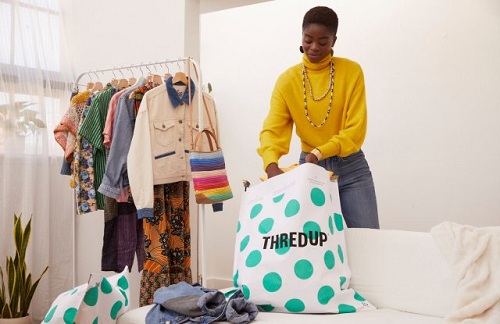 market over the next five years. It is expected to more than double the size of fast fashion market by 2030, with two in five consumers replacing fast fashion purchases with secondhand clothing.
The report shows, consumers’ purchase of secondhand clothing items increased by seven times last year. In the last 10 years, consumers have saved around $390 billion by buying 6.65 billion secondhand clothing items. Post pandemic, one of three consumers aims to shop for sustainable apparels. Around 60 per cent consumers aim to save money through sustainable shopping while 51 per cent aim to cut environmental waste. Around 50 per cent to opt for value shopping.
Collaboration to tackle fashion’s environmental impact
Consumers also aim to reduce their personal impact on the environment. However, for this, they need to collaborate with brands, says Chris Coulter, CEO, GlobeScan’s 2020 Healthy and Sustainable Living Study. Brands like Patagonia have already made this shift launching a repairs, returns and resale platform ‘Worn Wear’ in 2013. Companies including Levi’s, The North Face, Arc’teryx, REI, Eileen Fisher, and COS have also launched their own repair and resell schemes in recent years. Additionally, resale platform Rent the Runway has joined thredUP as a fully-fledged resale site.
Increasing brand accountability
To reduce fashion’s impact on the environment, around 44 per cent respondents urge the government to promote sustainable fashion. Around 47 per cent call for abolishment of sales tax or introduction of tax credit.
Respondents also urge the government to follow the UK’s example and make fashion brands more responsible for the waste created by them. They urge the government to levy on a £1p extended producer responsibility (EPR) charge on each clothing item towards its future recycling. Consultations on this strategy are currently underway in the US.
Pakistan lines up $5 billion investment across textile value chain by 2025
 A vital sector for economic growth, the Pakistan textile industry has embarked on an ambitious plan to double exports by 2025. The industry has earmarked a $5 billion investment across textile value by the end of target year. It has already noted a growth in new orders that would help sustain for next few years. As per Global Village Space report, Pakistan expects this growth drive to continue for the next few years and consolidate its position in the global textile market.
A significant contributor to industrial exports, the textiles is one of Pakistan’s most dynamic sectors. However, since the last few years, the sector has been on a decline due to rising production costs, power shortages, faulty strategies, and lack of government support. The sector is also threatened by a worldwide recession and quality competence. Its contribution to global textile exports is negligible compared to other South Asian regional competitors due to low production base. On the other hand, rapid industrialization and evolving technologies are helping other nations install latest machines to produce new fabrics more efficiently.
Low profitability, technology raises cotton import bill
Over the years, the textile industry has suffered on several fronts. Current global economic crisis, increasing production, energy and raw material costs,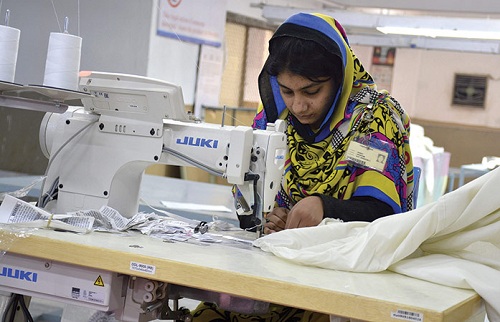 obsolete technology, and lack of investment are slowing growth with consistent decline in cotton production adding to woes.
In 2020-21, Pakistan’s cotton production declined to 6.5 million bales compelling the sector to import raw cotton from the US, Brazil and Egypt. This year, low profitability, poor seed quality, and lack of technology and innovations is compelling the industry to import around 10 million cotton bales. It has already imported 331,560 tons of cotton worth $ 532.1 million compared to last year’s imports of 49,573 tons valued at $ 86.9 million.
Most of Pakistan’s current textile industry growth is being achieved through cotton and MMF imports. The country is utilizing full textile production capacity to cater to increasing orders. Many players are expanding production capacities to accommodate new orders.
Opportunity to target double digit exports
The pandemic gave Pakistani exporters an opportunity to improve their product quality and competitiveness in global market. It also gave exporters, an opportunity to target double digit growth from July to May 2020-21 compared to the same period a year ago. From July-May 2020-21, Pakistan’s textile exports increased by 18.85 percent to $13.74 billion compared to $ 11.56 billion in the same period of corresponding year. Home textile exports increased to $3.642 billion as against $2.879 billion over the last year while exports of men’s garments increased 16 per cent to $3.505 billion against $3.019 billion last year.
Pakistan’s exports of women’s garments increased 33 per cent to $646.49 million during the period against $486.52 million in the corresponding period previous year. Leather apparel exports rose 11 per cent to $584.02 million against $528.02 million while the exports of jerseys, pullovers, and cardigans surged by 57 per cent to 530.14 million against $ 337.39 million in the same period in FY20. Exports of T-shirts increased 14 per cent to $453.4 million against $398.79 million last year while exports of made-up articles of textile materials increased 15 per cent to $432.47 million against $ 377.24 million of last year.
Amazon listing boosts market Pakistan’s rising textile exports are also a result of its addition to Amazon’s sellers’ list. Pakistani entrepreneurs can now sell products through the platform which helps them promote their businesses and expand to newer markets. Its addition to the Amazon platform also provides online buyers easier access to Pakistani brands. Having recovered from the COVID-19, Pakistan’s textile exports are growing at a robust pace. Exports are being further advanced by new energy package announced by the government for the export industry and market- friendly exchange rates.
FAAMA urges for government support for fabric and accessories industry
The Fabric and Apparel Accessories Manufacturers Association (FAAMA) has urged the Government to give due recognition for its growing value addition to the economy and foreign reserves as required support can help tap a $ 2 billion business opportunity faster
This key sub-sector of the $5 billion apparel industry has grown to account for $ 800 million up from $500 million a few years ago.
With imported raw materials amounting to $ 3 billion annually, FAAMA believes the local industry can significantly enhance its contribution with the right support and policies.
The raw material component of the apparel industry is 65 per cent. The import value of $ 2.8 billion signifies a huge gap and equally an opportunity. Whether Sri Lanka can locally produce the entire raw material requirement locally is a challenge and could take a long time. However, local manufacturers have progressed satisfactorily so far after much sustained effort, said Pubudu de Silva, President, FAAMA
He said the fabric and accessories segment has added a value of nearly 50 per cent to the apparel industry. Additionally, customers are preferring in-country sourcing by their suppliers/producers as part of efforts to manage the rising logistics cost as well as lead time. This dynamic certainly helps local manufacturers of fabric and accessories. “
Given these compelling factors there must be unwavering support to fabric and accessories manufacturers to further enhance their contribution which will benefit the country substantially. Apparel industry, including fabric and accessories, must receive a similar thrust or priority like for tourism or ICT,” FAAMA President emphasised.
To expand the local manufacturing, several new initiatives have been made, including the establishment of a dedicated Eravur fabric park in the Eastern Province, which FAAMA welcomed.
However, FAAMA is of the view that a broad infrastructure plan aligned to industry growth forecasts and goals will help. A level playing field in terms of cost as against overseas competitors is also important, it said.
PYMA urges for a change in duty structure for textile industry
Pakistan Yarn Merchants Association (PYMA) has urged the government to change the duty structure for the textile industry as announced in the budget document to create vast employment opportunities.
Hanif Lakhany, Senior Vice Chairman, PYMA and Vice President, Federation of Pakistan Chambers of Commerce & Industry (FPCCI) and Farhan Ashrafi, Convener FPCCI Yarn Standing Committee demanded this while addressing the 1st meeting of the FPCCI Standing Committee on Yarns.
They said that 2 percent customs duty on filament yarn, 2 percent additional customs duty reduction and abolition of 2.5 percent regulatory duty were announced in the budget speech, but unfortunately, all the recommendations of the Commerce Division were ignored, and without stakeholders’ consultation, anomalies committee’s recommendations were made part of the budget, which is unacceptable
Khurshid A Shaikh, Former Central Chairman, PYMA, said that the user industry of the yarn sector is facing big loss as the cotton production is very low. Fibre and yarn are two major sectors which can boost the textile sector of the country.
M Usman, Leader, PYMA, said, nylon yarn and viscose yarn are major issues. He urged the government to resolve the issue of tariff over yarn and fibre.
Hafeez Aziz, Chief, PCLC said, yarn traders are facing a lot of problems at different stages and they don’t get refunds for many years. In exports, yarn traders play a major role but they suffer much. The Federal Board of Revenue (FBR) always keeps yarn traders in darkness and always demands tax more than income from traders, he alleged.
Junaid-ur-Rehman, Member Managing Committee, KCCI, said, the council should also discuss issues of cotton yarn and government policy for raw material of cotton must be pro-business and industry.
HKRITA to celebrate 3rd anniversary of G2G system with new exhibition
The Hong Kong Research Institute of Textiles and Apparel (HKRITA) will soon celebrate the 3rd anniversary of its Garment-to-Garment Recycling System (G2G) by holding an exhibition, The Garment to Garment Journey’, from July 06-August 31, 2021.
The exhibition will demonstrate the different stages in the recycling of old garments, in which they are reduced to fabric materials that are then refashioned into new garments. To reflect the highs and lows of research, the demonstration will feature both cheering and challenging examples of recycled popular garments and fabrics such as shirts and blouses, knitwear, and denim. Video footage will show G2G users sharing their very own recycling journeys. Also displayed will be physical artworks made by users, demonstrating the creative side of recycling.
G2G is the world’s first post-consumer garment recycling system that can be operated in retail spaces. It is an award-winning project. These awards include, a Red Dot Award: Product Design 2019, and a gold medal in both the 47th International Exhibition of Inventions in Geneva and in the Asia International Innovative Invention Award of 2019. G2G was also honored in Fast Company’s Innovation by Design Awards of 2019 (Retail Environments category).
The project is now in its second phase of development, during which system capacity will be expanded, functionality optimized and processes more fully automated. These enhancements will be taking place concurrent with the exhibition, and the improved G2G will open to the public in September 2021.











