


FW
Oscar Reig Plaza named American Silk Mills’ new CEO
Oscar Rieg Plaza is the new CEO of American Silk Mills. In this role, Rieg Plaza will be responsible for parent company Sutlej Textiles and the company’s home textiles division.
Former vice president of sales at Covington Fabrics, Rieg-Plaza was earlier also the owner of Barcelona Sales. At American Silk Mills, he will join the leadership team of Jeff Smith Senior Executive Vice President- Sales and Marketing and Kena Hohenour, Director-Design and Merchandising.
With a presence in over 60 countries, Sutlej Textiles currently serves a global clientele with its eco-friendly and sustainable manufacturing practices that have enabled the company to achieve the Global Recycle Standard.
Founded in 1896, American Silk Mills specializes in designing and distributing textiles to customers across residential, contract, transportation, and specialty markets. The company’s products include fine jacquard textiles, high-quality silks, a variety of luxurious velvets and Sensuede, an eco-friendly synthetic suede.
Vietnam’s cotton consumption to reach 7.3 million bales in 2020-21: USDA
Driven by a robust growth in Vietnam’s cotton yarn and product exports, Vietnam’s cotton consumption in 2020/21 is projected to reach to a record 7.3 million bales, according to the latest report from the United States Department of Agriculture (USDA). As per a Grain Central report, yarn exports from Vietnam in 2020/21 have already exceeded the previous year’s record by more than 10 per cent through the first 11 months of the marketing year.
Most exports have been driven by a demand from China with exports to country accounting to 6o per cent of Vietnam’s total cotton lint consumption. China’s August to June imports of Vietnamese cotton yarn were a record and equal to roughly 4 million bales of cotton lint consumption. US imports from Vietnam were a record in the first 11 months at more than $5 billion. The country mostly imported knitted cotton sweaters, pullovers, and other similar articles of clothing which accounted for roughly 30 percent of the total value of US cotton product imports from Vietnam.
NIFT to open more design resource centers for the handloom sector
The National Institute of Fashion Technology (NIFT) is setting up 10 more design resource centers to help the handloom sector. These are being set up at weavers' service centres in Kolkata, Chennai, Bengaluru, Hyderabad, Kannur, Indore, Nagpur, Meerut, Bhagalpur and Panipat. They would enable weavers, exporters, manufacturers and designers to access design repositories for sample/product improvisation and development.
NIFT has already established such centers at the weavers' service centers in Delhi, Mumbai, Ahmedabad, Bhubaneshwar, Guwahati, Jaipur and Varanasi. Each of these centers has accumulated a large number of designs and sample over the years.
Set up in 1986, NIFT is the pioneering institute of fashion education in the country and has been in the vanguard of providing professional human resource to the textile and apparel industry. It was made a statutory institute in 2006 by an Act of the Indian Parliament with the President of India as ‘Visitor’ and has full fledged campuses all across the country. Over the years NIFT has also been working as a knowledge service provider to the Union and State governments in the area of design development and positioning of handlooms and handicrafts.
Popshowroom highlights technology importance at sourcing show Magic
US-based fashion e-commerce company Popshowroom highlighted the importance of innovation and technology to drive the fashion business at the renowned sourcing show, Magic.As per an Apparel Resources report, the company aims to inspire the show visitors to re-embrace the vibrancy of life and be energetic and casual. The company’s teams are in a process to build a brand that offers customized fashion to its global customers.
Popshowroom had set up its algorithm centre in May this year, in Nanjing, China, a city well known for its apparel manufacturing and efficient logistic system in its efforts towards integrating innovation and technology with the company’s business model.
The company is working towards creating a digital one-stop supply chain solution to upgrade apparel manufacturing, Pine You, Head-Product and Technology, says, the company uses technologies to minimize its cost at each production stage. It is currently developing an advanced technology in collaboration with experts in Computer Vision, Natural Language Processing.
Ease rules to import yarn, urges BTTLMEA
Terry towel manufacturers and exporters in Bangladesh are urging the government to ease yarn import rules through land ports, as the prices of this basic raw material have increased in local markets. M Shahadat Hossain Sohel, Chairman, The Bangladesh Terry Towel & Linen Manufacturers and Exporters Association (BTTLMEA, said, the association currently has a lot of work orders from international retailers and brands and needs yarn at competitive prices. As per a Daily report, Sohel has urged the government to give factory owners who do not have bond licences, an opportunity to import yarn at a concessional rate so that they could be more competitive in the international markets. BTTLMEA also urged the government to allow import of yarn from India through major land ports, such as that of Bhomra and Sonamasjid.
It urged the government to improve the infrastructure in these land ports and facilitate warehouses and storage of raw materials like cotton, yarn and fabrics for the apparel industry. BTTLMEA also demanded partial shipment facility through the land ports, including the one in Benapole.
Monsoor Ahmed, CEO, Bangladesh Textile Mills Association (BTMA), said Bangladesh should not depend on one or two sources for importing cotton, yarn and fabrics as any disruption could hinder the sector's overall supply at any time without any prior notice. He said allowing partial shipments through the land ports would not be wise as it would open up scopes for irregularities
Pakistan’s textile and clothing exports rise 22.94 per cent
Pakistan’s textile and clothing exports increased 22.94 per cent to $15.4 billion in FY2020-21 as compared to $12.526 billion in the previous year, shows the latest data by the Pakistan Bureau of Statistics. Most of this growth was fueled by the expansion in export of value-added sectors. In addition, in the last financial year export-oriented industries remained closed due to COVID-19 lockdown and cancellation of orders from global buyers, which also contributed to the steep rise of exports.
In FY21, Pakistan’s RMG exports increased 18.83 per cent to $3.032 billion in FY21 as compared to $2.552 billion in the previous year. Exports of home textiles increased 28.87 per cent to $2.771 billion this year compared to $2.150 billion in the previous year. Towel exports grew 31.81 per cent to 937.536 million in FY21 in comparison to $711.265 million in the previous year. Export of leather-based clothes increased 14.02 per cent while leather-based gloves surged 22.26 per cent. Exports of uncooked leather-based declined by over 12.04 per cent. Export of cotton materials grew 4.98 per cent in FY21 to $1.921billion, whereas the export of cotton yarn increased by 3.26 per cent to $1.016 billion on a year on year basis.
The exports of tents, canvas and tarpaulin went up by 12.10 per cent, while those of artwork, silk and artificial textile surged by 17.68 per cent and that of made up articles, excluding towels and mattress increased by 28.08 per cent.
Asia Garment Hub to help industry promote sustainable business practices
Launched last week, digital platform, the Asia Garment Hub aims to help industry stakeholders understand, promote, and operationalize decent work and sustainable business practices across the supply chain. As per a Spin Off report, the online forum was set up by GIZ Fabric in collaboration with International Labor Organization’s ‘’Decent Work in the Garment Sector Supply Chains in Asia’ project’ to address critical challenges in the industry. The platform not only addresses manufacturers, brands, trade unions, employer organizations and development partners, but also journalists, civil society, policymakers, and individuals interested in a more sustainable and socially fair future for the industry.
Access to the Hub is free of charge. Its navigation and content is offered in English and 10 other languages including Amharic, Bahasa, Bengali, Burmese, Chinese, Hindi, Khmer, Sinhalese, Urdu, and Vietnamese. A regional project implemented by the German Development Cooperation Deutsche Gesellschaft fur Internationale Zusammenarbeit (GIZ) GmbH on behalf of the German Federal Ministry for Economic Cooperation and Development, the GIZ Fabrics aims to to foster sustainability in the Asian textile and garment industry.
Funded by the Swedish International Development Cooperation Agency (Sida), International Labor Organization’s (ILO) ‘Decent Work in Garment Supply Chains Asia’ project aims to improve the working conditions and rights of workers, and supports a social dialogue, productivity, gender equality and environmental sustainability in the garment sector in Asia.
Industry needs to redefine sizing charts as demand for plus size fashion grows
 Roughly 67 per cent of women in America are size 14 or larger. Yet, the standard to define ‘plus size fashion’ in the country is unclear. As per market research firm NPD Group, most American retailers define plus size as size 18 and above. However, most companies and brands issue their own size guidelines. Some companies also include sizes 14 and above into their portfolio. They also include tall plus, petite plus and juniors plus categories in their collection, which have special size requirements of their own.
Lack of size evolution and availability hampers market growth
Plus size market accounted for almost 19 per cent of the entire US women’s $113.8 billion apparel sales during the 12 months ending May 2021. The market offers limited clothing options, says Lauren Chan, Founder, Henning. Brands and companies design plus-size clothes on the basis of previous shopping habits of consumers. They fail to realize that shopping patterns evolve in plus sizes just as they do in smaller sizes, adds Cece Olisa, Co-founder, The Curvyon, an annual shopping event for plus size shoppers.
In April, designer Lena Dunham unveiled her five-piece women’s ready-to-wear collection starting at size 12 in collaboration with 11 Honoré. However, many brands and retailers fail to include larger sizes. Owned by private equity firm Sycamore Partners, Loft began selling plus sizes only in 2018. Many retailers who earlier offered plus-size fashion closed shop during the pandemic.
According to Joanna Griffits, Founder and CEO, Krix, many brands enter the plus size market. However, they soon quit as things don’t go according to plans. Another issue plus size fashion faces is the availability of plus size clothes. Most plus size garments are available only online, making it difficult for shoppers to try them before buying. Also fashion schools don’t teach designers to make plus-size designs. New York City’s Fashion Institute of Technology offers a class called ‘Production Pattern Development for Women’s Plus-sizes, teaching future designers how to “gain a better understanding of the important areas of the body that present a challenge when developing styles,” says the course description.
The torch-bearers
Some brands are like Athleta, Dia & Co and PSK Collective are now taking active steps to include plus-size consumers. Lingerie brand ThirdLove offers bras and underwear in a wide range of sizes. Activewear brands like Superfit Hero have removed traditional numerical sizes or size sections from their shelves. The brand, which earlier sold sizes XS through 5XL when it was launched, has shifted to sizes large to 7XL last year.
The use of plus-size models has also increased in recent years. However, they are mostly used by brands as a marketing strategy, adds, Nadia Boujarwah, Co-Founder and CEO, Dia & Co.
New initiatives to meet shoppers’ demands
The needs of plus size shoppers also vary according to their sizes. A tall plus-size shopper has vastly different needs than a petite plus-size shopper. To cater to diverse needs brands like Good American use algorithms on their website to show shoppers models in their past purchases. However, some brands are skeptical of such methods as they would need to consult consumers rather than data before launching their collections.
A way brands can accommodate the needs of plus-size consumers is by hiring more plus-size people, opines Olisa. Their websites need to show clothes different size models, adds Chan. Brands also need to stand up for issues faced by plus size shoppers like fat shaming. Taking a step in this direction, Nike introduced plus-size mannequins in 2019. Others are likely to soon follow suit.
Enhanced services, investments can push up Bangladesh in global RMG ranking
 For the last two years, Bangladesh ruled as the world’s second largest apparel exporter. However, in 2020, the scenario changed as Vietnam outstepped Bangladesh in apparel export earnings. Recent WTO Trade Statistical Review 2021 shows, Vietnam’s share in the global apparel market grew from 6.2 in 2019 to 6.4 in 2020, while Bangladesh's share declined to 6.3 per cent in 2020 from 6.8 percent in 2019.
Diversification helped
Since 2010, Vietnam has been steadily strengthening its position in the global apparel market. As per a Daily Star report, in the last 10 years, Vietnam focused on product and market diversification to move up the apparel value chain. It also emphasized on enhancing productivity and skills, and reducing dependence on the apparel sector. In 2020, Vietnam earned around one-fourth of its total export earnings of $281.4 billion from the apparel sector while Bangladesh, earned about four-fifths of its $42 billion revenues from apparel exports. Vietnam was also able to pass on the benefits of higher productivity and better prices to laborers by paying them almost 1.5 times more wages.
In 2020, export earnings of both Bangladesh and Vietnam declined 15 per cent and 7 per cent respectively.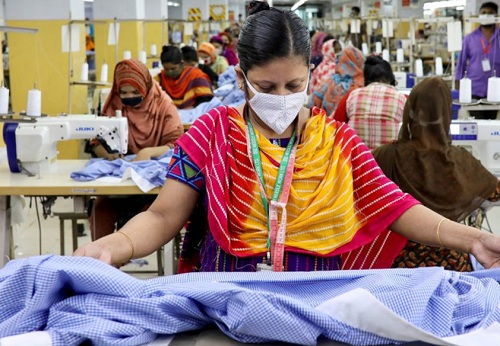 Apparel companies in Bangladesh experienced frequent production breakdowns from April to June, 2020. They also faced several order cancellations that resulted in huge loss of export earnings. The situation slowly improved by 2020-end as Bangladesh received orders from major brands and buyers. The resurgence of COVID-19 in Vietnam also helped Bangladesh regain a few lost orders and its position in the global apparel market.
Industrials parks with improved services
To sustain growth momentum, Bangladesh needs to build more industrial parks and RMG clusters with common services and required infrastructure. Also new policies to encourage adoption of new and advanced technologies at the enterprise level are in order. Other areas that need attention include improving management capacities and enhancing skills and production capacities. Improving financial services and digital platform-based services is another way Bangladesh can increase competitiveness. It can also shift to other fast growing non-cotton segment by changing incentive structure and attracting new investors.
SEZs for more FDIs
Bangladesh apparel sector is primarily driven by its domestic enterprises. It needs to attract more FDIs by developing new special economic zones across the country. It also needs to sign more FTAs and Closer Economic Partnership Agreements (CEPAs) with important trading partners. Production networks and value chains with regional partners and other important trading partners such as Canada, Japan and others bilaterally, and also possibly with RCEP need to be developed.. These networks will enable Bangladesh diversify its operations in the global RMG market.
Bangladesh can definitely regain lost position in the global apparel market if it adopts the above mentioned measures.
Rieter signs agreement to acquire three Saurer businesses
Switzerland-based Rieter Holding has signed an agreement to acquire three businesses of China’s Saurer Intelligent Technology Co; Saurer Netherlands Machinery Company, the parent company of Saurer Spinning Solutions GmbH & Co KG and Saurer Technologies GmbH & Co KG. The purchase price for the businesses is €300 million on a cash and debt free basis.
In total, the three businesses had a combined turnover of €142 million in 2020, the year of the COVID crisis. In 2019 and 2018, the total combined turnover was at a level of €235 million and €260 million, respectively.
Rieter will acquire 57 per cent of the shares of Saurer Netherlands. The shares will be returned to Saurer after the implementation of the transaction in six to nine months.
Rieter will also supply automatic winders to Saurer in the future. Rieter has also invested in two attractive component businesses – Accotex and Temco.











