FW
Mafatlal Industries to reduce physical presence to 60% by 2030
The flagship company of the India-based Arvind Mafatlal Group, Mafatlal Industries, plans to reduce the percentage of its physical outlets to 60 per cent from the current 90 per cent by 2030. The company will focus on different segments in textiles and markets in coming years. It also plans to adopt a concentrated approach to the FMCG market and introduce a range of hygiene products.
Mafatlal Industries is one of the oldest textile manufacturers in India and is engaged in manufacturing and sale of fabric in various categories of cotton, polyester-cotton, linen, voiles, prints, etc. The company has a presence of over 11 decades in textile manufacturing and is a part of Arvind Mafatlal Group. The company is widely recalled for its innovative manufacturing facilities. It exports its products to the Middle East, Saudi Arabia, Europe, Sri Lanka and Bangladesh. The products exported by the company include voiles, cotton and rayon printed fabrics, printed voiles, yan dyed shirting, and various uniform fabrics.
Jeanologia to present new on-demand production model at Texprocess Frankfurt
Spanish company engaged in developing ecoefficient technologies, Jeanologiawill present its new operative model to produce on demand with zero discharge at Texprocess Frankfurt from June 21-24, 2022.
Integrating its technologies, the company promotes a revolutionary production model close to the consumer to produce what sells instead of selling what is produced through digitalization, sustainability, and automation.
For Jeanologia, the solution to end this inefficient production structure is to encourage a closer production or “postponement” of value adding to the garment in order to cut the time-to-market and eliminate stock and waste. And to do so without increasing the costs, guaranteeing competitivity and ensuring maximum productivity.
To this end, Jeanologia has developed Urban Factory, a new digital finishing plant, interconnected and automated that integrates all its technologies for garment finishing. Based on a production that is totally sustainable and with zero discharge, it responds quickly to consumer demands with an agile and digital production that does not pollute and saves costs.
Brazil will increase cotton supply to Bangladesh: Cotton Brazil
At the sellers’ mission event in Dhaka, Cotton Brazil, the international market development program for Brazilian cotton certified by the Brazilian Cotton Growers Association (ABRAPA), said, the country aims to increase cotton supply to Bangladesh to ensure continuity and sustainability through strategic partnerships in Asia.
As per a Dhaka Tribune report, the initiative will help promote sustainability and also demonstrate Brazil as a reliable partner of high-quality and traceable cotton.
The Brazilian business mission visited Bangladesh recently and met the officials of BTMA, BGMEA, Ministry of Industries, Cotton Development Board, and some prominent textile millers including Noman Group, MAS Group, NRG Group, ISRAQ Group, Viyellatex Group, Syed Group and Salma Group on June 14 in a hotel in the capital.
The event agenda also focused on Cotton Brazil’s commitment to ensuring short-term, medium, and long-term business continuity through its promotion of Brazilian cotton export.
Cotton Brazil aims to further increase its market share in key countries like Bangladesh and also plans to increase production capacity to meet Asia’s growing market demands.
It will also continue to initiate market awareness for the quality, traceability, and sustainability of Brazilian cotton.
Archroma, Baldwin join hands to support textile development projects
Global leader in sustainable specialty chemicals Archroma and a manufacturer and supplier of precision spray systems, Baldwin have joined hands to support textile manufacturers in their development projects. Through this collaboration, the two companies aim to improve their product safety, performance and functionality besides maximizing the productivity of the finishing application process.
Archroma and Baldwin are currently testing Archroma’s finishing products and systems, such as the soon-to-be-launched PFC-free* Smartrepel® Hydro SR for water-based soil repellence, as well as metal and inorganic particle-free antimicrobial technologies like Sanitized T 20-19 and TH 15-14, which will be launched at the upcoming Techtextil 2022.
The first test results will be available for discussions with both partners at Techtextil at their respective booths.
Epson Australia to launch new Mona Lisa ML-8000 printer at PacPoint
Epson Australia plans to launch its new Monna Lisa ML-8000 direct-to-fabric textile printer at PacPrint.
The ML-8000 is a next-generation digital textile printer with high print quality, productivity, stable operation with minimal downtime. It allows easy operation for an affordable price, making it the ideal printer for companies looking to move into local, onshore digital printing and production.
The ML-8000 comes with eight of the latest PrecisionCoreprintheads. The printer ensures performance and usability with its eight PrecisionCoreprintheads that allow it a typical print speed of 155 square metres per hour at 600x600 dpi – 2 pass. Maximum print speed is up to 250sqm an hour at 300x600 dpi, 1 pass. Resolution is up to 1200 dpi, print width up to 180cm, with up to eight colours.
The Monna Lisa ML-8000 is produced with Epson’s print partner Robustelli, which has a history of textile design and manufacturing in Italy’s Como province.
The ML-8000’s image quality is enabled by Epson’s high quality printheads. Epson says its exclusive Microweave and lookup table technologies reduce banding and graininess, and advanced new Multi-Layer Halftone Technology, which randomises the halftone dot pattern on each layer, reducing image degradation caused by dot misalignment. Dynamic Alignment Stabiliser technology also ensures stable print quality, by controlling waveforms on each printhead chip, for higher dot placement accuracy and more uniform dot density on each pass.
The ML-8000 also features symmetrical colour alignment for “consistent colour overlap order” during bidirectional low pass printing, and Accurate Belt Position Control (ABPC) technology automatically detects the belt feeding distance to ensure precise fabric feeding. The result, says Epson, is optimal quality and speed, with superb reproduction of colour gradations, fine details and complex geometric patterns.
Turkiye’s textiles and raw materials exports sees over 12% risefrom Jan-April’22
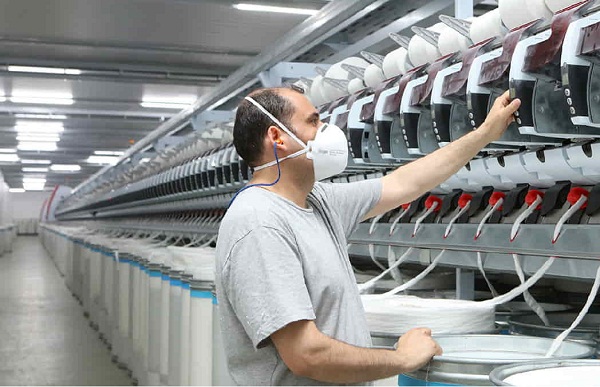
Turkiye’s textiles and raw materials exports increased 12.4 per cent to $4.6 billion during January-April 2022 compared to the same period of previous year. As per a Textile Intelligence report, exports of textiles and raw materials surged 13.7 per cent to $1.2 billion in April 2022 compared to the same period in previous year, indicates ‘April 2022 Export Performance Report’ published by ITHIB. The share of textile and raw materials in Turkiye’s overall exports amounted for 5.3 per cent during the period.
EU emerges largest market for Turkiye
EU emerged the largest importer of textiles and raw materials from Turkiye during the January-April 2022 period. Exports to 27 EU countries increased 14.7 per cent to $2.2 million during the period compared to the same period in previous year. The second highest importers of textiles and raw materials from Turkiye were African countries whose exports increased 32.7 per cent during the period to reach $531 million.
However, Turkiye’s exports of textiles and raw materials decreased 3.5 per cent to 948,000 tons on the basis of quantity in the first four months of 2022. Exports to EU increased 4.1 per cent on quantity basis to 419,000tons during this period while that of Africa reached their highest share of 11.8 per cent totaling 112,000 tons.
Italy imports most textiles and raw materials during Jan-Apr’22
The highest increase in exports of textiles and raw materials was fromItaly during the first four months. Exports to Italy increased 34.1 per cent to reach $480 million during this period. The other countries recording most imports of textiles and raw materials from Turkiyewere, Germany, whose imports increased 4 per cent to $359 million and the USwhose imports increased 17.9 per cent to $316 million. They were followed by Spain and United Kingdom.
Belarus emerges highest importer in April
Belarus emerged the largest importer of textiles and raw materials from Turkiye in April clocking an increase of 76.3 per cent. It was followed by Spain with imports increasing 56.5 per cent and Morocco with 54.4 per cent increase in imports textiles and raw materials from Turkiye. Yarn dominates exports with 15.1% increase
Yarn emerged the most exported product group fromTurkiye during the period with exports increasing 15.1 per cent. This was followed by woven fabric whose exports increased 29.9 per cent to reach $920 million. The third most exported product group was technical textiles whose exports declined 6.2 per cent to $808 million. Turkiye’sfibre exports increased 29.5 per cent to $397 million during January-April period of 2022. These were dominated by synthetic-artificial fibers with a 60 per cent share in overall fiber exports.
Towels most exported product from Jan-Apri’22
Turkiye’s exports of knitted fabricsamounted to $398 million during the period. In home textiles, the most exported products were towels and cleaning clothes with a share of 34.4 per cent. Their exports increased 17.3 per cent during the period to $262 million.
India’s home textile exports decline during Jan-Mar’22
The value of India’s home textiles export declined during the January-March 2022 quarter to $2.189 billion from $2.333 billion in the October-December 2021 quarter. In FY2021-22, India’s total home textile exports fetched $8.898 billion. Of this, the share of cotton home textile was 41.19 per cent, while that of man-made fibre home textile was 18.65 per cent, wool/animal hair home textile 7.94 per cent, and home textile made from other material 32.22 per cent.
On the other hand, exports from neighboring Pakistan grew steadily during the period. The of home textile exports from Pakistan increased from $1.262 billion in first quarter 2021 to $1.309 billion in second quarter, $1.421 billion in third quarter and $1.575 billion in fourth quarter 2021, as per TexPro.
In comparison, home textile exports earned $10.941 billion for China in January-March 2021, which dipped slightly to $10.905 billion in second quarter. The value increased to $11.677 billion in third quarter and further to $12.031 billion in fourth quarter 2021. However, the export value declined to $10.062 billion in first quarter of this year, when COVID-19 related lockdowns were imposed in the country.
Vietnam enterprises should expand facilities, say experts
The value of Vietnam;s garment and textile exports increased by 23.5 per cent to $18.7 billion during the first five months of this year.
As per Nam Định Textile and Garment Corporation (Natexco), its revenue increased by 23 per cent during the period to VNĐ1 trillion.
At present, the corporation has orders to produce until the end of September. It is also continuing to negotiate with partners about year-end orders.
Besides that, Natexco will continue to restructure its resources for becoming a textile centre in the northern region, meeting the demands of the domestic market and exports.
Dau Phi Quyet, Deputy General Director, ViệtThắng Corporation, adds, despite many difficulties and challenges, the corporation generated 25 per cent more revenues and 35 per cent more profits during the period
So far, the corporation’s raw materials and accessories supplies have been stable.
However, importing spare parts, equipment and supplies from Europe would take 12 to 20 weeks, higher than the 6-8 weeks before. If this situation does not improve, it would affect its production and export plans.
Meanwhile, Le Tein Truong, Chairman, Việt Nam National Textile and Garment Group (Vinatex) said that Vinatex gained a growth of 50 per cent in revenue during the first quarter of 2022.
However, Vinatex also faced many challenges impacting negatively on the domestic textile industry as well as the group in the first quarter, including the Russia-Ukraine conflict and a reduction in the economic growth of developed regions like the US and EU.
Experts believe, to promote the export of textile and garment products, enterprises must continue investment in expanding production facilities and proactively supply materials and auxiliary materials to meet rules of origin and take export opportunities from new-generation free trade agreements In addition, market research should be promoted to develop short- and long-term strategies and goals. Risk management is also a top priority.
Lenzing Group joins TfS initiative
A world-leading provider of wood-based specialty fibers for the global textile and nonwoven industries, Lenzing Group has joined the chemical industry’s sustainable supply chain initiative, Together for Sustainability (TfS). Together with Lenzing, numerous internationally active chemical companies have joined the initiative. Their common goal is to make the global supply chains of the chemical industry sustainable.
The global TfS initiative follows the principles of the UN Global Compact and Responsible Care. The Lenzing Group stands for ecologically responsible production of specialty fibers made from the renewable raw material wood. As an innovation leader, Lenzing is a partner of global textile and nonwoven manufacturers and drives many new technological developments.
The Lenzing Group’s high-quality fibers form the basis for a variety of textile applications ranging from elegant clothing to versatile denims and high-performance sports clothing. Due to their consistent high quality, their biodegradability and compostability Lenzing fibers are also highly suitable for hygiene products and agricultural applications.
Karl Mayer Rotal sells first Greendye machine to Nein Hsing
Karl Mayer Rotal, the site with the Karl Mayer Group's denim center of excellence, has sold its first Greendye machine to Taiwanese manufacturer Nein Hsing
The machine ensures two times cleaner and three times more efficient indigo dyeing than with the processes of conventional equipment. It uses the nitrogen (NOX) technology to control the chemical dyeing process. The nitrogen atmosphere in the technology temporarily prevents the necessary oxidation of the indigo dye. Further advantages result from the design of the dyeing vats. A high-flow, low-speed indigo circulation system and a design that avoids turbulence and surface foaming significantly reduce chemical consumption. A saving of up to 50 per cent of hydrosulphite and caustic soda – the main environmental polluters of the process - and thus a halving of the gray water footprint is possible.
A reduction of 50 per cent is also possible in the final washing water consumption. Thanks to the NOX reactor, the Greendye system requires only three dyeing baths instead of nine - like conventional systems - to achieve the same indigo dye shade, with correspondingly lower water consumption. In addition, the washing process is more economical due to the higher fixation of the indigo dye on the fiber.
Fewer dyeing baths also mean shorter dyeing sections. The reduction of daily water and chemical consumption as well as waste water and yarn waste optimizes not only the environmental balance but also the production cost in indigo dyeing. In addition, the operating costs are extremely low. Compared to traditional indigo dyeing systems, the Greendye system requires less space due to its shorter design, less maintenance, less time for operation and less spare parts for the same output.