FW
Steve Madden buys sneaker giant Greats
Steve Madden has bought Greats. This will combine Greats’ strengths – which include an outstanding brand and stylish, classic designs that appeal to today’s more casual consumer – with Steve Madden’s proven business model, established infrastructure, and global reach.
Steve Madden which opened in 1990 in the US is into fashion footwear and accessories for women, men and children. It also has purses, sunglasses and more. These include daring silhouettes in high heels and purses to trend setting styles in men’s shoes. The brand is inspired by the streets. The pavements are its runway. Steve Madden gets inspired by new trends, rock and roll vibes and a large dose of urban touches. The brand is all about being unique and confident and embraces individuality with daring styles, jaw dropping heels, but always that sassy, sexy touch. Steve Madden has revolutionized the shoe industry, merging years of experience with unique and creative designs.
Greats is a footwear brand specializing in premium sneakers and well-known for its timeless yet aspirational and versatile styles. It has differentiated itself in the sneaker market with stylish, classic, quality designs suitable for office weekdays to adventuresome weekends. Greats is a direct-to-consumer footwear company. This luxury shoe brand manufactures its sneakers, boots and pool slides at the same factories as designer brands, yet for about a third of the price tag.
Indonesia apparel sector grows 20 per cent in Q2
Indonesia’s textile-garment sector grew 20.71 per cent in the second quarter of 2019 as the country’s industrial sector grew 5.05 per cent. Manufacturing industry was the largest contributor to the national economic growth in the May-June 2019 quarter, contributing 0.74 per cent. The agricultural sector contributed 0.71 per cent, while the trade sector’s and the construction sector’s shares were 0.61 per cent and 0.55 per cent respectively.
The country’s textile and apparel industry is supported by a structure that has been integrated from upstream to downstream, and the products are also known to be of high quality in the international market. With economic growth, and a shift in demand from basic clothing to functional clothing, such as sportswear, the national textile industry is building production capabilities and increasing economies of scale in order to meet the demand in domestic and export markets.
Jordan clothing sales fall 50 per cent
Clothing sales in Jordan dropped 50 per cent during Id this year compared to the same period in 2018. Demand was especially low during June and July. Customs fees and taxes imposed on the sector have reached 47 per cent, causing the kingdom to lose its competitive edge. Other challenges facing the sector include illegal e-commerce and the mail package trade that abuses regulations and allows entry of goods with exemption from customs fees. Anyone with a passport and a national identification number can order up to five packages a month, with exemption from customs. However, people abuse these regulations and use friends’ passports to order goods without having to pay extra customs or taxes and then sell these goods at low prices. This is an illegal form of trade known as mail package trade.
E-commerce allows people to have virtual shops without having to pay operational costs, taxes and other fees and costs as a committed trader would. Random issue of licenses has caused an overflow of shopping malls in areas that are very close to each other. There has been a call for studying commercial locations and putting mechanisms in place that regulate which spaces can be used commercially.
Japan denim hub launches brand
Japan’s denim production hub straddling Hiroshima and Okayama prefectures has launched its own brand called Japan Denim. This initiative has been taken amid dwindling production of domestic denim due to a surge of low-cost fast-fashion clothing and cheap products from overseas, making it increasingly difficult to eke out a profit. There are 18 companies in the hub that have collaborated. These are small and midsize manufacturers that take pride in their sophisticated skills, working behind the scenes to supply high-quality denim to luxury brands. They offer uniquely designed denim products such as a skirt with large pleats in the front and a pair of pants sewn with pearls all over the piece. These companies are confident in their high-quality skills as they also handle denim products for overseas premium brands. But because most of the merchandise are produced under original equipment manufacturing arrangements, they remain in obscurity.
Manufacturers in Japan are trying to establish their own apparel brands across the country but many are struggling having failed to gauge consumer preferences. Japan Denim encourages them to provide designs and eases their fight for survival. Japan Denim also plans to expand sales channels into department stores and overseas markets.
Kenya develops export processing zones
Kenya’s export processing zones help promote and diversify exports by ensuring the country moves from traditional exports to value-added products in various areas. Policies and structures have been put in place that stimulate domestic and foreign investment in export-oriented manufacturing, commercial and service activities. Exports and manufacturing are seen as key stimulators of the country’s economic growth.
The country has more than 72 gazetted zones in 19 counties. The main advantages include a 10-year tax holiday and, thereafter, tax at the rate of 25 per cent, exemption from import duty, exemption of VAT, exemption from withholding tax and single EPZ licences. Other advantages are applications for new investors cleared within 30 days, quick issuance of work permits where required, and availability of land and factory buildings for the zones, which are developed with the requisite infrastructure, enabling investors to easily move in and start operations.
The export processing zones can manufacture a range of products like textiles and apparel, textile accessories, horticulture and floriculture processing, fortified blended foods, relief supplies, pharmaceuticals and pharmaceuticals extraction, manufacture of medical supplies and health supplies, blending and packaging of tea and coffee, meat processing, macadamia nut processing, extraction and packaging of avocado oils and fruit juices.
Vietnam sustains US cotton exports
US cotton exports have fallen from the previous year. Reasons include lower production and trade barriers. Shipments from the US to eight of the top 10 markets fell with China witnessing the largest decline. Indonesia and Thailand helped drag exports to Southeast Asia lower on declining use in both countries. Lower Indonesian yarn exports to China have helped contribute to declining imports.
However, US cotton exports to Vietnam continued another positive year of growth. Foreign direct investment in Vietnam by several East Asian countries boosted cotton imports and consumption to record levels in 2018-19, with further import growth expected in 2019-20. US cotton exports to India also witnessed significant growth in 2018-19 and surpassed the previous years by over two-thirds. South Asia was the only region which expanded imports, with India and Bangladesh driving the bulk of demand.
In 2019-20, US cotton exports are forecast to expand with a rebounding crop that’s estimated to grow by more than a quarter. With larger exports projected, the United States is expected to help meet greater global demand in 2019-20 with Vietnam imports (the top US market) expected to break the previous year’s record. US cotton exports to Vietnam have increased 294 per cent over the last five years.
Vietnam’s cloth imports up four per cent
For the first seven months of 2019, Vietnam’s cloth imports increased 4.5 per cent over the same period last year. Imports from China increased by 10 per cent, it is expected imports will continue to grow.
The textile industry is Vietnam's second largest export industry. The two digit growth has attracted a large number of investors, but its upstream industries such as weaving and dyeing and finishing don’t attract investment due to concerns about environmental pollution. This leads to the current imbalance in Vietnam's textile industry. Poor cloth distribution leads to the restricted development of the industry and low added value of production.
The EUFTA requires textile cloth should be produced locally. This may induce Vietnam's textile industry to invest in upstream industries. But pollution concerns come in the way. In the past few years, some projects devoted to the production of cloth materials have been turned down. For example, the TAL group of China put forward a dyeing cloth project, which was rejected. Dyeing cloth links do have the risk of polluting the environment, but if the project is put into the wastewater treatment process, the pollution can be minimised or even eliminated.
Taiwanese brand Baosheng’s July sales up 21 per cent
Baosheng’s July sales increased by 21.9 per cent. For the seven month period to July sales increased 19.7 per cent. The international gross margin increased by 22.9 per cent. For the first half of the year Baosheng’s net profit rose by 39.3 per cent in China and sales rose by 19.4 per cent.
Baosheng is a Taiwanese sporting goods retailer. For the first half of the year revenues of Yuyuan, which owns 62.2 per cent of Baosheng, grew by 6.32 per cent. Its sales increased by 3.2 per cent in July. For the seven month period sales were up six per cent. In the first half of this year, Yuyuan’s net profit increased by 10.52 per cent. Earnings per share increased by 12.47 per cent.
The Yuyuan group faced many adversities, especially the US threat to impose tariffs on shoes made in China, and therefore many customers changed their purchasing strategies, which accelerated the group’s adjustment of production capacity. At the same time, the group faces fluctuation of customers caused by the more flexible purchase method and the change of consumer preferences. Although China’s retail industry has slowed down in the first half of the year, and especially the apparel industry, whose growth rate has dropped by 620 basis points, the sports industry is thriving.
Demand for wool slumps
Wool’s supply and retail chain is facing difficulties. A glut of shopping space, stores and websites are chasing sales at a time when business costs are constantly rising while demand is not. Chinese textile mills have been scaling down their buying orders and processing activities since April. Domestic shoppers in China, who consume half that country’s processed wool, are spending less, and European and North American demand has also slowed this year leaving mounting stocks of unsold product in wool’s pipeline.
Australian wool growers have had to cope with the devastating impact of climate change and the ongoing drought. Most of the world’s merino wool is produced on dryland farms which are completely dependent on natural rainfall. Higher raw wool prices are the only saving grace for many who are spending heavily on feeding their flocks. Wool sheep farming is a lifelong commitment and many industry members have been working in wool all their professional lives. Most farmers are third or fourth generation, some with family farm histories reaching back much further.
The ongoing pollution of waterways and precious land resources by the fast-fashion model and the manmade fiber industry has left consumers with a serious moral dilemma. Wool has natural durability with the wool fiber being able to bend 20,000 times before breaking.
Garment workers toil in Bangladesh
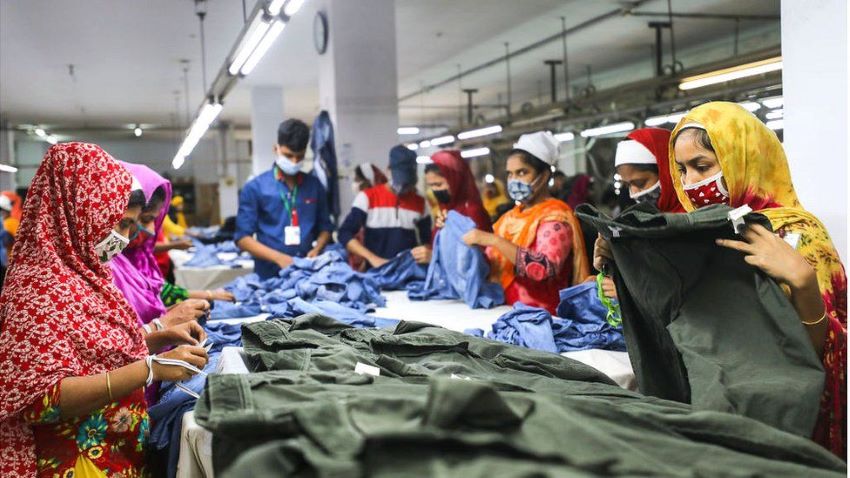
Bangladesh’s garment industry is booming and setting export records but workers struggle to get by. Senior sewing operators toil for up to 14 hours a day. Workers have no time for recreation and frequently have to work at their factory on weekends. Couples live in cramped quarters, a rented single room in a house with a tin roof. They have little privacy and often have to share a toilet, bathroom and kitchen with another family who live in the same house.
A huge workload follows a slight wage increase. Workers in an assembly line-like system of production are now expected to produce more items of clothing per hour. Workers who used to stitch 100 pieces of apparel in one hour are now being ordered to stitch 120 to 130 pieces. Workers in the readymade garment trade, the most dynamic sector of Bangladesh’s economy that produces clothes for leading western brands, do not receive health coverage from their employers.
Bangladesh readymade garments exports tripled over a ten-year period and account for 84 per cent of Bangladesh’s total export volume. Every year, the country’s garment sector, which employs 3.5 million people, keeps setting records for exports and dominating all Bangladesh sectors in that area.