


FW
Uttar Pradesh signs MoU with Flipkart
The Uttar Pradesh government has signed an MoU with e-commerce site Flipkart to bring state's handicraft products on the platform.
Through this initiative, the state government aims to tap the 40 crore customers on Flipkartto provide a vast market for handicraft products of the state.
Along with handicrafts and handloom and products, the platform will also display products made by Divyangjans of the country.
Flipkart is also training craftsmen for this initiative while the government is providngfacilities and loans to handicraftsmen and weavers and taking their products to the market of the country.
The state government is also organizing camps to give subsidies on loans to weavers. The government is providing a subsidy of up to 20 per cent on loans and up to seven per cent on interest as per rules.
US’ textile and apparel imports grow by 30.97% in H1FY2022
US’ textile and apparel imports grew by 30.97 per cent to $66.308 billion in the first six months of 2022, compared to $50.626 billion in the same period of 2021. With a 26.8 per cent share China continued to be the largest supplier of textiles and clothing to the US, followed by Vietnam with 13.87 per cent.
As per a Fashion Network report, apparel dominated of textiles and garments importsof the US in January-June 2022, and were valued at $49.578 billion, while non-apparel imports accounted for $16.729 billion, according to the latest Major Shippers Report, released by the US department of commerce.
Segment-wise, among the top 10 apparel suppliers to the US, imports from Bangladesh and Indonesia surged by 60.30 per cent and 60.27 per cent year-on-year respectively. Imports from India and Cambodia too grew by 57.27 per cent and 52.52 per cent respectively. Additionally, imports from Pakistan grew by 49.99 per cent compared to the same period of the previous year.
Of the total US textile and apparel imports of $66.308 billion during the period under review, cotton products were worth $29.541 billion, while man-made fibre products accounted for $33.396 billion, followed by $1648.531 million of wool products, and $1721.557 million of products from silk and vegetable fibres.
Bluesign Finder to evolve as a comprehensive search engine for textile dyes
By defining ‘sustainable attributes’ for bluesign®approved chemicals registered in the bluesign®Finder, Bluesign is furthering its ability to provide more sustainable solutions by providing specified search functions to help chemical suppliers and the textile industry make better informed decisions. The bluesign®Finder is a web-based, advanced search engine for manufacturers. It contains a positive list of preferred chemical products. Today more than 20,000 bluesign®approved chemical products are registered in the bluesign®Finder
In addition to the existing functions within the bluesign®Finder, Bluesign®System Partner chemical suppliers can claim selected sustainability attributes for their bluesign® approved chemical products that will be displayed within the bluesign®Finder. Sustainability claims will be verified by Bluesign during on-site assessments and through chemical assessments. The Bluesign® Finder will be amended with search functions starting this year. It will evolve and implement a comprehensive online search engine for sustainable textile auxiliaries and dyes.
SBTi approves Burberry’s net-zero emissions target
Burberry’s net-zero emissions target has been approved by the Science Based Targets initiative (SBTi).
Burberry target’ to reach net-zero emissions by 2040 are based on the latest climate science and meet the urgent need to keep warming to 1.5°C in line with the Paris Agreement. Burberry’s net-zero target is underpinned by a series of commitments across scope 1, 2 and 3 emissions.
In the near term, the brand aims to reduce absolute scope 1 and 2 greenhouse gas (GHG) emissions 95 per cent by 2023 from a 2017 base year, and reduce absolute scope 3 GHG emissions 46.2 per cent by 2030 from a 2019 base year.
In the long term, Burberry commits to maintain at least 95 per cent absolute scope 1 and 2 GHG reductions from 2023 through 2040 against a FY2017 base year, while reducing absolute scope 3 GHG emissions 90 per cent by 2040 from a 2019 base year.
Burberry’s net-zero emissions target builds on the British luxury brand’s longstanding commitment to reduce its direct and indirect environmental impacts and make a positive difference to the lives of people around the world. Burberry is currently carbon neutral across its own operations globally, all the electricity it uses is from renewable sources and almost every product it makes has a social or environmental benefit.
14th CAITME 2022 to be held from September 07-09, 2022
International exhibition of equipment and technologies for the textile, clothing and knitwear industry in Central Asia, 14th CAITME 2022, will return in the traditional expanded format from September 07-09, 2022. It will be held at the Uzexpocentre in Tashkent, Uzbekistan. The event is supported by key ministries and trade and production associations and will be attended by industry professionals and experts from the entire Central Asian region, key investors and international organisations.
More than 300 companies from 20 countries are expected to participate in the 2022 edition. The National Pavilions of Italy, Germany and South Korea will be set up at the event along with wide expositions of companies from Austria, Belgium, Switzerland, Turkey, China and other leading manufacturing countries. Indian textile engineering will be represented by 22 leading manufacturers of equipment and accessories for various stages of textile and clothing production.
The main sections of the exhibition will include textile and clothing equipment for all stages of production; controlling and measuring, laboratory equipment; accessories, components and devices; chemicals, dyes, textile auxiliaries; and textile waste processing equipment, etc
Sales of private labels owned by apparel retailers surge
Sales of brands and private labels owned by retailers across the apparel segment are surging as consumers increasingly shift to lower priced brands in supermarkets and department stores.
Sales of most lifestyle retailers have surged by double-digits despite price hike. For instance, the sales of Shoppers Stop reached highest levels in a quarter for private brands. The retailer’s private brands grew by 29 per cent while their average selling price increased by 50 per cent during the quarter. The retailer’s volume more than doubled, and its private brand contribution reached 15 per cent at an overall level and 21% within apparel, says Venu Nair, Managing Director.
The private brands of Reliance Retail also noted a six-fold increase in business to account of 30 per cent of overall sales. The company extended its own labels beyond stores and competed with national brands at the local grocers level.
Reliance Retail launched 14 new brands during this period, which helped it to grow over 300 basis points on its own brand share into overall performance for the business, says Gaurav Jain, Head, Strategy and Business Development.
Rising inflation forced consumers to skimp on expenses and opt for cheaper alternatives, and in some cases, even unbranded ones. Recent Kantar data shows unbranded products grew by 7-16per cent for categories such as edible oil, butter, flour and toilet cleaners, while branded ones in these segments declined by 2-11 per cent.
High-value products, GSP+ compliance can boost Bangladesh RMG exports to Germany

Tightening of purses by German consumers is likely to affect Bangladesh’s RMG exports to the country, says Achim Troster, German ambassador to Bangladesh. Germany has been affected by the Russian war in Ukraine and rising inflation across the world, says the ambassador. To benefit from the GSP+ status, Bangladesh needs to comply with human rights, labor rights and environmental standards, adds Troster
Germany’s RMG orders from Bangladesh have declined significantly in the past months as warehouses across Europe are still stocked with unused inventory. To tide over this, the Bangladesh garment industry needs to diversify and concentrate more on high-value products, Troster opines.
Compliance to GPS conventions required
He warns, Bangladesh should not take GSP+ facilities for granted as EU is likely to insist on the nation’s compliance to all 27 conventions linked to the facility. The 27 international conventions that need to be complied by Bangladesh include: compliance to human rights, labor rights and environmental standards. Bangladesh does not need to comply completely with all the rules but needs to demonstrate an ability to improve.
Domestic analysts believe, this could be challenging for Bangladesh and requires the government to actively implement it. Bangladesh needs to ensure compliance with these conventions by 2029 as EU might be inflexible by then, says Troster. A majority of the parties concerned in the EU organizations urged Bangladesh to comply, while a few analyst recommended the country to continue the current status quo. The extensive sanctions levied against Russia have caused immediate economic blows to the Western countries. They may also impact Bangladesh as it graduates from least developed status, warns Troster
EBA scheme boosts Bangladesh-Germany trade
One of the biggest export markets for Bangladesh, Germany’s bilateral trade with the country is increasing gradually. Trade is getting a boost by the EU tariff preferences granted under the "Everything but Arms" arrangement. Bangladesh mostly exports textiles to Germany while it imports machinery as well as chemical products and electrical goods from the country. The German government is focusing on renewable energy, and is committed to positive climate action despite the Russia-Ukraine war. It is negotiating with the Bangladesh government on the matter. In March, a German delegation offered Bangladesh privileged partnership on climate and development. The partnership will concentrate on adaptation and mitigation, and emphasize on renewable energy, says Tröster.
Rising cotton prices spark sale of spinning mills in Gujarat
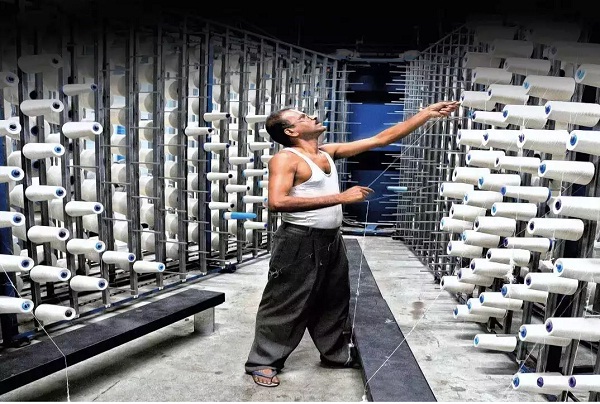
The entire textile value chain in Gujarat has been reeling under the effects of rising cotton prices that has reached almost Rs 1.1 lakh per candy (365kg). The price rise has eroded the profit margins of almost all spinning mills in the state. In fact, three mills have already been sold since Diwali 2021 and another four in Saurashtra are up for sale.
Low yarn prices pressurize input costs
Despite a rise in cotton prices, weak demand in the domestic and export markets has not caused yarn prices in the state to rise, leading to a rise in input costs of spinning units. Most yarn manufacturers in the state are facing losses of around Rs 30-50 per kg depending on the quality of their yarn. The unprecedented hike in cotton prices followed by a decline in demand is pressurizing the industry, says Jayesh Patel, Director Omax Cotspin.
Having a capacity of 70,000 spindles, the Dhrangadhra-based company recently acquired a spinning unit in Rajula region of Amreli district. The spinning unit, with a capacity of 51,000 spindles, was under pressure even before the hike in cotton prices. Its owner wanted to exit the business completely and sold the unit to Omax Cotspin. The acquisition will enable Omax Cotspin double its capacity, says Patel.
Likewise, Jasdan-based MM Group has acquired two spinning mills in the past one year. The group added 53,000 more spindles besides acquiring mid-size units, adds Natvarlal Navadiya, Director, MM Group.
Weak demand leads to 15% less valuations
More spinning units in the state are likely to be sold if the situation does not improve, explain experts. Unable to meet input costs due to rising cotton prices, mills are reducing capacity utilization over the past four months. Some have finally decided to sell off and diversify business.
Spinning mills in Gujarat have been affected by a continuous weak demand. Their valuations have reduced almost 15 per cent. With the situation showing little signs of improvement, potential buyers are adopting a wait and watch policy. Weaving units face heat of rising costs
Textile weaving and processing units in Gujarat have also been affected by the rise in input costs and a dip in demand. The state has around 200 cotton weaving units that are currently running at low capacities. Demand for grey fabrics in the state is low, making prices volatile. Operation of spinning units at low capacities is impacting weaving units in the state, claims Bharat Chhajer, Former Chairman, Powerloom Export Development Council
China’s depleting textiles market share an opportunity for India
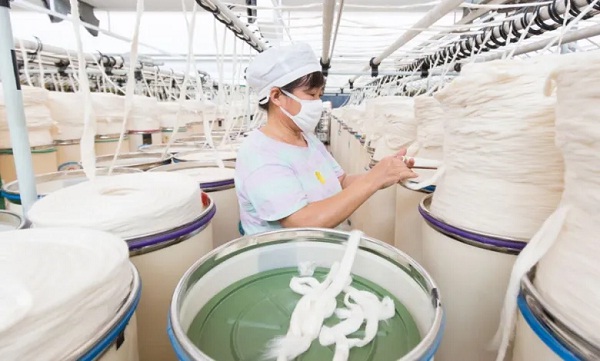
China’s current textile troubles can bring new opportunities to India’s exporters as demand for cotton from China has dropped this year. A few Chinese companies have lost up to 30 per cent orders, as per Beijing Cotton Outlook, the South China Morning Post. The number of textile factories with operational machines has also declined 13.3 per cent, as per the China National Cotton Information Centre. Experts believe, this could worsen as more countries stop buying cotton from East Asian countries.
Step up exports to China
KK Lalpuria, the Executive Director and CEO, Indo Count Industries, opines, India should take this opportunity to increase textile exports to China. India currently holds about 6 per cent market share. The government should aim to increase textile exports to $100 billion by 2030. To reach this goal, Indian exporters need to overcome numerous bugbears indicates a CRISIL Ratings report. Cotton prices have more than doubled in one year, making the situation even worse. Rise in domestic cotton prices has led to exports becoming less competitive.
Gautam Shahi, Director, CRISIL Ratings, attributes this to an increase in the price of raw materials like cotton due to a US ban on cotton produced in Xinjiang, China which is the biggest producer of the fiber. He urges the government to help players in the sector achieve steady growth. Experts also advise the government to introduce policies that encourage diversification of textiles portfolios, capacity building, and competitiveness. Also, there is a need to focus on new foreign trade agreements (FTAs).
Include textiles in FTAs
Anand Ramanathan, Partner, Deloitte India, urges the government to include textiles into all FTAs. These agreements can significantly impact India’s textile industry. For example, the India-UAE trade pact will help lower import duties for Indian exporters. This will boost trade between the two countries besides making the textile industry more competitive and help create jobs. As per a report by the Press Information Bureau, India’s textile and clothing industry adds about 2 per cent to the country’s GDP. Before COVID began, it employed close to 105 million people. Hence, the government needs to help the sector by adopting the ‘China Plus One’ strategy to get a more significant share of the global textile market. Lalpuria says, India can benefit from this policy as many international brands have diversified to other places instead of China.
Boost prices cotton through mechanization
India can also benefit from its huge cotton production and a well-established industry that makes all kinds of fabrics and yarn. Schemes like the Production-Linked Incentive (PLI) scheme and the Interest Equalisation Scheme have helped make the country more competitive. Growing at a 6.2 per cent CAGR from 2020 to 2025, India’s technical textiles exports are worth $2 billion with the country aiming to reach a goal of $10 billion exports in three years.
Cotton prices can be fixed by increasing the number of cotton crops and using machines, says Ramanathan. He advises farmers to connect with banks to get money and ensure more mechanization and investments in new technologies.
Adopt sustainability
Farmers also need to monitor new trends catching on around the world. They need to learn about sustainable ways to make things. RK Dalmia, Senior President and Director, Birla Century says, they aim to integrate sustainability throughout the entire value chain. About 84 per cent of trash being produced by them is being recycled or reused. It recently also started recycling of fly ash from power plants to make factories more in line with international standards, he adds. Ramanathan opines, ensuring responsible production of fabrics can help boost exports. It can also help manufacturers procure all raw materials from one place. This can give India a big advantage over Bangladesh and Vietnam, he adds. Thus, to achieve the $100 billion export goal, Indian government and players need to focus on resolving the current problems, adds Ramanathan.
US apparel imports rise by 40.14% Y-o-Y in H12922
During the first half of 2022, the US apparel imports increased by 40.14 Y-o-Y to $49.58 billion.
Particularly in June ’22, the imports grew by 40.30 per cent Y-o-Y to $8.64 billion, while the growth noted on monthly basis over May ’22 was 1.52 per cent.
As per OTEXA data, analyzed by team Apparel Resources, top six Asian countries (China, Vietnam, Bangladesh, India, Indonesia and Cambodia) together exported garments worth $32.82 billion to the US in H1 ’22, which is 66.20 per cent of total import values of the US.
China remained the top shipper to the US in the period with $10.25 billion worth of apparel exports, growing by 40.15 per cent on yearly basis.
Vietnam exported garments worth$9.19 billion to the US in H1 ’22, noting 35 per cent yearly growth, while Bangladesh and India upped their shipment by 60.30 per cent and 57.27 per cent, respectively.
Indonesia stayed on fifth position and shipped $3 billion worth of garments to the US, noting 60.27 per cent yearly jump.











