


FW
Imports value of US textile and apparels increase 28.1% Y-o-Y in June
The imports value of US textile and apparelsincreased by 28.1 per cent Y-o-Y to $11.45 billion in June. The imports volume increased by 18.2 per cent Y-o-Y to 10.65 billion sq m. US apparel imports value in June 2022 rose sharply by 40.3 per cent Y-o-Y to 8.64 billion and the imports volume increased by 18.9 per cent Y-o-Y to 2.76 billion sq m.
The US textile and apparel imports volume from China declined by 11 per cent Y-o-Y to 3.25 billion sq m in June 2022. The imports value reached $2.95billion increasing by 15.8 per cent Y-o-Y. US apparel imports value from China in June 2022 rose by 32.9 per cent Y-o-Y to $1.98 billion, and the imports volume reached 1.04 billion sq m, up by 12.5 per cent year-on-year. Compared with 2019, the total imports value from China decreased by 11.5 per cent, and the reduce rate saw a seasonal decrease.
Over the past 5 years, China's share in US textile and apparel imports was on the decline. And it stayed at 25.8 per cent by June 2022.
Garment policy boosts investments, new jobs in Karnataka
Around 544 medium and small garment units have invested Rs 745 crore in the state besides adding about 64,000 jobs over the past three years, owing to the state’s favorable garment policy, says Shankar PatilMunenakoppa, Handloom & Textile Minister. Launched in 2019, the policy will be in force for two more years.
Mega projects under the policy attracted another Rs 1,060 crore investments, creating about 17,300 jobs. The garment policy 2019-24 aims at attracting investment of up to Rs 10,000 crore and adding about 5 lakh jobs, adds Munenakoppa.
Known as the garment capital of India, Karnataka provides a fifth of the clothes manufactured in India. Karnataka plays a major role in exporting raw materials. Karnataka contributes 49 per cent of mulberry silk production, 12 per cent of wool production and 6 per cent of cotton production.
China’ to expand duty-free facility to 99% ‘Made in Bangladesh’ products
In addition to products made 98 per cent in Bangladesh, China plans to grant 1 per cent more products’ Made in Bangladesh duty-free facility in in the Chinese market.
Noor MdMahbubulHaq, Additional Secretary to the Commerce Ministry (FTA), claims, apparels, jute and jute products, leather and leather goods, frozen fish, agri products and light engineering items are already enjoying duty-free access in the Chinese market while adding now with the facility further expanded by 1 per cent, Bangladesh needs to assess whether it has new products to get the benefits from the tariff line.
It may be mentioned here China had been providing 97 per cent duty-free facility to 8,256 Bangladeshi products including all apparel products, since 1 July 2021. The facility was expanded to 98 per cent later by adding another 383 new products including leather items to the list.
With several new innovations, upcoming Munich Fabric Start to be bigger

With the theme ‘Far Furore’, the upcoming edition of Munich Fabric Start is set to be bigger than ever, says Sebastian Klinder, Managing Director, Munich Fabric Start. To be held on August 30 and September 1, 2022, the exhibition will feature 1,500 collections from 900 exhibitors spread across 45,000 sq mt space. This year’s Munich Fabric Start will comprise eight zones: Fabrics and Additionals with international material innovations for all apparel segments; ReSource and innovation novelties for sustainable innovations; Design Studios with fabric designs and new print developments on an enlarged area; the Keyhouse innovation hub, Bluezone denim powerhouse; The Source, a new sourcing area for international vertical integration.
The Source Segment
A one stop solution for holistic fashion in Europe The Source area will present 65 international manufacturers of cut-make-trim to high-end garments. The area will attract participants from countries Portugal, Turkey, Morocco, Tunisia, Bosnia and Vietnam among others. Hosted in new Hall 8 with around 2,500 sq. mt. additional space, the unique new venue will offer flexible sourcing services and rethought value chains.
ReSource to offer certified recycled fabris
ReSource, the sourcing platform for sustainable material developments will offer bio-certified, bio-based, recycled, recyclable or regeneratively sourced fabrics and ingredients and continues to gain in importance.
A new area in Atrium 3
Atrium 3 of the exhibition venue will house a completely new area the Design Studios. Housing around 40 studios, the area will feature well-known exhibitors lie: Buntastic, Eleonora Clerici, Fusion CPH, Le Studio Copenhagen, LETI, Musticstsyle or Zisser Textile Design, who have been presenting in Munich for many years. For the first time, the Create collective will be represented with its 27 creative studios enlivening the print segment of the trade fair.
Keyhouse to feature trendsetting showcases
An innovation hub for the fashion of tomorrow information and interaction, the 1,000 sq. mt. Keyhouse area will feature trendsetting show cases alongside sustainable innovations – be it on sustainability, digitalization, traceability, technology or finishing. The area will host the main lecture forum of Munich Fabric Start with exclusive keynotes panel discussions, trend presentations, Q&A sessions and expert talks by international industry insiders.
Bluezone: Denim Powerhouse
The Bluezone are will be held at Hall 6&7 on August 30 and 31. A global key event for the denim industry featuring around 100 international denim mills, weavers, manufacturers and finishing companies under the motto ‘Campus’, Bluezone area will showcase caps, socks, bags and bottles and FloydTravel Cases.
At the entrance of Bluezone, Wiser Tech will present an automated high-tech machine park to revolutionize denim finishing. Titled ‘The Italian Luster’, the new project will depict a fully integrated value chain of Italian denim production. The participating companies include: ACM Trims, Berto Industria Tessile, the Elleti Group, Fashion Art and Olimpias.
Talks on sustainability
Bluezone and Transformers Foundation will organize a series of lectures on the core topic of sustainability on both days. On August 30, a lecture on energy and decarbonization will be held and the next day, a review and exchange of Transformer Reports on Unethical Behaviour and Cotton will be presented.
US Cotton exports decline 1.7 million bales in MY2021-22
Cotton exports by the US declined by over 1.7 million bales for marketing year (MY) 2021-22 from the previous MY to 14.7 million bales due to less exportable supplies, according to the US department of agriculture (USDA). Despite higher production, beginning stocks in August 2021 were more than 4 million bales lower than a year earlier.
Export volumes remained depressed in the first half of the marketing year. Higher domestic consumption and logistical constraints also constrained shipments.
According to USDA export sales reporting (ESR), total MY 2021-22 shipments were 14 million bales, 700,000 bales lower compared with the USDA forecast.
For the second consecutive year, China was the largest export market and accounted for roughly one-third of US shipments, according to ESR data. Most exports to China were intended for state reserves.
Of the top ten export markets in 2021-22, Turkey, India and Peru witnessed higher exports relative to the previous year.
Majority consumers top following trends amid rising inflation: Survey
Majority of consumers globally have stopped following fashion trends due to rising inflation levels, says a new survey by EY Future Consumer Index. Around two thirds of respondents said they no longer feel the need to keep up with the trends, with 69 per cent now attempting to repair rather than replace their belongings.
A further 60 per cent of the 18,000 respondents from 24 countries interviewed in May and June said they are relying less on beauty and cosmetic products to boost their confidence.
Customer buying behaviors are changing once more and supply chain theory has become the topic of dinner conversation around the country, with Irish businesses taking note," says Ivan O'Brien, Consulting Partner, EY Ireland.
Digital behaviors learned during lockdown will continue to be embraced if they offer savings to Irish consumers, and businesses with user-friendly digital channels have an opportunity to capitalize on this.
Additionally, producers are moving away from lean production processes and embracing 'just in case' planning, so as to avoid running out of stock due to sudden increases in demand
The report also found that finances are now a concern for four in five people.
Despite improving sentiment towards sustainability year-on-year, two-thirds of participants in the EY survey said the high price of sustainable goods is off-putting.
The survey also found that one in eight consumers have used digital currencies, rising to 15 per cent among Gen Z and 18 per cent among millennials.
Huntsman Textile Effects bags ‘Exporter of the Year’ Award
Leading global provider of high-quality dyes, chemicals and digital inks for textile-related industries, Huntsman Textile Effects was awarded with the ‘Exporter of the Year’ award for the second consecutive year.
Conferred by the Gujarat Dyestuffs Manufacturers Association (GDMA), the award, reportedly, recognises companies that have demonstrated outstanding export performance for 2019-2020 and 2020-2021.
During this period, Huntsman earned the highest foreign exchange from self-manufactured direct export of dyes and dye intermediates.
The company operates a state-of-the-art global dyes and chemicals manufacturing unit in a designated industrial zone of Padra in Baroda, Gujarat. The facility is spread across 62 acres and offers direct and indirect employment to over 800 people.
ABG to buy Ted Baker for £211 million
Authentic Brands Group, the US owner of sports clothes marque Reebok and leisure wear maker Juicy Couture has signed a deal to buy the 35-year old struggling British fashion group Ted Baker for £211 million ($254 million).
Like other bricks-and-mortar businesses, Ted Baker has struggled in the face of fierce online competition before and during the Covid pandemic.
Jamie Salter, CEO, ABG says, Ted Baker is a highly regarded, uniquely British brand whose strong fashion credibility resonates with consumers around the world, Its association with ABG will help build on the brand's global foundation through a business model focused on licensing, wholesale, retail, digital and strategic marketing partnerships.
Adopting China’s cotton growing techniques can benefit Pakistan: Report
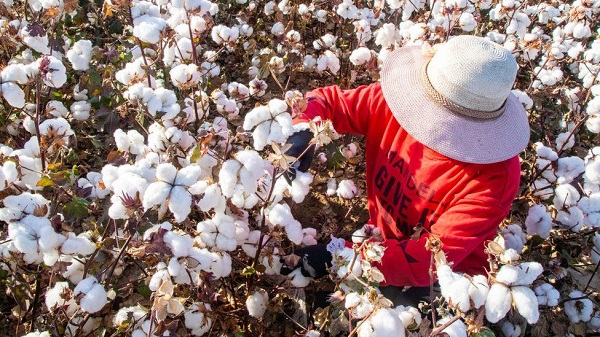
Xinjiang cotton offers comparative advantage for Pakistan, says a report by Gwador pro. The industry enables Pakistani farmers to adopt Chinese techniques of intercropping and double cropping.
Close cooperation in mechanical harvesting
Mehmood Ul Hassan Khan, Director, Center for South Asia & International Studies (CSAIS) notes, mechanical harvesting helped Xinjiang save 50 per cent water consumption and 30 per cent fertilizer use. It also helped the region reduce labor costs up to 30 per cent besides enhancing yield by the same percentage. Therefore, Khan recommends, Pakistan and China should explore close cooperation in mechanical harvesting to further strengthen cotton yields.
Develop new seed varieties
The report also advises Pakistan farmers to develop new types of cotton seeds, and employ Chinese molecular biology to introduce these seeds. The Punjab government has allotted two agro-based industrial zones in Vehari and Bhalwal to offer several incentives including tax waivers to Chinese firms to form a knowledge platform between these two countries.
Despite it being one of the largest crops in the country, Pakistan lags behind Xinjiang in cotton production. Xinjiang companies are able to breed high-yield and high-quality cotton seeds suitable for planting in Pakistan. The country can benefit from the adoption of natural gold fiber cotton.
Facilitating JVs in garment projects
As per a Daily Times report, Pakistan can also benefit from joint efforts and close cooperation with Xinjiang in cotton production that may facilitate joint ventures in garments projects in future. The largest cotton growing region in China, Xinjiang produced cotton over 2.51 million hectare in 2020 nearly the same as 2019. This year too, Xinjiang is expected to see another bumper harvest, posing a bright outlook for the national economy and exports.
Over 50 per cent of farmers in Xinjiang usually grow cotton, shows statistical data from the China Cotton Association (CCA). Majority of this comes from ethnic minorities who mainly engage in cotton farming for their daily livelihoods. . Boosts employment in China
China’s cotton industry also provides substantial employment opportunities to many migrant workers. In the last two months, nearly 4,000 people in the Aral township in Aksu Prefecture joined the migrant cotton-picking community, earning an average RMB 6,000 (about $895) per capita. Nowadays, cotton fields in north Xinjiang are mainly harvest using machines and the practice becoming popular in south Xinjiang as well. Around a fifth of the world’s cotton is produced in Xinjiang. To boost growth, Xinjiang has shared its cotton growing expertise with a few Central Asian countries.
China’s comparative advantage in cotton research and industrialization and its advanced breeding and seed production techniques can benefit Pakistan cotton growers under the CPEC agreement.
India’s textile and apparel exports grow 2.15% from April-July’22: CITI
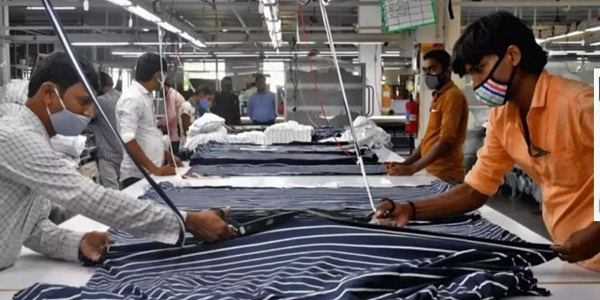
Analysis of the DGCI&S exports data by the Confederation of Indian Textile Industry (CITI) shows, from April to July 2022, India’s textile and apparel (T&A) exports grew 2.15 per cent to $12,892.21 million compared to $12,621.04 million during April-July 2021. However, month-on-month analysis shows, exports declined 15.01 per cent to $3,578 million in July 2022.
Dip in textile exports
India’s textile exports declined 10.30 per cent from April to July 2022. Export value of cotton yarn/fabrics/made-ups, handloom products etc fell 12.23 per cent during the period to $4,109.08 million from $4,681.56 million in April-July’21 period. In July 2022, cotton yarn/fabrics/made-ups and handloom products exports declined 28.17 per cent to $944.92 million from $1,315.42 million in July 2021.
MMF exports decreases
India’s MMF yarns/fabrics exports fell 0.33 per cent to $1,765.7 million during April-July 2022 compared to $1,771,59 million during April-July 2021 period. On a year-on-year basis, MMF exports declined 10.33 per cent to $437.59 million in July 2022 from $486.91 million in July 2021.
Textile exports registers larger decline in July’22
In July’22, India’s textile exports declined 24.15 per cent to $1,660.66 million from $2.189.46 million. Apparel exports on the other hand, fell 0.6 per cent to $1,380.91 million down from $1,389.22 million in July’21. The cumulative exports of textiles and apparels grew 2.15 per cent to $12,892.21 million during the April-July’22 period compared to $12,621.04 during the April-July’21 period. Share of T&A exports declined to 8.38 per cent in July 2022 from 10.08 per cent during July 2021. From April-July’22 period, the share of India’s T&A exports declined to 8.19 per cent from 9.63 per cent in the April-July’21 period.
Future positive as IIP increases from April-July’22
T Rajkumar, Chairman CITI says, Indian textile and apparel industry is facing several unprecedented challenges for the last few months. However, he hopes, production will improve in future as from April-July’22, the Index of Industrial Production for textile increased 0.8 per cent while that of clothes increased 50.9 per cent. Though dip in share of textiles and apparels exports of all commodities is a matter of great concern, growing production provides some relief for the industry, adds Rajkumar.











