


FW
Growth momentum of Bangladesh garment exports to India to continue: BGMEA
Bangladesh’s garment export to India will continue to grow, saysFaruque Hassan, president of the Bangladesh Garment Manufacturers and Exporters Association (BGMEA).
Bangladesh garment shipments increased by 58.07 per cent to $365.95 million in the July-December period of the current fiscal year from the $231.53 million recorded in the same period a year ago, according to data from the Export Promotion Bureau.
Of the total, knitwear exports surged by 66.46 per cent to $161.69 million in value. The shipments of woven garment surged 52 per cent to $204.26 million at the same time.
Exporters say the demand for Bangladeshi garment items is rising in India because of the expanding middle-income groups in the world's second-most population nation. Many prefer garment items produced in Bangladesh as they cannot afford expensive Indian high-end garment items.
MdShahidullahAzim, Managing Director, Rupa Knitwear, says a lot of Indian businessmen are placing a good number of orders in Bangladesh to re-export to other countries.
Sharif Zahir, Managing Director, Ananta Group, adds, his group sells $10 million worth of garment items, mainly denim, ladies underwear, woven shirts and knitwear items in India every year
Bangladesh denim exports to the US rise by 42.25% in 2021
Bangladesh has surpassed Mexico and China in denim apparels exports to the US. In 2021, it exported denim apparels worth $798.42 million worth to the US, noting 42.25 per cent Y-o-Y growth.
In 2021, US’ total denim apparel imports increased by 31.36 per cent to $3.68 billion in 2021. Bangladesh’s share increased to 21.70 per cent in 2021 from 15.65 per cent in 2019, despite US not being able to surpass its 2019 import values in denim apparel category.
As per Apparel Resources, Mexico shipped denim apparels worth $ 654.87 million to the US, increasing by around 39.60 per cent on yearly basis, while China slipped to 5th position in just two years and managed to clock $387.91 million from its denim apparel export to the US in 2021.
Despite short-term disruptions created by COVID-19 in Vietnam, the country clocked its 3-year highest export revenues in 2021 in the mentioned category as its shipment valued $402.29 million, as compared to $368.18 million in 2020 and $372.02 million in 2019.
Bangladesh regains global position as the second largest RMG exporter
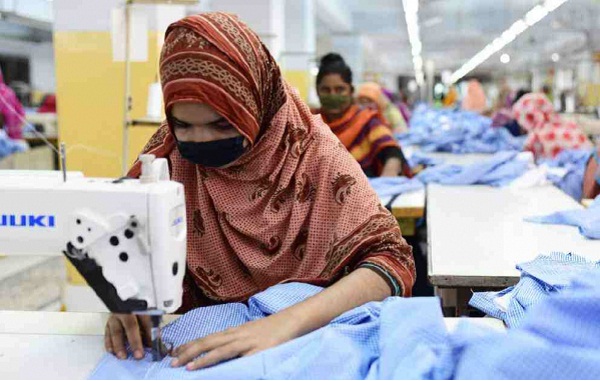
Bangladesh is back to being the world’s second-largest apparel exporter. Latest Export Promotion Bureau (EPB) statistics show, Bangladesh’s apparel exports surged 30.30 per cent to $23.99 billion from July to January 2021-22. Knitwear exports surged 32.89 per cent to $13.27 billion. On the other hand, export of woven garments surged 27.23 per cent to $10.71 billion.
In 2021, Bangladesh’s apparel export earnings grew 30.36 per cent to $35.81 billion. The country’s earnings from apparel exports surpassed Vietnam’s export earnings of $32.75 billion, reveals the General Statistics Office. The surge in apparel export earnings was dominated by knitwear exports that rose 37.72 per cent to $19.59 billion compared to $14.22 billion in the same period last year. During the year, Bangladesh’s exports of woven products also surged 22.46 per cent to $16.21 billion, says Faruque Hassan, President, BGMEA.
Lower prices, on-time delivery boost orders
In January 2021, Bangladesh’s apparel export earnings grew 42.71 per cent to $4.08 billion, says a Textile Today report. This was the highest ever single month apparel exports achieved by the country. Exports of both knitwear and woven garments grew 40 per cent year-over-year. Despite, pandemic related challenges, exporters showed tremendous resilience and efforts to boost business. One reason, Bangladesh managed to increase exports in 2021 was the ability of manufacturers to keep factories operational during the year. Also, exporters accepted orders at lower prices and shipped them on time, adds Hassan.
Exporters also upgraded their technology, production capacity and product quality, which helped gain more orders, Hassan explains. Their commitment to execute bulk orders encouraged many buyers to relocate purchases to Bangladesh.
Chinese investment crucial to sustain growth
Exporters currently have enough work orders to retain their second position in the global apparel market, adds Shahiduallah Azim, Vice-President, BGMEA. He hopes Bangladesh apparel industry reaches new heights in the next five years. However, to achieve this, Bangladesh needs to attract Chinese investment as well as buyers relocating their purchase destinations, he feels. They need to veer Chinese investors away from Vietnam and Myanmar.
Cautious planning, skill development needed
Azim believes, the recent leap in Bangladesh’s garment exports may not last and advises exporters to be cautious while planning capacity and expansion. Exporters should also make a qualitative shift in their business through diversification, innovation, design, technology up-gradation and capacity building.
They should encourage more skill development amongst workers and professionals and negotiate prices cautiously, he adds. Maintaining safety and sustainability will also help exporters maintain and improve current production standards, he sums up.
Demand-resistant price rise may help apparel brands sustain growth in the US

Despite factory shutdowns in Vietnam and supply chain issues, apparel companies in the US have managed to emerge successfully from the pandemic. As per a Live Mint report, most companies posted healthier than expected revenue and profit growth during the latest quarter of this fiscal. Ralph Lauren’s sales grew over 25 per cent compared to a year earlier in the three months ended December 25. Its operating margin grew to its highest levels since 2013 to 15.9 per cent. Revenues of Capri Holdings, owner of Michael Kors, Versace and Jimmy Choo, grew 24 per cent compared to a year earlier while its operating margins surged 6 percentage points. Profit margins of Levi’s and PVH Corp also increased in their latest quarter compared to both 2020 and 2019.
Prices on recovery mode
At the start of 2022, equal-weighted basket of these apparel companies had declined 15 per cent. However, they recovered just before their earnings were rolled out. Most apparel companies were also able to pass along higher supply chain and freight costs to consumers. Michael Kors’ brand increased average unit retail price of its shirt and bag in double digits during the quarter ended December compared to a year ago. The average unit retail price of Levi’s also increased 7 per cent for the full fiscal while Ralph Lauren’s prices increased 18 per cent during the last quarter of the fiscal year.
Ralph Lauren has raised its revenue and operating margins outlook for the current fiscal year ending March. Both companies expect their revenues to grow by about 10 per cent in their respective fiscal years. Levi’s revenues are expected to double its five-year average growth pace before the pandemic.
Supply chain and inventory issues dent growth
To achieve revenue targets, apparel companies need to continue increasing prices without impacting demand. They also need to fuel new demand. As per a Credit Suisse report, apparel was earlier considered a ‘deflationary’ category. Government stimulus announced last year along with pent-up demand and a collective lack of inventory, helped companies raise their status amongst consumers last year. However, easing of supply chain issues and ready availability of inventory may test their credibility this year. Simeon Siegel, Analyst, BMO Capital Markets believes, the industry may find it difficult to maintain inventory levels this year as most consumers have adopted casual style of dressing and are unlikely to refresh their wardrobes soon.
Cost inflation is likely to rise in mid-to high-single-digital percentage, says Ralph Lauren. Already, cotton prices have achieved their highest growth levels of 12 per cent this year. This is impacting profit margins of many apparel brands, reveals October 2021 data from the US Bureau of Economic Analysis. Defying trends, expenditure of Americans on clothing and footwear reached its highest levels since 2015 to 3 per cent of their total expenditure, signaling good times ahead for the industry.
US’ jeans imports rise by 31.36% in 2021: OTEXA
US’ jeans imports increased by 31.36 percent to $3.68 billion in 2021, according to the Commerce Department’s Office of Textiles and Apparel (OTEXA).
Jeans imports from top supplier Bangladesh jumped 42.25 percent to $798.42 million in 2021 following 2020’s 3.98 percent decline, according to OTEXA. While labor and factory safety concerns continued, Bangladesh’s’ import market share rose to 21.69 percent last year from 20 percent in 2020.
Mexico’s exports surged by 39.6 percent to $654.87 million for the year, rebounding from a 41.54 percent falloff in 2020. Mexico’s market share climbed to 17.79 percent in 2021 from 16.7 percent the prior year.
Imports from Vietnam rose by 9.32 percent to $401.49 million last year after ending 2020 with shipments to the U.S. down 1.08 percent. Its market shrefell to 10.94 percent for 2021 from a year-earlier 13.1 percent, as summer factory closures forced importers to look elsewhere.
Pakistan also revived production in 2021, with imports from the country soaring 54.8 percent to $389.76 million. This came a year after its shipments to the U.S. dipped 2.8 percent. Pakistan’s market share stood at 10.59 percent at year’s end, up from 9 percent in 2020.
China was the biggest loser in 2020 with a 52.29 percent drop off, but came back with a 16.87 percent increase in 2021 to $387.91 million. China’s market share dipped to 10.54 percent from 11.8 percent.
Led by Mexico, Nicaragua, Colombia and Guatemala were among the Western Hemisphere supplier nations that helped push the region’s shipments to the U.S. up 37.88 percent to 853.13 million last year.
Fulgar launches new sustainable yarn
Italian specialist in the synthetic fiber sector, Fulgarhas launched a new sustainable Q-Cycle yarn in partnership with BASF’s ChemCycling recycling project.
As per a Spin Off report, Q-Cycle is a new post-consumption recycled polyamide 6.6 that offers the same benefits of lightness, strength and resistance of regular nylon.
In a process called pyrolysis, BASF’s technology partners turn post-consumer plastic waste into a secondary raw material called pyrolysis oil. This oil then replaces the same amount of fossil raw materials at the beginning of the chemical production process. The share of chemically recycled material is allocated to the final product by using a third party audited mass balance approach.
The technology can be applied to plastic waste that cannot be mechanically recycled for technological, economic or ecological reasons, as well as end of life tires.
Indonesia’s TPT industry expects exports to reach $42 billion in 2022
Indonesia’s textile and textile product (TPT) industry hopes, its export performance will remain high at $12 billion or around Rp. 171.6 trillion throughout 2022. Redma Gita Wirawasta, Secretary General, Indonesian Filament Yarn and Fiber Producers Association (APSyFI), says the projection is based on stable demand from the European and US markets throughout 2021. China is still not fully running due to the energy crisis, so there will be a transfer of orders from European and United States buyers, adds Wirawasta.
However, he said, the increase in production costs is considered to hamper the competitiveness of domestic products in the world market.
Besides Indonesia, the transfer of orders from China was also aimed at Bangladesh and India as one of the largest textile producers in the world.
Meanwhile, the contribution of the textile industry to the gross domestic product (GDP) of the manufacturing sector was 6.08 percent in the third quarter of 2021. Meanwhile, the growth of the textile industry on a quarterly basis also improved to 4.27 percent (q to q) when compared to the previous quarter.
Textile exports in the January-October 2021 period also increased by 19 percent to $10.52 billion, in addition to the investment value which also increased by 12 percent to Rp5.06 trillion.
INDA moves IDEA to a two-year cycle and FiltXPO to every 18 months
INDA, the Association of the Nonwoven Fabrics Industry, recently announced that IDEA® – the World’s Preeminent Event for the Nonwovens & Engineered Fabrics Industry – will be held every two years instead of three starting in 2024.
The upcoming dates for IDEA® under the new schedule will be March 28-31, 2022, as currently scheduled, and then April 23-25, 2024. Both will be held as live, in-person events at the Miami Beach Convention Center in Florida.
The last time IDEA® was held in 2019 it broke all attendance records. INDA expects the 2022 edition March 28-31 to attract several thousand senior-level buyers and attendees from over 60 countries and several hundred exhibitors from a myriad of industry sectors, including absorbent hygiene, wipes, filtration, medical and surgical products, personal protective equipment, home and office furnishings, transportation, geosynthetics and building construction.
FiltXPO™, North America’s only exposition and technical conference dedicated exclusively to the filtration and separation industry, will be co-located with IDEA® in Miami Beach this March 29-31 to avoid conflicting with other filtration events that were originally planned in 2021. FiltXPO™ then returns to an 18-month schedule and will next take place October 10-12, 2023, at Navy Pier, Chicago,
Burberry launches Rodeo Drive takeover
Burberry has unveiled an immersive Spring/Summer 2022 collection at its flagship store on Rodeo Drive, Beverly Hills.
The ‘Animal Instinct’ womenswear collection introduces Riccardo Tisci’s latest iterations of the iconic Burberry trench coat, deconstructed and rebuilt in striking silhouettes that experiment and play with volume. Styles in a blend of classic Burberry gabardine and textural linen cotton are cropped at the back, while signature outerwear in soft fawn and dark biscuit shades are transformed through daring details. Geometric and experimental abstract prints feature on dresses and shirts, while the freedom of movement is explored through flowing gowns and mini dresses adorned with sweeping fringing, frills and straps. Sexy figurehugging silhouettes in stretch technical fabrics are juxtaposed with unstructured tailoring exuding a confident mood.
The menswear collection continues Riccardo Tisci’s experimentation with classics and exploration of individuality, sensuality and fluidity. Outerwear staples appear in non-confirming silhouettes, including trench coats re-cut with raglan or cap sleeves and sleeveless silhouettes. The collection title ‘Universal Passport’ is adorned on mesh T-shirts and shirts, affirming a message of connectivity and exploration. An ode to the escapism of the outdoors weaves through the collection, including on abstract printed T-shirts and cotton shirts echoing the layered colours of camouflage.
Within accessories, new bag silhouettes are introduced: the Rhombi, a new ellipse-shaped shoulder bag inspired by the abstract curved prints in the collection; an evolution of the house’s signature Olympia bag featuring a crescent curve and new soft shape with a circular strap; a new men’s quilted check leather bag in backpack and crossbody iterations embellished with the Thomas Burberry Monogram.
Pakistan’s ECC approves amended Textiles and Apparel Policy 2020-25
The Economic Coordination Committee (ECC) of Pakistan has approved Textiles and Apparel Policy, 2020-25 with certain amendments.As per a Global Village Space report, the revised Textiles and Apparel Policy 2020-25 was submitted by the Ministry of Commerce after incorporating few changes along-with implementation report.
The ECC approved summary submitted by Ministry of Communication for issuance of sovereign guarantee or SBLC worth of Rs. 6944.0 million against Operational Viability Gap Funding (VGF) for the construction of Sialkot (Sambrial) – Kharian Motorway project on BOT basis. It also approved the summary submitted by the Ministry of Energy, Petroleum Division submitted for 15 years extension of lease contract between Saindak Metals Limited and MCC China for Saindak Copper Gold Project. The ECC allowed the extension of lease contract and recommended to review financial aspect of the project annually by the professional expertises.
The ECC also approved the summary on determination of RLNG sale price for PLL’s supply to K-Electric (KE) by the Ministry of Energy, Petroleum Division’s. It also approved the Technical Supplementary Grants submitted by different ministries and divisions. The ECC deferred Power Division’s two summaries on Settlement of Payables to Government Owned Power Plants and Reinstatement of Tax on dividend for investors/shareholders of IPPs.











