


FW
Welspun India’s FY’22 revenues surge by 26.6%
Global home textile leader Welspun India’s FY’22 revenues increased by 26.6 per cent Y-o-Y to Rs 93,773 million. Revenues from the textile division reached Rs 87,911 million during the year on account 1 per cent Y-o-Y increase in sales of terry towels, 6 per cent Y-o-Y increase sales of bedsheets and 19 per cent Y-o-Y increase in sales of rugs.
The company’s emerging businesses of e-commerce, brands, flooring, and advanced textiles grew by a cumulative 44 per cent during the fiscal year. The share of these businesses in the overall revenue increased to 26 per cent from 23 per cent last year. Domestic retail turnover grew by 66 per cent in FY22. Flooring continued its upward trajectory and grew by 107 per cent during the fiscal. The investment in all of the company’s emerging businesses is starting to reap the desired results to drive itsgrowth plans for the future. The company is focusing on its medium to long term strategic priorities and growth pillars by emphasizing on sustainable growth, profitability, and deleveraging its balance sheet.
Textile and garment companies to set up facilities in Uttar Pradesh
Uttar Pradesh is drawing the attention of many textile and apparel companies who are setting up their facilities in the state.
As per an apparel resources report, Paragon Apparels plans to invest Rs. 300 crore in Meerut,which is expected to create 6,000 jobs.Besides, Artex Overseas will investRs. 180 crore; UC Garments,Rs. 10 crore; Universal Yarns and Tex, Rs. 40 crore; Pashupati Textile Prints, Rs. 19 crore; Ramesh Textiles, Rs. 6.40 crore and Kanodia Global, Rs. 25 crore.
Recently UP Government held an Investors Summit 2022, which was addressed by Prime Minister NarendraModi.
The government is also developing an appare park near Greater Noida. It also plans to set up a flatted factory project for apparel factories in Gorakhpur. The state is benefitting from the availability of skilled workforce, continuously improving basic infrastructure and proximity to Delhi.
Standard minimum wages of garment workers need to increase urgently: CCC Turkey
As per a new research by Clean Clothes Campaign (CCC) Turkey, there is an urgent need to increase the minimum living wage for garment workers as the current legal only 25 per cent of the workers’ daily needs.
The Turkish garment sector employs around 1,5 million workers who make clothes for reputed lobal fashion brands, including: Adidas, Banana Republic, Benetton, Boohoo, C&A, Esprit, GAP, G-star, Hugo Boss, H&M, Inditex – Zara, Levi’s, Marks & Spencer, Next, Nike, Puma, Primark, Urban Outfitters, and VF. The clothes made them are exported to top five export destinations including Germany, Spain, UK, Netherlands and France. CCC Turkey research shows, these workers earn below the prescribed legal minimum wage which makes survival difficult for them.
The report found that one in three garment workers earns just the legal minimum wage – even with overtime. The minimum wage currently in Turkey is 4.253 TRY or 241 EUR net, but a basic living wage would be at least 13.000 TRY or 880 EUR (for January 2022), states CCC Turkey. Calculations by the Confederation of Turkish Trade Unions (TÜRK-İŞ) have found similar results.
BegoDemir, Coordinator, CCC Turkey, says, due to hyperinflation, garment workers in Turkey are confronted with the insoluble problem of sustaining their families. The state gives incentives to employers, but it doesn’t control the implementation of labor law in the sector. The Turkish government needs to ensure compliance to the law. All brands that have their supply chain in Turkey also must make sure all the workers behind their products reach all their rights, he adds.
Reactive dyes, the most technically advanced segment in dyeing industry: Report
Reportlinker.com’s new report on the global textile dyes market titled, ‘Textile Dyes Market by Dye Type, Type, Fiber Type and Region - Global Forecast to 2027,’names reactive dyes as the most technically advanced segment in dyeing industry.
According the report, these dyes reduce water consumption and are more eco-friendly. They are suitable for dyeing rayon, cotton and a few nylon fabrics. These dyes are seeing a consistent demand. Their growth is being driven by a better environmental performance, low cost, and improved technical properties such as good wash-fastness and a wide range of color compatibility.
The highest growing segment in textile dyes is viscose, a lightweight dye with a shiny finish and soft feel.The demand for viscose is high in the fast fashion industry. The highest demand is being witnessed from Asia Pacific Region.
APAC is estimated to be the largest as well as the fastest-growing textile dyes market.
Asia Pacific is the biggest market and a production hub for fast fashion industry. Leading players in the region are Atul Ltd. (India) and Kiri industries (India) and many more. Asia Pacific has comparatively less stringent laws and regulation around textile dyes and have availability of cheap labor.
Mafatlal Industries to reduce physical presence to 60% by 2030
The flagship company of the India-based Arvind Mafatlal Group, Mafatlal Industries, plans to reduce the percentage of its physical outlets to 60 per cent from the current 90 per cent by 2030. The company will focus on different segments in textiles and markets in coming years. It also plans to adopt a concentrated approach to the FMCG market and introduce a range of hygiene products.
Mafatlal Industries is one of the oldest textile manufacturers in India and is engaged in manufacturing and sale of fabric in various categories of cotton, polyester-cotton, linen, voiles, prints, etc. The company has a presence of over 11 decades in textile manufacturing and is a part of Arvind Mafatlal Group. The company is widely recalled for its innovative manufacturing facilities. It exports its products to the Middle East, Saudi Arabia, Europe, Sri Lanka and Bangladesh. The products exported by the company include voiles, cotton and rayon printed fabrics, printed voiles, yan dyed shirting, and various uniform fabrics.
Jeanologia to present new on-demand production model at Texprocess Frankfurt
Spanish company engaged in developing ecoefficient technologies, Jeanologiawill present its new operative model to produce on demand with zero discharge at Texprocess Frankfurt from June 21-24, 2022.
Integrating its technologies, the company promotes a revolutionary production model close to the consumer to produce what sells instead of selling what is produced through digitalization, sustainability, and automation.
For Jeanologia, the solution to end this inefficient production structure is to encourage a closer production or “postponement” of value adding to the garment in order to cut the time-to-market and eliminate stock and waste. And to do so without increasing the costs, guaranteeing competitivity and ensuring maximum productivity.
To this end, Jeanologia has developed Urban Factory, a new digital finishing plant, interconnected and automated that integrates all its technologies for garment finishing. Based on a production that is totally sustainable and with zero discharge, it responds quickly to consumer demands with an agile and digital production that does not pollute and saves costs.
Brazil will increase cotton supply to Bangladesh: Cotton Brazil
At the sellers’ mission event in Dhaka, Cotton Brazil, the international market development program for Brazilian cotton certified by the Brazilian Cotton Growers Association (ABRAPA), said, the country aims to increase cotton supply to Bangladesh to ensure continuity and sustainability through strategic partnerships in Asia.
As per a Dhaka Tribune report, the initiative will help promote sustainability and also demonstrate Brazil as a reliable partner of high-quality and traceable cotton.
The Brazilian business mission visited Bangladesh recently and met the officials of BTMA, BGMEA, Ministry of Industries, Cotton Development Board, and some prominent textile millers including Noman Group, MAS Group, NRG Group, ISRAQ Group, Viyellatex Group, Syed Group and Salma Group on June 14 in a hotel in the capital.
The event agenda also focused on Cotton Brazil’s commitment to ensuring short-term, medium, and long-term business continuity through its promotion of Brazilian cotton export.
Cotton Brazil aims to further increase its market share in key countries like Bangladesh and also plans to increase production capacity to meet Asia’s growing market demands.
It will also continue to initiate market awareness for the quality, traceability, and sustainability of Brazilian cotton.
Archroma, Baldwin join hands to support textile development projects
Global leader in sustainable specialty chemicals Archroma and a manufacturer and supplier of precision spray systems, Baldwin have joined hands to support textile manufacturers in their development projects. Through this collaboration, the two companies aim to improve their product safety, performance and functionality besides maximizing the productivity of the finishing application process.
Archroma and Baldwin are currently testing Archroma’s finishing products and systems, such as the soon-to-be-launched PFC-free* Smartrepel® Hydro SR for water-based soil repellence, as well as metal and inorganic particle-free antimicrobial technologies like Sanitized T 20-19 and TH 15-14, which will be launched at the upcoming Techtextil 2022.
The first test results will be available for discussions with both partners at Techtextil at their respective booths.
Epson Australia to launch new Mona Lisa ML-8000 printer at PacPoint
Epson Australia plans to launch its new Monna Lisa ML-8000 direct-to-fabric textile printer at PacPrint.
The ML-8000 is a next-generation digital textile printer with high print quality, productivity, stable operation with minimal downtime. It allows easy operation for an affordable price, making it the ideal printer for companies looking to move into local, onshore digital printing and production.
The ML-8000 comes with eight of the latest PrecisionCoreprintheads. The printer ensures performance and usability with its eight PrecisionCoreprintheads that allow it a typical print speed of 155 square metres per hour at 600x600 dpi – 2 pass. Maximum print speed is up to 250sqm an hour at 300x600 dpi, 1 pass. Resolution is up to 1200 dpi, print width up to 180cm, with up to eight colours.
The Monna Lisa ML-8000 is produced with Epson’s print partner Robustelli, which has a history of textile design and manufacturing in Italy’s Como province.
The ML-8000’s image quality is enabled by Epson’s high quality printheads. Epson says its exclusive Microweave and lookup table technologies reduce banding and graininess, and advanced new Multi-Layer Halftone Technology, which randomises the halftone dot pattern on each layer, reducing image degradation caused by dot misalignment. Dynamic Alignment Stabiliser technology also ensures stable print quality, by controlling waveforms on each printhead chip, for higher dot placement accuracy and more uniform dot density on each pass.
The ML-8000 also features symmetrical colour alignment for “consistent colour overlap order” during bidirectional low pass printing, and Accurate Belt Position Control (ABPC) technology automatically detects the belt feeding distance to ensure precise fabric feeding. The result, says Epson, is optimal quality and speed, with superb reproduction of colour gradations, fine details and complex geometric patterns.
Turkiye’s textiles and raw materials exports sees over 12% risefrom Jan-April’22
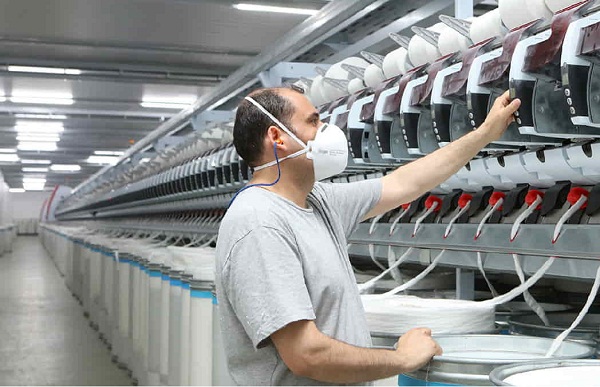
Turkiye’s textiles and raw materials exports increased 12.4 per cent to $4.6 billion during January-April 2022 compared to the same period of previous year. As per a Textile Intelligence report, exports of textiles and raw materials surged 13.7 per cent to $1.2 billion in April 2022 compared to the same period in previous year, indicates ‘April 2022 Export Performance Report’ published by ITHIB. The share of textile and raw materials in Turkiye’s overall exports amounted for 5.3 per cent during the period.
EU emerges largest market for Turkiye
EU emerged the largest importer of textiles and raw materials from Turkiye during the January-April 2022 period. Exports to 27 EU countries increased 14.7 per cent to $2.2 million during the period compared to the same period in previous year. The second highest importers of textiles and raw materials from Turkiye were African countries whose exports increased 32.7 per cent during the period to reach $531 million.
However, Turkiye’s exports of textiles and raw materials decreased 3.5 per cent to 948,000 tons on the basis of quantity in the first four months of 2022. Exports to EU increased 4.1 per cent on quantity basis to 419,000tons during this period while that of Africa reached their highest share of 11.8 per cent totaling 112,000 tons.
Italy imports most textiles and raw materials during Jan-Apr’22
The highest increase in exports of textiles and raw materials was fromItaly during the first four months. Exports to Italy increased 34.1 per cent to reach $480 million during this period. The other countries recording most imports of textiles and raw materials from Turkiyewere, Germany, whose imports increased 4 per cent to $359 million and the USwhose imports increased 17.9 per cent to $316 million. They were followed by Spain and United Kingdom.
Belarus emerges highest importer in April
Belarus emerged the largest importer of textiles and raw materials from Turkiye in April clocking an increase of 76.3 per cent. It was followed by Spain with imports increasing 56.5 per cent and Morocco with 54.4 per cent increase in imports textiles and raw materials from Turkiye. Yarn dominates exports with 15.1% increase
Yarn emerged the most exported product group fromTurkiye during the period with exports increasing 15.1 per cent. This was followed by woven fabric whose exports increased 29.9 per cent to reach $920 million. The third most exported product group was technical textiles whose exports declined 6.2 per cent to $808 million. Turkiye’sfibre exports increased 29.5 per cent to $397 million during January-April period of 2022. These were dominated by synthetic-artificial fibers with a 60 per cent share in overall fiber exports.
Towels most exported product from Jan-Apri’22
Turkiye’s exports of knitted fabricsamounted to $398 million during the period. In home textiles, the most exported products were towels and cleaning clothes with a share of 34.4 per cent. Their exports increased 17.3 per cent during the period to $262 million.











