FW
Candiani Denim launches Coreva Design, a sustainable denim brand
Candiani Denim, an Italian premium denim manufacturer, will officially launch its Coreva Design brand on September 19 during Milan Fashion Week.
The brand offers only natural and biodegradable stretch denim collections made from Coreva technology, which is patented exclusively worldwide by Candiani Denim. Coreva harnesses the elastic properties of a plant material, derived from natural rubber, to provide comfort without the need for synthetic yarns.
This particular stretch denim cloth, which uses no plastics, reduces its ecological impact at the end of its life by degrading in less than four months instead of 200 or more years.
Coreva Design uses fabrics that are the result of regenerative agriculture practices, the most responsible and conscious way of farming, which puts the properties and health of the soil first. Its collection consists of three distinctive and dynamic areas dedicated to leisure, premium denim and ready-to-wear.
The collection offers various styles including 5-pockets, worker trousers, chinos, denim jackets along with maxi shirts, as well as cargo, miniskirts, tops with maxi pockets, chemises and overcoats. Completing the selection are sweatshirts, hoodies and joggers made from an exclusive fabric of the Coreva family that is extremely soft and available in écru, indigo, gray and terracotta colors.
The brand will be managed through the company's executive offices in Mentana Square, next to the company's Candiani Denim Store. Artistic direction of the project's communication will involve Matteo Ward and Wråd Design Studio.
Apparel Group's Crocs Debuts at Riyadh Park Mall
Apparel Group's Crocs has opened its latest store at the Riyadh Park Mall in Saudi Arabia, further cementing its dominant presence in the country. The new store is the brand's 37th in Saudi Arabia and its 80th in the GCC region.
The official store launch was held on September 8th and was attended by esteemed guests including key influencers and media personalities from the region. The guests enjoyed the lively atmosphere in the store, which was filled with music from a top-notch DJ and colorful graffiti art. They also had the chance to personalize their Crocs with Jibbitz, the brand's signature charms.
Neeraj Teckchandani, CEO of Apparel Group, said, "Crocs has always stood at the intersection of comfort, style, and innovation. Our expansion in Riyadh and the broader GCC region is a testament to our unwavering commitment to our loyal customer base. The Riyadh Park Mall store is not just another location – it's a celebration of our shared journey with our customers who have embraced the brand wholeheartedly."
The new Crocs store in Riyadh Park Mall offers residents and visitors an extensive collection of the brand's latest designs, bringing forth a blend of comfort, color, and innovation.
OTEXA Report: USA's Apparel Imports Decline in 2023
The Office of Textiles and Apparel (OTEXA) has released the latest data on United States' apparel imports for the period of January to July 2023. This report delves into the year-on-year progress of the USA's overall apparel imports from around the globe and highlights trends in imports from top sourcing countries.
Global Apparel Imports Dip
According to the published data, the USA's apparel imports from the world experienced a significant decline, plummeting by 22.28% to US$ 45.74 billion in the first seven months of 2023, compared to US$ 58.86 billion during the same period in 2022.
Measured in Square Meter Equivalent (SME), the volume of imports also saw a substantial decrease, falling by 27.99% to 14.03 billion SME.
Top Sourcing Countries' Impact
The report reveals that all major apparel suppliers to the USA witnessed a substantial decline in both value and volume during this period. Notably, imports from Bangladesh dropped by 19.82% in dollar value to US$ 4.56 billion and 29.03% in SME to 1.39 billion.
However, Bangladesh's share in USA's global apparel imports slightly increased to about 10%. In July 2023, USA's imports from Bangladesh experienced a positive trend, growing by 7.80% year-over-year, while imports from other major suppliers declined.
China and Vietnam Face Declines
The USA's imports from China, its largest source of apparel imports, declined by 28.75% in dollar terms and 28.57% in SME. Import share from China also decreased during this period. Vietnam, the second-largest source, witnessed negative growth of 24.76% in dollar values and 29.31% in quantity-wise imports.
Impact on Other Top Sourcing Countries
Other top sourcing countries, including Indonesia, India, Mexico, Cambodia, and Pakistan, also experienced value-wise negative growth ranging from 8.69% to 30.61%.
Unit Price Increase
Despite the overall decline in imports, the unit price per SME increased by 7.94% for USA's aggregate imports from the world in January to July 2023, with Bangladesh contributing a substantial 12.99% increase.
Challenges and Opportunities
Despite the positive growth in certain segments, the business outlook remains uncertain due to rising costs and inflation.
Advanced economies' measures to curb inflation are limiting consumer spending power, potentially causing further dips in imports. However, there are opportunities for growth in the USA market, particularly in diversified and higher-value-added items. Recent investments and a focus on innovation can position companies to excel in various product categories and maintain a strong presence in the challenging market landscape.
CENTRESTAGE 2023: A Successful Platform for Fashion Brands
Asia's premier fashion event CENTRESTAGE concluded successfully on Saturday, attracting more than 7,700 buyers from 78 countries and regions. The three-day exhibition brought together more than 240 fashion brands from 19 countries and regions, showcasing a wide range of products from ready-to-wear to accessories.
The fair was well-received by both exhibitors and buyers. Many exhibitors said that they were able to meet new buyers and generate leads, while buyers said that they were impressed by the quality and variety of products on display.
The survey revealed a growing emphasis on sustainable fashion; 74% of respondents agreed this would be prevalent in the industry this year.
CENTRESTAGE also opened to the public on its final day. More than 30 fashion shows and events were organised throughout the fair, attracting enthusiastic participation from both industry professionals and the general public.
Here are some of the highlights of CENTRESTAGE 2023:
• The fair attracted more than 7,700 buyers from 78 countries and regions, a significant increase from last year.
• The number of buyers from the Middle East, Mainland China and ASEAN countries recorded significant growth.
• The survey revealed that 67% of respondents believed that Hong Kong-designed fashion products were of the same quality as those in developed markets.
• 85% of respondents named Hong Kong as their top choice for physical trade fairs.
• 74% of respondents agreed that sustainable fashion would be prevalent in the industry this year.
CENTRESTAGE is a valuable platform for fashion brands to connect with buyers and showcase their products. The fair has successfully created business opportunities for exhibitors and buyers, and it is a key event in the global fashion industry.
Lenzing Launches Real-Time Ocean Shipment Tracker
Lenzing, a leading global producer of wood-based specialty fibers, has launched a real-time ocean shipment tracker in collaboration with digital supply chain solution company project44.
The tracker uses AI and predictive analysis technology to provide customers with accurate real-time insights on fiber orders, ranging from shipment status, container location, to vessel route tracking and estimated arrival times at ports around the world.
The tracker also offers capabilities to improve the visibility of carbon emissions among partners and elevate the customer experience. This is in line with Lenzing's sustainability goals, which include reducing carbon emissions by 50% by 2030.
"Over the past couple of years, supply chain disruptions have highlighted the importance of advanced ocean shipment tracking," said Thomas Panholzer, Vice President Global Supply Chain at Lenzing. "Our real-time shipment tracker is a testament to Lenzing's 'Better Growth' corporate strategy, which reinforces our commitment to digitally transform and ensure transparency in the textile and nonwovens supply chain."
"Supply chain visibility continues to depend on successful collaborations," said Jett McCandless, founder and CEO of project44. "Lenzing's shipment tracker, powered by project44's unique data and insights, gives unprecedented customer access to real-time information that locates shipments across the globe. We are continuously seeking partnerships with pioneers like Lenzing who strive to incorporate new solutions and technologies into their offerings."
Lenzing Group revolutionizes global fiber supply chain with real-time ocean shipment tracker
Lenzing Group, a leading global producer of wood-based specialty fibers, is revolutionizing the fiber supply chain with a real-time ocean shipment tracker. In partnership with project44, this tracker aligns with Lenzing's sustainability goals, offering carbon emissions visibility and enhancing customer experiences.
To combat supply chain complexities, Lenzing integrates a real-time API between SAP and project44's Movement platform, bolstered by AI, GPS sensors, and machine learning. Customers gain real-time insights, including shipment status, container location, vessel routes, and estimated arrival times worldwide.
Thomas Panholzer, VP Global Supply Chain at Lenzing, emphasizes the importance of transparency and sustainability, promoting carbon emission tracking to collaborate with customers in reducing emissions.
Lenzing's tracker provides carbon emission data accredited by GLEC, enabling partners to set emission targets and adjust shipments accordingly. Jett McCandless, CEO of project44, highlights the power of collaboration in supply chain visibility.
Lenzing's VP of Global Sales Textiles, Jayaraman Sethuraman, supports the journey to reduce carbon emissions. The Pallavaa Group, a partner, expresses readiness for carbon-neutral solutions.
Lenzing IT's Christian Platzer underlines their commitment to enhancing transparency and customer satisfaction. Starting in September, Lenzing's ocean shipment tracker becomes accessible worldwide.
Focus on sustainable dyeing methods that recycles carbon-dioxide, saves water
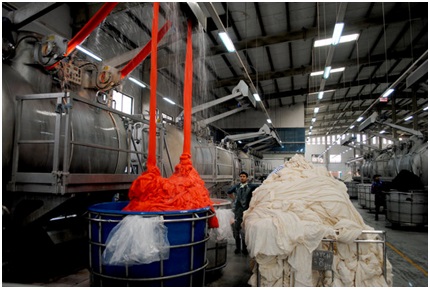
The textile and apparel sector is rapidly aligning with other manufacturing sectors to increase sustainability and decrease its carbon footprint. In a world full of colors, shades, hues and tints, fabric manufacturing that includes dyeing is not only one of the two main action points but also the single most polluting part of the entire textile manufacturing process, emitting a whopping 52 per cent of the sector’s carbon emissions.
Compared to extracting raw material or processing raw material to yarn that are responsible for 24 per cent and 15 per cent of carbon emission in the textile manufacturing process, the difference is just disproportionately large. Additionally, the dyeing and the subsequent washing process also consume 74 per cent of the water required in the manufacturing of textiles.
Dyeing it right
Headquartered in Hoofddorp, Netherlands, DyeCoo has more than 20 years of experience in carbon-dioxide technology. With extensive knowledge in design and engineering of Carbon-dioxide equipment, and factories in five different countries, DyeCoo provides clean textile processing solutions on an industrial scale. Its revolutionary Carbon-Dioxide Dyeing is a groundbreaking technology now being used globally to cut down water usage by half and carbon-emission by 90 per cent.
For the last 13 years textile manufacturers in the Netherlands, Taiwan and many other South East Asian textile hubs such as Vietnam and Indonesia. Nike, Adidas and Ikea are keen backers of this sustainability-forward process and prefer their vendors to use it for their products.
The DyeCoo process involves release of carbon-dioxide under high pressure, turning the gas into a gaseous liquid replacing water as the substrate to mix the dye and colour the fabric. Hence, its claim of zero water dyeing is indeed true. The process which involves stainless steel dyeing vat connected to a tank of carbon-dioxide with an adjustable pressure valve also has a built-in system that can recycle up to 95 per cent of the carbon-dioxide used for dyeing thereby making its claim of cutting down carbon-dioxide emission drastically is also true. However, it should be noted that water is used in the post-dyeing rinsing process as this is inevitable for now.
Other innovations in dyeing
Debs Corporation of Japan claims its patented process termed AirDry transfers dye from paper to fabric via a printer-like machine. This technology does not claim zero water usage – it only uses 95 per cent less water than standard processes and it saves up to 86 per cent of energy cost for the dyeing process, a true marvel in sustainability and cost-efficiency. British innovating start-up Alchemie Technology also lays claims to a process quite similar to that of AirDry. Swiss HeiQ Clean Tech states that its dyeing technology reduces the dyeing time of polyester with dispersed dyestuffs by 35 per cent, and is the best dyeing technology for polyester textiles.
Indian technology focused on waterless dyeing
Mumbai-based Deven Supercriticals has a patented technology Suprauno which claims to be completely water-free dyeing of any textile using legacy dyes and not limited to new technology-driven dyes that are currently expensive. Thanks to its realistic technology, Suprauno is being on-boarded by many Indian textile manufacturing units who are not interested in investing in expensive new-fangled colorants.
Many small enterprises in Tirupur are now showing interest in transferring from the traditionally used chemical dyes to bio-based dyes. Whilst the latter is more expensive and the process more time consuming, owners of small textile mills and dyeing units have felt the impact of chemical dyeing effluents polluting the town’s agricultural lands and water bodies and are making an effort to arrest the growing levels of toxicity in Tirupur.
Better Cotton champions traceability for sustainable fashion
Better Cotton, the world's largest cotton sustainability initiative, will play a pivotal role in the World Trade Organization's Public Forum by hosting a panel discussion on traceability within fashion and textile supply chains. The session, titled 'Traceability as the Key Enabler for Improving the Sustainability of Cotton Value Chains,' is scheduled for September 15th in Geneva, Switzerland.
Jacky Broomhead, Senior Traceability Manager at Better Cotton, will moderate the discussion, featuring experts like Maria Teresa Pisani from the UN's UNECE, Gregory Sampson from the ITC, Jeremy Thimm from GOTS, and Josh Taylor, also from Better Cotton. This panel will examine how traceability can enhance sustainability in cotton value chains, particularly in light of tightening diligence regulations, investor demands, and evolving consumer expectations.
Better Cotton's upcoming traceability solution, after two years of development, will provide supply chain visibility by tracking transactions between stakeholders. This technology will empower fashion retailers and brands to identify the origin of their cotton and the percentage of Better Cotton in their products.
Furthermore, traceability will strengthen the connection between farmers and supply chains, laying the groundwork for Better Cotton's Impact Marketplace, rewarding farmers for adopting sustainable practices.
Jacky Broomhead emphasized the need for collaboration to ensure that traceability benefits the entire textile industry and remains accessible and inclusive. The discussion at the Public Forum promises to shed light on the path toward more sustainable cotton supply chains.
Propper International enhances efficiency with Coats Digital's GSDCost solution
In a strategic move, Propper International Inc, a major supplier to the United States armed forces and other law enforcement markets, has teamed up with Coats Digital to implement the GSDCost solution. This innovative collaboration aims to revolutionize Propper's production operations by leveraging data-driven methodologies. The adoption of GSDCost promises to usher in a new era of streamlined efficiency, enhanced line balancing, and improved capacity planning processes for Propper International.
Propper International, known for manufacturing over 120 million garments for the U.S. Department of Defense and catering to a global workforce of 1,400, seeks to boost its manufacturing prowess further. The decision to adopt GSDCost stems from the need to replace time-consuming manual procedures with accurate, data-backed processes. The solution is projected to yield efficiency improvements ranging from 3% to 7% in its inaugural year.
Eric Marambio, Engineering Manager at Propper International Inc., expressed enthusiasm for the transformational potential of GSDCost. He highlighted structured sewing operation methods, achievable production goals, and accurate Standard Minute Values (SMV) calculations as some of the invaluable benefits the tool offers. The user-friendly interface and robust data sharing capabilities are expected to elevate Propper's product ranges quickly and successfully.
This collaboration aligns with Propper's goal to eliminate deficiencies in time, cost, and method analyses while ensuring efficient production management through real-time reporting. By reducing reliance on Excel spreadsheets, Propper aims to bridge the gap between planners and operators, thereby minimizing confusion, incorrect line balancing, and resource wastage.
Georgina Vazquez, Project Manager at Coats Digital, commended Propper's choice of GSDCost as a means to optimize production using scientifically proven methods. The implementation promises to enhance efficiency, ultimately positioning Propper International as a leader in the industry.
Coats Digital's GSDCost solution, based on the GSD methodology, is recognized as an international standard in the sewn products industry. It facilitates collaboration, transparency, and sustainability throughout the supply chain, allowing for accurate cost prediction and a more efficient garment manufacturing process. This strategic partnership exemplifies Propper International's commitment to excellence and growth in the market.
Santoni Shanghai Acquires Terrot to Build Circular Knitting Ecosystem
Santoni Shanghai Knitting Machinery Co., Ltd., a leading manufacturer of circular knitting machines, has acquired Terrot GmbH, a German company with a long history in the industry. The acquisition will help Santoni Shanghai to build a more integrated and scaled-up ecosystem for circular knitting machines.
The global circular knitting machine market is expected to grow significantly in the coming years, driven by the increasing demand for breathable and comfortable knitted fabrics. Santoni Shanghai believes that the acquisition of Terrot will help it to better seize this market opportunity.
Terrot is a well-respected company with a strong reputation for quality and innovation. Its products are used by leading textile manufacturers and brands all over the world. The acquisition will give Santoni Shanghai access to Terrot's technology and expertise, which will help it to develop new and innovative products.
The acquisition is also a strategic move by Santoni Shanghai to consolidate the circular knitting industry. The company believes that by combining its resources with Terrot's, it will be able to create a more efficient and competitive industry.
The acquisition is subject to regulatory approval. If approved, it is expected to close in the coming months.
In addition to the headline, here are some other key points from the text:
• The acquisition will help Santoni Shanghai to build a more integrated and scaled-up ecosystem for circular knitting machines.
• The global circular knitting machine market is expected to grow significantly in the coming years.
• Terrot is a well-respected company with a strong reputation for quality and innovation.
• The acquisition will give Santoni Shanghai access to Terrot's technology and expertise.
• The acquisition is a strategic move by Santoni Shanghai to consolidate the circular knitting industry.