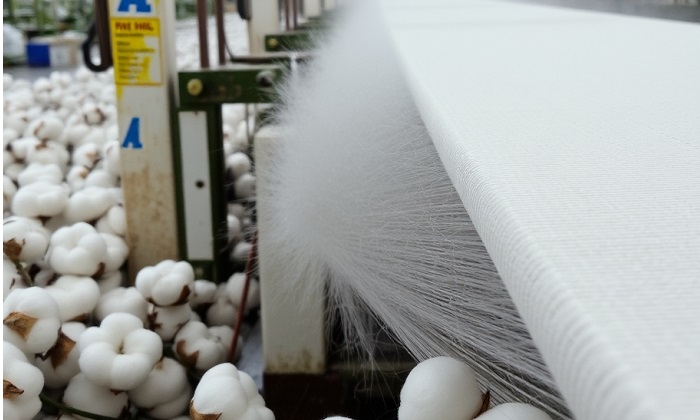
Argar Technology’s trump card while the ideating the production of HV (high visibility) fabrics was to manufacture new knitted fabrics to substitute 100 per cent polyester regularly used to achieve the chromatic specification fixed by EN20471 rules. Argar, double knitting technology was innovatively applied in the production of its high visibility HVis-Tes® Knitted Fabrics. In its new HVis-Tes® range of products the external face of fabric is now 100 per cent polyester, while the internal face is 100 per cent pure cotton.
According to the company, this peculiar interlacement guarantees at the same time the extraordinary features of durability and endurance of a polyester fabric and the comfort that only a cotton fabric is able to provide in touch with the skin. On customer’s request they are also available with antibacterial and UV-protection treatment (complying respectively with EN20645:2005 + EN20743:2007 and AS/NZS 4399:1996 norms).
The range of HVis-Tes® ESD Knitted Fabrics adds to the advantages of the high visibility items with the antistatic function given by conductive fibers. The features of HVis-Tes® ESD Knitted Fabrics fully comply with the specifications of EN20471, EN1149 and Oeko-Tex ® Standard 100 Class II Certifications rules.
Similarly, the features of Noflam®-HV Knitted Fabrics fully comply with the specifications of EN11612, EN20471 and Oeko-Tex ® Standard 100 Class II Certifications rules. The company guarantees knitted fabrics, which are fully manufactured and ennobled in Italy and mostly have European Preferential Origin. The few items of the standard collection which have no Preferential Origin Status can be manufactured with Preferential Origin upon Customer’s request.
- 1
- 2
- 3
- 4
- 5
- 6
- 7
- 8
- 9
- 10
Cotton markets hold firm as tariffs, higher supply reshape global fiber economic…
In a year marked by tariff escalations, geopolitical brinkmanship and a recalibration of global trade flows, the international cotton market... Read more
Beyond Cotton How Kapok could redefine sustainable insulation in textiles
In the lush, humid heart of Southeast Asian rainforests stands a giant, a silent sentinel of the forest canopy. Growing... Read more
Bharat Tex 2026: Redefining the global textile value chain
Union Minister of Textiles, Giriraj Singh, has officially unveiled Bharat Tex 2026, signaling a significant leap in India’s influence over... Read more
Intertextile Shanghai Spring 2026: A hub for global textile innovation
The textile industry’s pulse is quickening as Intertextile Shanghai Apparel Fabrics – Spring Edition prepares to open its doors from... Read more
Moscow Fashion Week 2026: Blending sustainable innovation with timeless glamour
Scheduled to run from March 14-19, 2026 in Moscow, Russia, the Moscow Fashion Week (MFW) is cementing its status as... Read more
The Store as Stage: How fashion is crafting immersive consumer worlds
The North American fashion retail sector in 2026 is shedding its product-first identity and shifting towards a model that values... Read more
Turning the supply chain upside down, on-demand production reshapes apparel
The global fashion industry, long celebrated for its creativity and scale, is facing a structural reckoning. For decades, retailers and... Read more
Intertex Milano 2026 - A global nexus for textile innovation
Intertex Milano is set to return this summer, confirming its status as a premier international destination for the textile and... Read more
Primark at crossroads as AB Foods weighs spin-off amid digital and Lefties press…
The long-standing supremacy of Europe’s budget fashion champion, Primark, is facing a test. As of February 2026, Associated British Foods... Read more
Vietnam, Bangladesh, Cambodia drive US apparel imports in 2025
The 2025 year-end data for the US apparel sector reveals an industry in structural flux. Despite aggressive tariff measures and... Read more