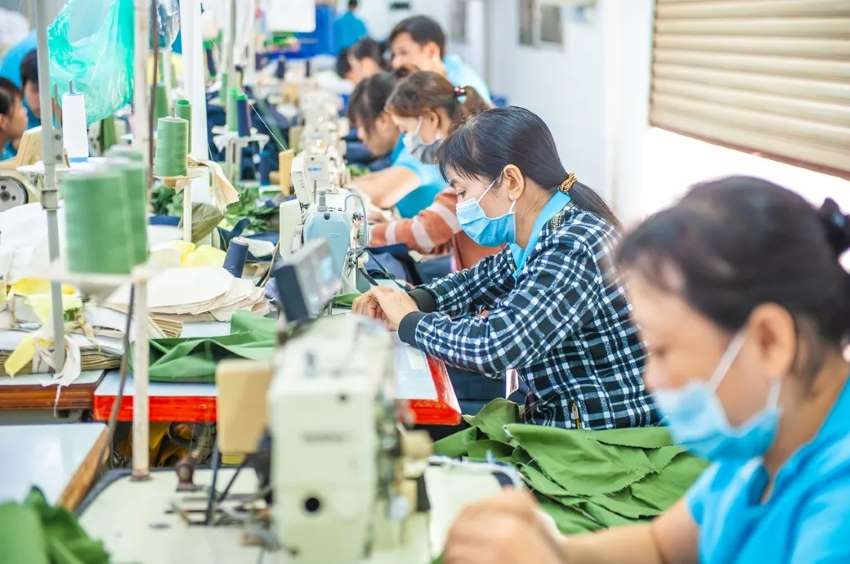
A campaigner for higher wages in Asia has urged global clothing brands to take responsibility for the millions of workers in the region who are poorly paid by suppliers and ignored by governments. Incidentally, Asia accounts for more than 60 per cent of the world's garment production, with the industry employing more than 15 million people directly, most of them women.
According to Anannya Bhattacharjee, Coordinator with the Asia Floor Wage Alliance (AFWA), a supply chain lobby group, workers deserve a living wage because the minimum wage set by most Asian countries is inadequate to keep them out of poverty. Meanwhile, higher wages in China, the world's largest clothing exporter, are driving brands worldwide to seek cheaper alternatives in countries such as Bangladesh, India, Pakistan and Sri Lanka. Suppliers in these countries are under enormous pressure to reduce costs and produce garments as quickly as possible.
Wages in the garment industry are ‘structurally failing’ to meet workers' basic needs, leading to excessive overtime, ill health and workers being forced to live apart from their families, according to the Clean Clothes Campaign, which is a member of AFWA.
- 1
- 2
- 3
- 4
- 5
- 6
- 7
- 8
- 9
- 10
Intertextile Shanghai Spring 2026: A hub for global textile innovation
The textile industry’s pulse is quickening as Intertextile Shanghai Apparel Fabrics – Spring Edition prepares to open its doors from... Read more
Moscow Fashion Week 2026: Blending sustainable innovation with timeless glamour
Scheduled to run from March 14-19, 2026 in Moscow, Russia, the Moscow Fashion Week (MFW) is cementing its status as... Read more
The Store as Stage: How fashion is crafting immersive consumer worlds
The North American fashion retail sector in 2026 is shedding its product-first identity and shifting towards a model that values... Read more
Turning the supply chain upside down, on-demand production reshapes apparel
The global fashion industry, long celebrated for its creativity and scale, is facing a structural reckoning. For decades, retailers and... Read more
Intertex Milano 2026 - A global nexus for textile innovation
Intertex Milano is set to return this summer, confirming its status as a premier international destination for the textile and... Read more
Primark at crossroads as AB Foods weighs spin-off amid digital and Lefties press…
The long-standing supremacy of Europe’s budget fashion champion, Primark, is facing a test. As of February 2026, Associated British Foods... Read more
Vietnam, Bangladesh, Cambodia drive US apparel imports in 2025
The 2025 year-end data for the US apparel sector reveals an industry in structural flux. Despite aggressive tariff measures and... Read more
The New Dress Code: Sportswear’s takeover of modern wardrobes
For much of the last decade, fashion retail has been defined by volatility. Trends have shortened, discount cycles have intensified... Read more
Hemp finds its moment in India’s $500 billion American trade calculus
In the grand arithmetic of India’s expanding trade engagement with the US, the headlines usually gravitate toward oil cargoes, aircraft... Read more
EU PET spunbond imports under scrutiny, misclassification sparks regulatory and …
The European nonwovens and technical textiles sector is facing an unprecedented compliance crisis as a rise of customs misclassification threatens... Read more