European sustainability regulation is beginning to alter the commercial pattern of the global textile and apparel industry, pushing brands closer to fibre producers, recyclers, spinners and material innovators. The shift is getting a boost from the European Union’s Ecodesign for Sustainable Products Regulation (ESPR) and Digital Product Passport (DPP) framework, which are raising the importance of traceability, material provenance, recycled content and product-level sustainability data.
For decades, apparel sourcing largely operated through fragmented, transaction-driven networks. Fibre producers, spinners, fabric mills and garment manufacturers often worked independently, with brands buying finished fabrics or garments without visibility into every upstream input. That model is difficult to sustain when buyers must showcase where materials originated, how they were processed and what substances they contain.
The commercial opportunity is substantial. Global Market Insights estimates that the textile-to-textile recycling market was valued at about $4.8 billion in 2025 and could reach $44.8 billion by 2034, representing a 24.9 per cent CAGR.
From fragmented chains to integrated networks
Circularity is forcing a change in how textile companies structure procurement. Instead of relying predominantly on spot-market purchases, brands are increasingly seeking long-term relationships with recyclers and upstream manufacturers capable of providing consistent recycled feedstock and auditable material data.
This is particularly important for next-generation recycling technologies, which require substantial investment before reaching commercial scale. Long-term offtake agreements can give recycling companies greater revenue visibility while giving brands access to dedicated supplies of recycled fibres. Inditex, for instance, has committed to commercial-scale purchases of recycled lyocell and blended yarns linked to Circ and Lenzing. Birla Cellulose has also entered a long-term supply arrangement with Circulose to convert discarded textile pulp into viscose filament and staple yarns. Such agreements indicate a broader transition: sustainability is moving from a procurement preference to a supply-security consideration.
|
Category |
Baseline (pre-2024) |
Market status (2025-26) |
Long-term 0rojection (2030-34) |
|
Recycled Fiber Source Share |
>90% PET Beverage Bottles |
Transition to Post-Consumer Textile Feedstock |
Predominantly Fiber-to-Fiber Depolymerization |
|
T2T Market Valuation |
$2.8 bn (2024) |
$4.8-5.1 bn |
$44.8 bn (2034) |
|
EU Regulatory Status |
Voluntary ESG Reporting |
Mandatory ESPR In-Force; DPP Frameworks Active |
Full DPP Enforcement & Landfill/Incineration Bans |
|
Dominant Recycling Method |
Mechanical Shredding (Downcycling) |
Hybrid (Mechanical + Industrial Pilot Chemical) |
Scaled Chemical, Solvent & Enzymatic Dissolution |
|
Procurement Structure |
Transactional Tier-by-Tier Spot Buys |
3- to 5-Year Direct Offtake Agreements |
Vertically Integrated Closed-Loop Sourcing Hubs |
Mills invest upstream
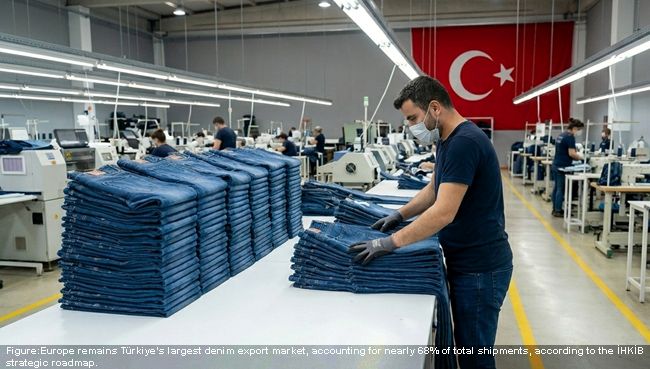
The transformation is also reaching spinning and weaving operations. Manufacturers in major textile-producing countries like India, Turkey and Portugal are adapting carding systems, automated fibre-blending equipment and spinning machinery to handle regenerated fibres, which can have shorter staple lengths and different processing characteristics from virgin materials.
The objective is not simply to increase recycled content, but to maintain yarn strength, consistency and commercial quality while ensuring the recycled material can be traced back to its source. This creates a stronger business case for direct technical collaboration between brands and mills. Product specifications can increasingly be established before production rather than after fabric procurement. The result is a move away from conventional order-by-order sourcing towards coordinated material development, testing and production.
Blends remain the biggest obstacle
The industry's circularity ambitions, however, face a major technical constraint: textile waste is rarely made from a single material. Poly-cotton fabrics, elastane-containing garments, coatings, dyes and chemical finishes complicate automated sorting and fibre recovery. Collection systems also remain fragmented, limiting the amount of usable feedstock reaching recycling facilities.
McKinsey research has indicated that Europe could theoretically recycle a substantial share of its textile waste into new fibres over the long term, but current infrastructure captures and processes only a fraction of that potential.
Mechanical recycling creates another limitation. Shredding can shorten cotton fibres, reducing the quality and count of yarn that can be produced. As a result, mechanically recycled cotton often needs to be blended with virgin material to achieve commercially acceptable performance. Chemical recycling offers a different route. Technologies based on dissolution, glycolysis and hydrothermal processes can potentially separate materials or recover molecules closer to virgin-equivalent quality.
Sorting becomes strategic infrastructure
As recycling moves towards scale, sorting technology is becoming as important as recycling technology. Textile manufacturers are exploring optical and near-infrared sorting systems, automated material identification and closed-loop recovery of pre-consumer cutting waste. Bringing sorting, fibre preparation, spinning and fabric manufacturing closer together can reduce contamination and improve control over feedstock.
This vertical integration could eventually create new competitive advantages for textile manufacturers. Companies able to guarantee material purity, recycled content and traceability may become preferred suppliers for brands facing increasingly detailed regulatory requirements.
Lenzing’s new model shows the way
Lenzing AG is an important example of how fibre innovation is becoming embedded in the broader circular economy. The Austrian producer of Tencel and Ecovero fibres has developed Refibra technology, which incorporates textile waste pulp into new cellulosic fibres. The model links waste recovery directly with commercial fibre production rather than treating recycling as a separate downstream activity. The implication extends beyond individual technologies. As regulation increases the value of traceable materials, fibre companies, recyclers, spinners and fashion brands have stronger incentives to coordinate their operations.
End of anonymous sourcing
The emerging textile economy is therefore moving from a chain of independent transactions towards a connected material ecosystem. For brands, this means greater involvement in upstream material development. For spinners and fabric manufacturers, it means investing in traceability, sorting and recycling-compatible production systems. For recyclers, long-term brand commitments can provide the financial certainty needed to scale capital-intensive technologies.
The competitive advantage may ultimately belong to companies that can combine circular feedstock with reliable quality, transparent provenance and scalable production. EU regulation is not eliminating textile supply chains. It is changing who controls them and making upstream integration central to the business of global apparel sourcing.