The global denim fabric trade may appear remarkably stable at around €3.9 billion, but beneath this number the market is passing a structural shift. Data from ExportPlanning shows that conventional pure-cotton denim under HS 520942 has declined at a compound annual rate of 0.3 per cent since 2009. In contrast, blended denim fabrics classified under HS 521142 have grown at 8.8 per cent CAGR over the same period. This signals more than a change in fabric composition. It points to a broader reconfiguration of how global fashion companies design products, source fabrics and manage inventory.
Consumers in North America and Europe expect denim to combine comfort, stretch, lighter construction and shape retention with the visual characteristics of traditional indigo fabric. That is pushing brands towards cotton-elastane, recycled polyester and other man-made fibre combinations. For denim mills, sale in conventional cotton production is no longer enough to protect margins. Investment in blending, finishing, stretch construction and higher-value fabric development is becoming increasingly important.
Asian scale meets price deflation
Asia continues to dominate the global denim export map. China accounted for about 43.2 per cent of global denim fabric exports in 2025, with shipments worth €1.75 billion. Pakistan followed at €533 million and India at €374 million. Yet the latest trade figures expose a growing decline in the traditional volume-led model.
During January-April 2026, China's denim export volume increased 5 per cent, while export value fell 9.2 per cent year on year. Pakistan experienced a similar pattern: volume rose 3.8 per cent, but value declined 9.8 per cent. India's volumes increased 3 per cent, even as export value dropped 9 per cent.
Table: Denim export trade performance
|
Country |
Fabric exports 2025 |
2022-25 value CAGR |
Jan-Apr 2026 value YoY |
Jan-Apr 2026 volume YoY |
|
China |
€1.75 bn |
-4.90% |
-9.20% |
+5.0% |
|
Pakistan |
€533 mn |
-3.80% |
-9.80% |
+3.8% |
|
India |
€374 mn |
-7.50% |
-9.00% |
+3.0% |
|
Turkey |
€298 mn |
-0.50% |
+9.6% |
+14.5% |
|
Italy |
€68 mn |
-15.40% |
-12.00% |
-11.10% |
|
Japan |
€59 mn |
-7.20% |
-20.60% |
-17.30% |
The gap between volume and value is an important indicator. Mills are shipping more fabric but receiving less revenue, suggesting that overcapacity in standard constructions, weaker apparel demand and aggressive price competition are eroding unit realizations. For producers dependent on conventional cotton denim, this creates a difficult equation: maintaining capacity utilization increasingly requires accepting lower prices.
Turkey proximity an advantage
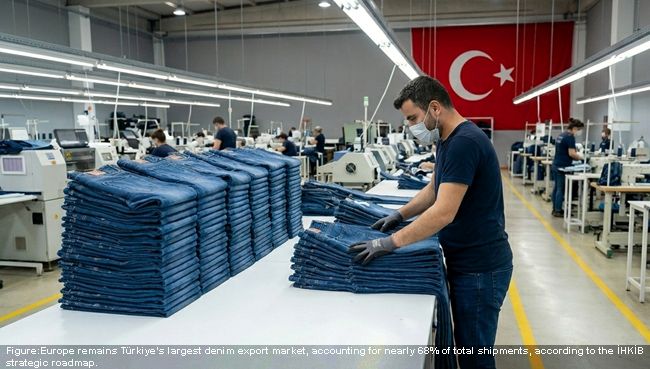
Turkey is moving in the opposite direction. Its denim fabric exports were worth €298 million in 2025, but during the first four months of 2026 export value increased 9.6 per cent, while volume jumped 14.5 per cent. That performance sets it apart from the major Asian exporters. The explanation lies partly in geography.
European retailers are reassessing sourcing strategies after years of prioritising the lowest possible FOB price. Longer shipping routes now carry greater risks, from freight volatility and geopolitical disruptions to inventory obsolescence. Turkey's proximity to European markets allows brands to shorten replenishment cycles and respond more quickly to changing demand. Its integrated textile ecosystem also enables it to import semi-finished fabrics and convert them into higher-value finished products.
In 2025, Turkey imported about €81 million of relevant fabric while maintaining a much larger export position. This dual role strengthens its position as a regional processing and sourcing hub rather than simply a low-cost manufacturing base.
The shift reflects a broader change in fashion economics: speed is now being treated as a source of margin protection.
Premium mills face a different problem
Italy and Japan showcase the other side of the market transition. Italian denim fabric exports fell 15.4 per cent between 2022 and 2025 and declined another 12 per cent in value during January-April 2026. Japan suffered an even sharper 20.6 per cent decline during the same period. These producers cannot easily compete with Asian mills through price cuts without damaging the premium positioning that supports their business models. As a result, declining volumes translate more directly into declining revenue.
The pressure is particularly acute for heritage pure-cotton and rigid denim. Brands seeking lower costs, greater comfort and faster product rotation have more alternatives than they did a decade ago. That does not mean premium denim is disappearing. Instead, the market is becoming more segmented. High-end mills will need to justify price premiums through design, craftsmanship, traceability, technical performance or sustainability rather than relying solely on fabric heritage.
The new sourcing equation
The rise of synthetic blends and the shift towards nearshoring are ultimately connected. A fabric that costs more per metre can still reduce the total cost of a fashion programme if it enables faster replenishment and reduces unsold inventory. A European denim retailer, for example, could replace a portion of heavyweight cotton sourcing from southern China with cotton-elastane and recycled-polyester fabrics from Turkey. Even with a higher fabric price, shorter lead times could enable the retailer to respond more closely to actual store demand.
In the case outlined by ExportPlanning, shifting 40 per cent of procurement to Turkish mills reduced production lead times from 12 weeks to 18 days. Although the fabric cost was 6 per cent higher per linear metre, improved inventory alignment reduced end-of-season markdowns by 14 per cent.
The lesson is important for the entire apparel supply chain. The cheapest fabric is not necessarily the lowest-cost sourcing option when inventory, freight, markdowns and lost sales are included.
India faces a choice
For India, the trade data is both a warning and an opportunity. The country remains one of the world's largest denim fabric exporters, but its 9 per cent value decline in early 2026 alongside volume growth mirrors the margin pressure affecting China and Pakistan. Indian mills therefore face the pressure to move beyond commodity denim. Investments in stretch fabrics, recycled fibres, functional finishes, lightweight constructions and faster production cycles could help protect export value.
At the same time, India's large domestic apparel market offers mills an opportunity to build demand for higher-value denim locally while strengthening export capabilities.
The global denim market is consequently entering a new competitive phase. Cotton is not disappearing, Asia is not losing its manufacturing relevance, and Turkey is not replacing China. Instead, the basis of competition is changing. The next phase of denim trade will be shaped by a combination of fabric performance, sourcing proximity, inventory speed and total supply-chain economics. Mills that continue competing primarily on volume and price risk being trapped in a market where shipments rise but revenues fall. Those that combine technical fabric innovation with geographic flexibility are better positioned to capture the value emerging from the industry's structural reset.