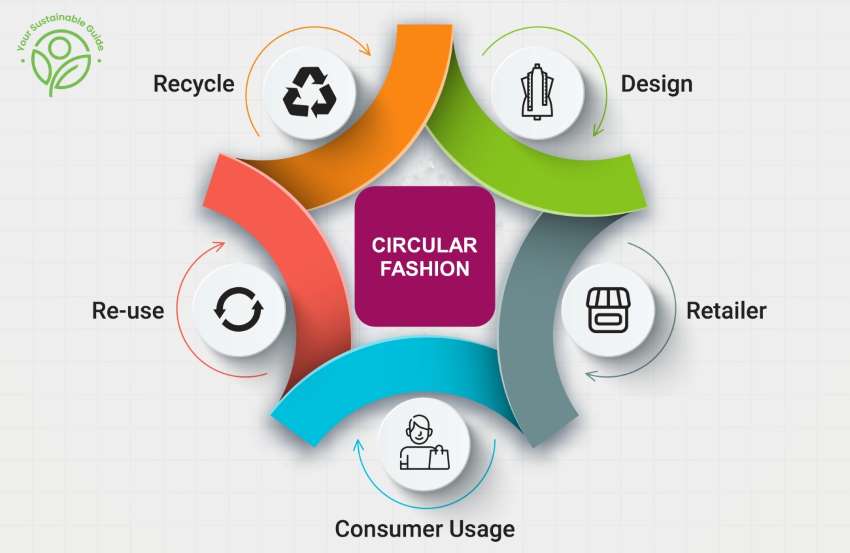
The US alone generates an estimated 24 billion pounds of post-consumer textile waste (PCTW) — the equivalent of about 70 pounds of textiles per person, which ends up in landfills each year according to the Environmental Protection Agency. Major apparel brands such as H&M and The North Face are working to help minimize textile waste through take-back programs, campaigns and collections made from recycled fabrics, while enterprising startups and even the European Union are creating circular processes and economic models.
The solutions presented by the five winners of the first-ever , a €1 million challenge for early-stage innovation in the fashion industry adds to the list of ideas. Introduced in August by the non-profit H&M Conscious Foundation, the goal of the Award is to catalyze bold, pioneering ideas to help protect the planet by closing the loop for fashion.
The first five winning ideas range from creating new textiles out of citrus juice by-products and an online marketplace for recycling of textile leftovers to using microbes to recycle waste polyester. Now, the global public is asked to allocate the €1 million grant between the winners in an online vote this week.
Over 2,700 innovators from 112 countries shared their ideas to help close the loop for fashion. The winning innovations are important contributions in the journey towards a circular fashion industry. Now, the foundation has invited the public to use their voice and influence how much funding each idea should get, said H&M CEO Karl-Johan Persson, also a board member of the H&M Conscious Foundation.
Public votes for their favorite innovations will determine distribution of the €1,000,000 grant. The idea that gets the most votes receives €300,000, second most votes receives €250,000 and third, fourth and fifth most votes receive €150,000 each. Everyone can vote atglobalchangeaward.com, February 1-7. The voting result and the people behind the winning innovations will be revealed at a grand award ceremony in Stockholm, February 10, and on globalchangeaward.com on February 11.

- 1
- 2
- 3
- 4
- 5
- 6
- 7
- 8
- 9
- 10
Trade pacts, integrated manufacturing power India’s textile export ambitions
Global apparel sourcing is entering a new phase in which resilience, compliance and manufacturing depth matter as much as cost... Read more
Next-gen digital Indigo systems redefine textile manufacturing economics
The global textile sector is experiencing a structural shift as industrial-scale digital dyeing technologies replace traditional indigo vats in major... Read more
Fashion retail’s physical comeback, stores become experience hubs
Online shopping has permanently altered fashion consumption, making convenience, algorithmic recommendations, endless assortment and doorstep delivery standard expectations. Yet the... Read more
India reworks apparel export strategy as US tariffs squeeze margins
As tariff volatility, shorter retail buying cycles and aggressive price negotiations in the US expose weaknesses in the country’s traditional... Read more
MIT’s recyclable yarn could disrupt spandex’s grip on fashion
Stretch has become essential to modern fashion. Activewear, denim, underwear and athleisure all depend heavily on elastic fibres such as... Read more
Speed, synthetics and trade pacts propel Vietnam past Bangladesh
Vietnam has overtaken Bangladesh to become the world's second-largest exporter of ready-made garments (RMG), marking more than a symbolic change... Read more
The €2,150 Question: Can Europe afford circular fashion at scale?
Europe's push to build a circular textile economy is facing an uncomfortable commercial truth. The technology capable of producing virgin-quality... Read more
From cotton peaks to polyester pressures, textile supply chains face a reset
The assumption that textile supply chains can absorb periodic swings in cotton prices has become untenable. During the first seven... Read more
Global sourcing reset exposes India’s apparel competitiveness gap
The assumption that global apparel sourcing would naturally shift from China to India is proving increasingly misplaced. Fresh trade data... Read more
The new fashion equation, quality, agility and value replace speed and discounts
The traditional order that once separated low-cost fast fashion from premium luxury is steadily breaking down as consumers become more... Read more