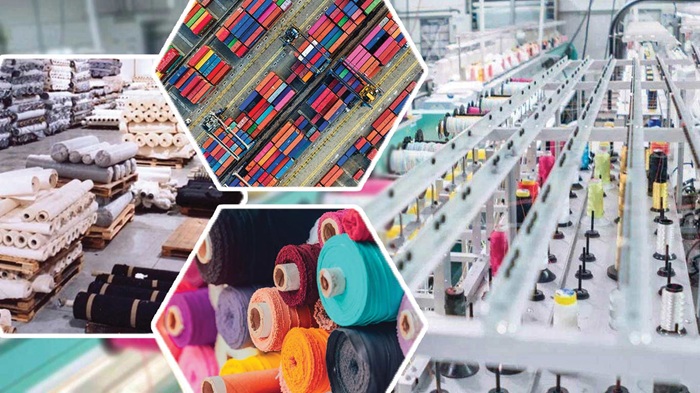
Vietnam and China are collaborating in the textile and garment sector. China and Vietnam hold a pivotal position in the global textile market. Industries in the two countries are highly complementary. China is the world’s biggest exporter and Vietnam is the second biggest. Vietnam is taking a path similar to China’s, both having communist leaders who turned toward export-led market capitalism in recent decades, and in terms of selling ever more footwear, clothes and bags to the world. Their industries compete for customers but they are also complementary in that Chinese factories supply much of the fabrics and other inputs needed in the business, while Vietnamese factory hands are increasingly supplying the labor as costs rise in China. Textile firms on both sides of the border are working together to turn a profit.
Amid the trade war with the United States, China has lost some of its business to Vietnam. On the other hand, it is not just foreign third parties moving factories from China to Vietnam. Chinese investors themselves deem it beneficial to relocate some of their supply chain to Vietnam. However Vietnam does not have as large and complex a network of textile suppliers and processors as China does. That is one reason the smaller country relies on the larger one as its biggest source of imported goods overall.
- 1
- 2
- 3
- 4
- 5
- 6
- 7
- 8
- 9
- 10
Beyond the DTC Rush: Levi’s hybrid channel strategy sets a new retail benchmark
The global apparel sector is entering a phase where channel strategy is no longer a tactical lever but a core... Read more
The New Rules of Resale: EPR turning secondhand into fashion’s strategic growth …
The global fashion industry is facing a decisive regulatory and commercial reset. What began as a sustainability narrative around reuse... Read more
The 2027 Mandate: Why denim’s future hinges on verifiable data
For decades, the global denim industry has relied on a narrative of durability, heritage, and authenticity. That narrative is now... Read more
Europe’s textile core unravels as costs, imports and policy pressure bite
Europe’s textile and apparel sector, long seen as a benchmark for craftsmanship and industrial depth, is slipping into a prolonged... Read more
Automation, innovation, regulation are the forces shaping textiles in 2026
The global textile sector has entered a new era. Early 2026 saw the industry breach a $1.06 trillion valuation, reflecting... Read more
The new Brussels rulebook, every EU apparel order is now a balance-sheet risk
The humble export order sheet is undergoing a transformation. What was once a straightforward commercial instrument: SKU, volume, FOB price,... Read more
Why 2026-27 could be a defining cotton year for India’s farm-to-fashion economy
The global cotton economy is entering a more constrained phase, and for India, the implications run far beyond the farm... Read more
Luxury resale’s next big battle is no longer digital, it is about who controls s…
For nearly a decade, the luxury resale story was written in the language of platforms. Market leadership was measured by... Read more
Digital Arms Race: Indian apparel giants deploy AI to neutralize tariff crisis
The Indian textile and apparel sector is in a digital survival phase in 2026, shifting from traditional labor-intensive models to... Read more
Europe’s Textile Endgame: Why Project FAE is becoming fashion’s most critical in…
Europe’s apparel majors are no longer treating circularity as a branding layer. With Project FAE or Feedstock Activation Europe, the... Read more