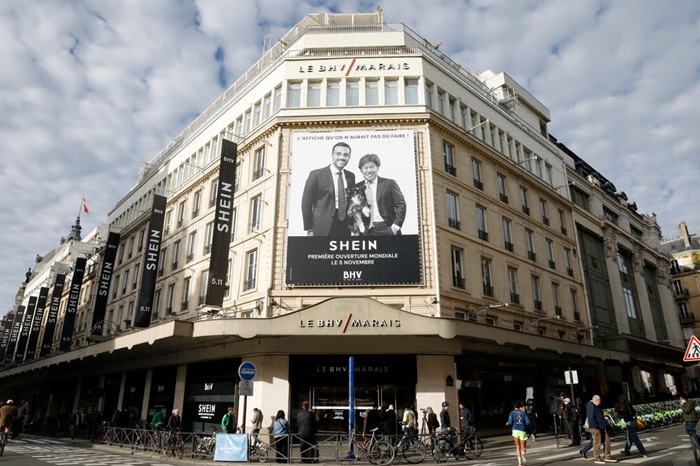
When Shein finally planted a permanent retail flag in Paris, the move looked symbolic as much as strategic. The company that perfected algorithmic fashion churning out thousands of new designs daily and delivering €5 impulse buys to smartphones across Europe chose to debut its first enduring brick-and-mortar presence inside BHV Marais, one of the city’s most storied department stores.
On paper, the partnership promised a neat coming together of: digital scale meets heritage retail. In practice, it has turned into something closer to a stress test, of pricing, regulation, culture and the basic economics of fast fashion when removed from the frictionless world of apps and warehouses. The experiment reveals a blunt truth: what thrives in the infinite aisle of e-commerce does not automatically translate to the finite realities of physical retail.
Europe’s silent digital takeover
Long before it ever rented shelf space in central Paris, Shein had already embedded itself into everyday wardrobes across the continent. Its growth was not loud or brand-driven in the traditional sense. It was mathematical, powered by search algorithms, micro-trend detection and relentless price compression. By mid-2025, the company’s monthly active users in the EU rivalled those of legacy fashion groups built over decades.
Table: Shein’s top EU markets by monthly users (2025)
|
Country |
Monthly Users (mn) |
Economic impact/role |
Market insight |
|
France |
27.8 |
€5.2 bn economic output |
Highest cultural influence; strong resistance to non-local trends. |
|
Spain |
25.8 |
€3.0 bn economic output |
Heavy engagement; world leader in TikTok traffic per capita. |
|
Italy |
23.9 |
€3.6 bn economic output |
Strongest growth in Gen Z and Gen Alpha demographics. |
|
Germany |
25.7 |
€7.2 bn economic output |
Revenue powerhouse; highest GDP contribution in the EU. |
|
Poland |
8.8 |
€920 mn economic output |
Critical logistics and e-commerce hub for Eastern Europe. |
Source: CedCommerce / AWISEE Report 2025 The table illustrates two critical dynamics. First, France is both opportunity and contradiction: Shein’s largest audience, yet also the most sceptical. The country that built luxury maisons and artisanal craft traditions is now the platform’s single biggest user base. Second, scale clusters around digitally mature, youth-heavy markets. Spain and Italy show engagement intensity, while Germany delivers monetisation. Poland’s role as a logistics hub hints at the operational backbone enabling 10-day delivery promises.
This user growth also translated into sheer physical movement of goods. Low-value e-commerce parcels entering the EU jumped 26 per cent to 5.8 billion shipments in 2025, with Shein and rival platforms driving much of the increase. In effect, Europe’s postal system became an extension of Shein’s warehouse.
From infinite scroll to finite shelf
Yet what works when a consumer scrolls through 7,200 new listings a day becomes complicated when confronted with racks, mirrors and rent. The BHV corner in Paris initially felt like a novelty. Shoppers queued out of curiosity. TikTok creators filmed IRL Shein hauls. Footfall looked promising. Conversion, however, told a different story.
Table: Shein’s Paris store reality (late 2025, early 2026)
|
Metric |
November 2025 (Launch/BFCM) |
January 2026 (Current) |
Variance / Trend |
|
Daily Sales Revenue |
€50,000 (Peak spikes) |
€2,000 - €5,000 (Steady state) |
↓ 90% (Normalization) |
|
Operating Cash Registers |
7 Active (Pop-up/Event focus) |
1 Active (Long-term anchor) |
Consolidation to 1 unit |
|
Average Item Price |
€9 (Entry-level impulse) |
€30 - €45 (Mid-tier/Premium) |
↑ 300% (Intent-driven) |
|
Public Sentiment |
Curious / Experimental |
58% Negative Perception (FR) |
Shift to prudence/pragmatism |
|
Seller Commission |
5% (Incentive rate) |
9% (Standardized rate) |
Platform maturation |
Source: Institut Français de la Mode / Industry Reports The data captures the arc of enthusiasm turning into hesitation. Revenue fell by over 90 per cent within weeks. Seven cash registers were reduced to one. Most tellingly, the price delta widened dramatically. A €9 online item ballooned to €30-€45 in-store once rent, staffing and inventory risks were added. That gap erodes Shein’s core promise: hyper-affordability.
Digital shoppers forgive thin fabrics or inconsistent sizing when the price feels negligible. Inside a physical store, expectations change. At €40 for jeans, comparisons shift to Zara, H&M or Uniqlo. The psychological advantage disappears. The paradox becomes clear: Shein’s strength ultra-low cost through centralised logistics and direct shipping is exactly what a store undermines.
When policy overtakes platform speed
If operational friction weren’t enough, timing compounded the challenge. Just as Shein opened its doors, France tightened the screws on ultra-fast fashion with one of the toughest regulatory frameworks in Europe. New measures include:
• An eco-tax starting at €5 per item, rising to €10 by 2030
• A sweeping advertising ban targeting ultra-fast fashion promotions and influencer marketing
• Heightened scrutiny of product safety and sustainability claims
• At the continental level, the pressure intensified further. On February 17, 2026, the European Commission launched formal proceedings under the Digital Services Act, examining allegations of addictive design features and the sale of non-compliant products. For a company built on constant nudges, flash drops and gamified shopping behaviour, such oversight strikes at the heart of its growth engine. The store in Paris, therefore, isn’t just a retail experiment. It has become a regulatory lightning rod.
The true price of the €9 outfit
Behind the policy debate lies a deeper tension: affordability versus accountability. French shoppers spend an average of €9 per Shein item, a price point almost impossible for traditional retailers to match while maintaining European labour and sourcing standards. During an inflationary cycle, that difference matters.
But the environmental bill is harder to ignore. Shein’s reliance on air freight to meet rapid production-to-door cycles has pushed emissions sharply upward reportedly rivalling the annual footprint of countries such as Lebanon. Consumers feel the contradiction. Surveys show a majority want sustainable wardrobes, yet budget realities dictate otherwise. The Paris storefront captures this divide in real time: teenagers queuing for bargains on one side of the street; protesters holding placards reading ‘Shein C’est Non’ on the other. It’s not merely a brand clash, it’s a generational and economic fault line.
The broader question now confronting Shein is structural: can an ultra-fast, digitally native supply chain coexist with the slower economics of physical retail?
Traditional stores demand: higher margins, curated assortments, predictable inventory and brand storytelling. Shein’s model thrives on: endless assortment, ultra-low margins, rapid testing, disposable consumption
These systems operate on opposing logics. The BHV partnership shows that footfall alone doesn’t guarantee success. Without a compelling price advantage or elevated brand value, the physical format becomes a liability rather than an amplifier.
More than a store, a signal
Seen narrowly, the Paris venture looks like an underperforming pilot. Seen broadly, it’s a bellwether for the future of global fast fashion. If the most digitally dominant player struggles to convert clicks into bricks in the fashion capital of Europe, it suggests the limits of platform power in heavily regulated, culturally sensitive markets.
Shein’s Paris presence was meant to legitimise the brand. Instead, it has exposed the friction between speed and sustainability, scale and scrutiny, affordability and accountability. For now, the cash registers sit mostly idle, a quiet reminder that the economics of the internet don’t always survive contact with the real world.