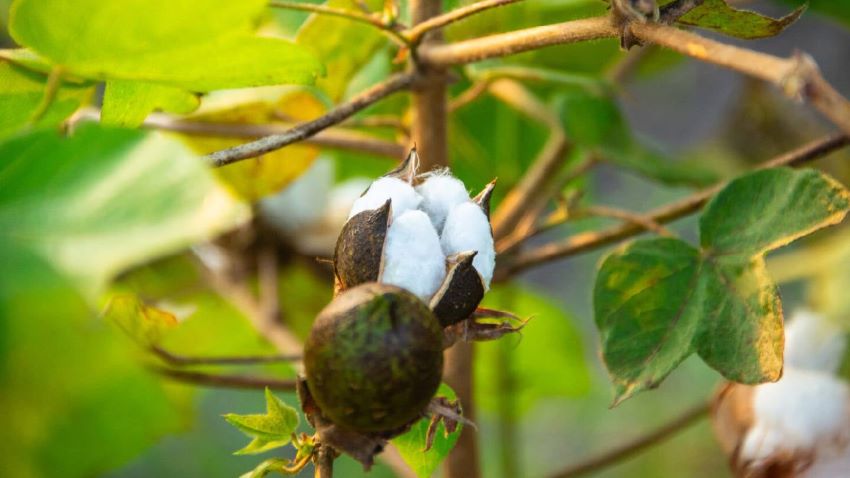
Telengana will discourage cultivation of cotton from this year. Reason: fears that the cotton prices in the international market will come down and Telengana farmers may suffer. Cotton cultivation area will be reduced from the present 42 lakh acres to 15 to 20 lakh acres.
The decision is to discourage cultivation of cotton and encourage crops like soybean and maize. Arrangements will be made for sufficient seed of soybean and maize. Irrespective of cultivation area, soybean seed subsidy will be extended to all farmers. Earlier the subsidy on seeds was given only to farmers having five acres. Implements needed to sow soybean seeds would also be given to farmers on subsidy.
The World Trade Organisation passed a resolution on cotton exports in a recent meeting at Nairobi to which India was a signatory. India will remove export subsidies on cotton exports from next January. Though the Union Ministry of Commerce and Industry clarified that the Nairobi ministerial decision on elimination of export subsidies on cotton will, in fact, be good for Indian exports, as it will create a level playing field for farmers, Telengana fears cotton prices in the international market will come down.

- 1
- 2
- 3
- 4
- 5
- 6
- 7
- 8
- 9
- 10
From gym to boardroom performance fabrics are redefining apparel demand
The global apparel industry has entered a new phase of evolution as the distinction between sportswear and everyday fashion continues... Read more
Digital Dominance Redefined: Zara moves past H&M in $100 bn fast fashion bat…
The global fast-fashion sector has reached a inflection point in 2026 where the battleground is no longer only store shelves... Read more
Spykar accelerates offline expansion: plans 100 new stores across India
A titan of the Indian denim-first fashion scene, Spykar has officially unveiled an aggressive retail growth strategy. As consumer demand... Read more
The Inventory Illusion: Rethinking the Zara benchmark in a volatile retail era
For over a decade, the global fashion industry has treated the Zara playbook as the gold standard of inventory efficiency.... Read more
Retail Without Retail: How Walmart’s depot network is turning space into logisti…
Walmart is fundamentally rewriting the commercial real estate and retail logistics playbook with the rise of its ‘Walmart Depots’ a... Read more
Global textile regulation tightens, forcing realignment across fashion supply ch…
Global fashion and consumer goods supply chains are entering a decisive regulatory transition as Extended Producer Responsibility (EPR) frameworks for... Read more
Luxury’s new power axis, US dominance, China reset, Gulf surge
As the post-China luxury order takes shape, the US is emerging as the industry’s most dependable growth engine, while Japan,... Read more
India’s $9 Billion Landfill Blind Spot How trashed clothes hold the key to globa…
A massive economic windfall is sitting uncollected in India’s landfills, and the key to unlocking it lies in rethinking how... Read more
Red Sea crisis reshapes textile trade routes, challenges India’s export margins,…
Global apparel trade is now in a new operational phase where geopolitical stability and logistics reliability are as important as... Read more
EU’s textile waste rules enter enforcement phase, raising alarms across fashion …
Europe’s apparel and textile industry is approaching one of its most significant regulatory transitions in decades. As the European Union... Read more