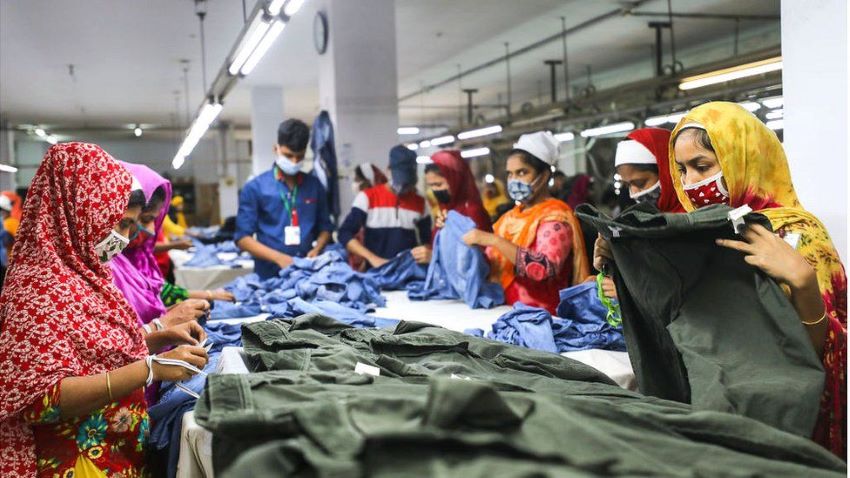
The US sanctions have given Iran a rare opportunity to revive its textile and clothing industry. There is a big opportunity for existing textile and apparel plants to expand and for new entrants to set up shop. In addition the Iranian currency’s depreciation has provided an additional boon by cutting imports and smuggling, which are the nagging problem of the industry. Smuggled clothing costs Iran and its apparel producers heavily in lost revenues.
Textile and clothing accounted for 20 per cent of Iran’s economy in 1991. By 2009, this share dropped to three per cent. For more than 100 years until the early 1990s, the textile industry remained one of the largest sources of employment within Iran’s non-petroleum sector. The first industrialized textile factories were established in the 19th century during the Safavid dynasty. Despite remaining a cottage industry, textile production continued to play an important role in the economy. The industry consists of companies engaged in spinning, weaving, knitting, dyeing, and printing, and of finishing plants that process yarns from natural and synthetic fibers to produce a variety of woven and knitted fabrics. The major textile items are blankets, machine-made carpets, handmade carpets, serge, as well as fabrics and garments.
- 1
- 2
- 3
- 4
- 5
- 6
- 7
- 8
- 9
- 10
The £7 Billion Question: Who pays for fashion’s ‘free rental’ habit?
The global fashion industry is facing an uncomfortable paradox: its most valuable customers may also be its most destructive. A... Read more
India, China Bangladesh face fresh headwinds as global apparel markets rebalance
Global apparel trade is entering a more uneven recovery phase, with demand growth persisting but losing uniform momentum across major... Read more
Global cotton enters a deficit year in 2026 as supply drop meets logistics risk
The global cotton economy has entered a fragile and sensitive phase. Early projections for the 2026-27 season suggest that world... Read more
India’s textile trade gets a Pacific push as New Zealand FTA removes tariff barr…
India and New Zealand have inked a ‘once-in-a-generation’ Free Trade Agreement (FTA), one that will have a profound impact on... Read more
Lululemon’s world-first nylon circularity push signals a new apparel arms race
The global apparel industry’s circularity narrative is entering a more technically demanding phase. Polyester recycling once the flagship of sustainable... Read more
Beyond the DTC Rush: Levi’s hybrid channel strategy sets a new retail benchmark
The global apparel sector is entering a phase where channel strategy is no longer a tactical lever but a core... Read more
The New Rules of Resale: EPR turning secondhand into fashion’s strategic growth …
The global fashion industry is facing a decisive regulatory and commercial reset. What began as a sustainability narrative around reuse... Read more
The 2027 Mandate: Why denim’s future hinges on verifiable data
For decades, the global denim industry has relied on a narrative of durability, heritage, and authenticity. That narrative is now... Read more
Europe’s textile core unravels as costs, imports and policy pressure bite
Europe’s textile and apparel sector, long seen as a benchmark for craftsmanship and industrial depth, is slipping into a prolonged... Read more
Automation, innovation, regulation are the forces shaping textiles in 2026
The global textile sector has entered a new era. Early 2026 saw the industry breach a $1.06 trillion valuation, reflecting... Read more