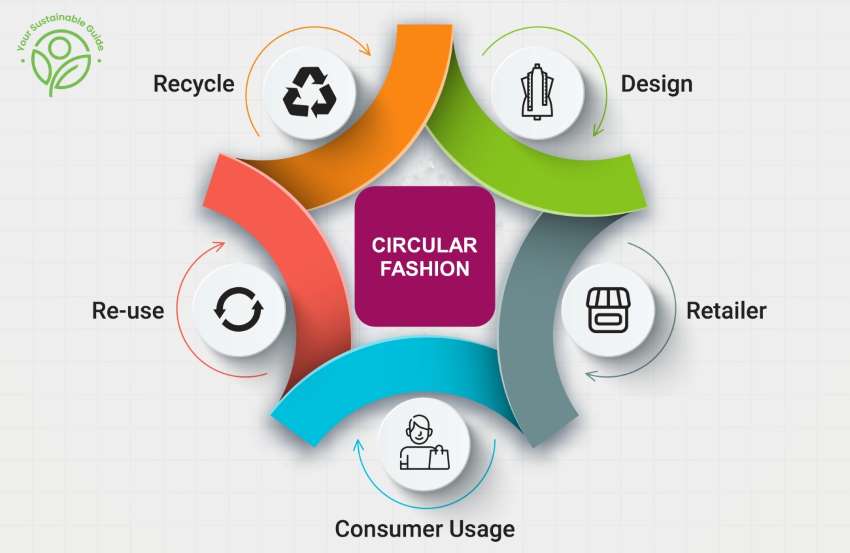
Companies are, with an ever-increasing frequency, moving into the recommerce marketplace. Adding this element of circularity to business models is seen as an opportunity to both enhance the organisation’s sustainability credentials while also providing a new revenue stream.
UK -based retailer John Lewis has launched a pilot buy-back program in partnership with recycling specialist Stuffsr. The scheme will be made available to a small number of customers as a precursor to rolling out a full-scale version later in the year. Similarly, fashion retailer Guess has announced a partnership with I:CO in an initiative which facilitates the collection, certified sorting, reuse and recycling of used apparel and footwear.
The John Lewis initiative will see garments purchased from the company within the last five years instantly valued via an app, before allowing this apparel to be sold back to the company – meaning, customers can claim a John Lewis voucher once the value of returned apparel reaches a threshold. These items can then be collected by courier service in as little as three hours.
The Guess and I:CO collaboration will enable customers to take a minimum of five garments into stores in exchange for a 15 per cent discount off any purchase in-store or online before an agreed deadline.

- 1
- 2
- 3
- 4
- 5
- 6
- 7
- 8
- 9
- 10
China’s inward turn, domestic demand is rewriting the export model
China is undergoing one of its most consequential economic recalibrations in decades, driven by geopolitical instability, rising Western protectionism, and... Read more
Why Shein sees itself as a technology company, not a fashion brand
The modern fashion industry has traditionally been defined by creativity, merchandising expertise and global sourcing networks. Yet few companies have... Read more
India’s textile sector turns crisis into competitive advantage
India’s textile and apparel industry has emerged from one of the most turbulent periods in its recent history, transforming a... Read more
India’s Export Divide: Textile mills advance, apparel makers face global headwin…
India’s textile and apparel (T&A) sector entered FY2027 with a striking internal contradiction. While the country’s overall merchandise exports increased... Read more
China’s inward turn, domestic demand is rewriting the export model
China is undergoing one of its most consequential economic recalibrations in decades, driven by geopolitical instability, rising Western protectionism, and... Read more
Egypt bets on a $2 bn green textile city to become Europe’s next sourcing hub
Egypt is making a decisive play to become one of the world's most important apparel manufacturing destinations after securing a... Read more
EU textile imports hit $295.66 bn as price wars mask manufacturing stress
The European Union’s textile and apparel imports grew to $295.66 billion in 2025, a 9.4 per cent year-on-year increase from... Read more
Landmark India-UK trade pact to supercharge textile export margins
The long-awaited India-UK Comprehensive Economic and Trade Agreement (CETA) is officially scheduled to commence on July 15, 2026. This breakthrough... Read more
Is it the end of aspirational luxury? Asia’s consumers demand more than logos
While the global personal luxury goods market remains broadly stable at around €358 billion, the apparent resilience masks a deeper... Read more
Vietnam wins, India slips as US apparel sourcing undergoes massive reset
A trade realignment is transforming the global apparel market, yet India’s manufacturing has stalled at the starting line. Newly released... Read more