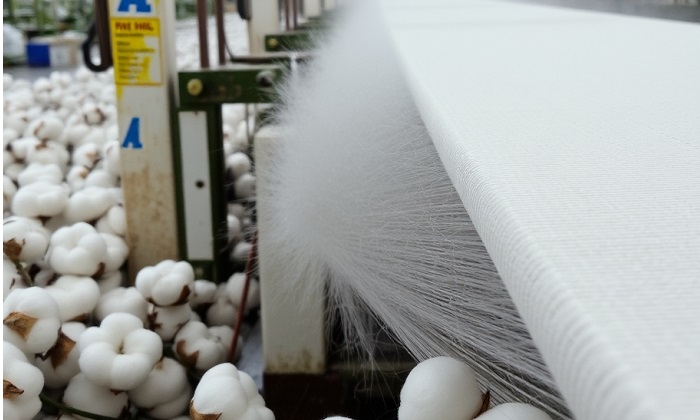
Since 2011, the cotton industry has struggled under high stock levels, initially in China, but now more outside China.
Broader merino wool is often blended with acrylic and some polyester.
Polyester, the big gorilla of fibers, is frightening even cotton. Polyester staple fiber has lifted in price since 2015, but is trading at a relatively modest rank of 41 per cent.
The US price is a little more restrained than the Australian dollar price due to falling exchange rates since 2014. The average merino price has returned to its peak level of 2011. The average merino price is therefore close to the top of its range of the past ten years.
In terms of percentile ranks the merino price is performing better than the major fibers but acrylic and cotton have high percentile ranks as well. Apparel fiber prices have generally lifted from low levels in 2015, rising in varying strength up cycles. The performance of cotton is even more impressive than the merino price given its stock levels.
While the merino wool price ratio to other fibers is extreme, the major fibers have been trending higher in US dollar terms since 2015. Cotton, despite a heavy handicap of high stock levels, is managing to trade at its ten year 77th percentile level.
In terms of percentile rank, acrylic and cotton are not too far behind merino wool prices. The case for wool exceptionalism is not as strong when other fiber prices are considered.

- 1
- 2
- 3
- 4
- 5
- 6
- 7
- 8
- 9
- 10
Vietnam wins, India slips as US apparel sourcing undergoes massive reset
A trade realignment is transforming the global apparel market, yet India’s manufacturing has stalled at the starting line. Newly released... Read more
US clothing prices rise faster than inflation, reshaping fashion retail strategy
After nearly two years of heavy discounting, inventory liquidation, and margin decline, apparel prices in the US are now rising... Read more
From gym to boardroom performance fabrics are redefining apparel demand
The global apparel industry has entered a new phase of evolution as the distinction between sportswear and everyday fashion continues... Read more
Digital Dominance Redefined: Zara moves past H&M in $100 bn fast fashion bat…
The global fast-fashion sector has reached a inflection point in 2026 where the battleground is no longer only store shelves... Read more
Spykar accelerates offline expansion: plans 100 new stores across India
A titan of the Indian denim-first fashion scene, Spykar has officially unveiled an aggressive retail growth strategy. As consumer demand... Read more
The Inventory Illusion: Rethinking the Zara benchmark in a volatile retail era
For over a decade, the global fashion industry has treated the Zara playbook as the gold standard of inventory efficiency.... Read more
Retail Without Retail: How Walmart’s depot network is turning space into logisti…
Walmart is fundamentally rewriting the commercial real estate and retail logistics playbook with the rise of its ‘Walmart Depots’ a... Read more
Global textile regulation tightens, forcing realignment across fashion supply ch…
Global fashion and consumer goods supply chains are entering a decisive regulatory transition as Extended Producer Responsibility (EPR) frameworks for... Read more
Luxury’s new power axis, US dominance, China reset, Gulf surge
As the post-China luxury order takes shape, the US is emerging as the industry’s most dependable growth engine, while Japan,... Read more
India’s $9 Billion Landfill Blind Spot How trashed clothes hold the key to globa…
A massive economic windfall is sitting uncollected in India’s landfills, and the key to unlocking it lies in rethinking how... Read more