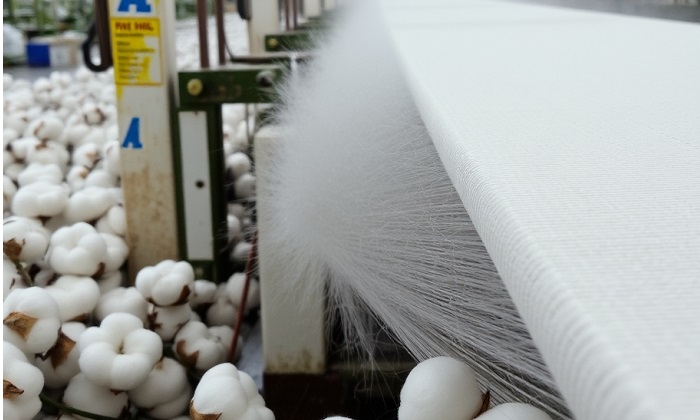
Nigeria is aiming at accelerating a sustainable increase in the production and processing of cotton.The cotton sector aims at increasing production by 20 per cent in 2018 as farmers are encouraged by better returns due to increasing cotton prices and improved yields.
At one time Nigeria’s textile industry created over 8,00,000 jobs, representing 25 per cent of the total number of jobs in the manufacturing sector.
There were 175 textile mills in the country during its golden era (i.e. 1985 - 1991) out of which today all but 27 of them have gone under.
Key challenges affecting the sector are lack of cotton lint, smuggling and counterfeiting, inadequate infrastructure, limited access to power and funding.
Funds needed by manufacturers to recapitalise have been hampered by the high interest rates charged on loans by financial institutions. The 30 per cent interest rate charged in Nigeria by commercial banks would appear as exorbitant when compared, for example, with the six per cent charged in China on loans given to textile manufacturers.
Globally power supply accounts for about 15 per cent of the production cost in the textile industry. In Nigeria it is almost 45 per cent.
Production of cotton lint which accounts for 40 per cent of the raw materials required in the textile industry has remained a critical challenge.

- 1
- 2
- 3
- 4
- 5
- 6
- 7
- 8
- 9
- 10
Landmark India-UK trade pact to supercharge textile export margins
The long-awaited India-UK Comprehensive Economic and Trade Agreement (CETA) is officially scheduled to commence on July 15, 2026. This breakthrough... Read more
Is it the end of aspirational luxury? Asia’s consumers demand more than logos
While the global personal luxury goods market remains broadly stable at around €358 billion, the apparent resilience masks a deeper... Read more
Vietnam wins, India slips as US apparel sourcing undergoes massive reset
A trade realignment is transforming the global apparel market, yet India’s manufacturing has stalled at the starting line. Newly released... Read more
US clothing prices rise faster than inflation, reshaping fashion retail strategy
After nearly two years of heavy discounting, inventory liquidation, and margin decline, apparel prices in the US are now rising... Read more
From gym to boardroom performance fabrics are redefining apparel demand
The global apparel industry has entered a new phase of evolution as the distinction between sportswear and everyday fashion continues... Read more
Digital Dominance Redefined: Zara moves past H&M in $100 bn fast fashion bat…
The global fast-fashion sector has reached a inflection point in 2026 where the battleground is no longer only store shelves... Read more
Spykar accelerates offline expansion: plans 100 new stores across India
A titan of the Indian denim-first fashion scene, Spykar has officially unveiled an aggressive retail growth strategy. As consumer demand... Read more
The Inventory Illusion: Rethinking the Zara benchmark in a volatile retail era
For over a decade, the global fashion industry has treated the Zara playbook as the gold standard of inventory efficiency.... Read more
Retail Without Retail: How Walmart’s depot network is turning space into logisti…
Walmart is fundamentally rewriting the commercial real estate and retail logistics playbook with the rise of its ‘Walmart Depots’ a... Read more
Global textile regulation tightens, forcing realignment across fashion supply ch…
Global fashion and consumer goods supply chains are entering a decisive regulatory transition as Extended Producer Responsibility (EPR) frameworks for... Read more