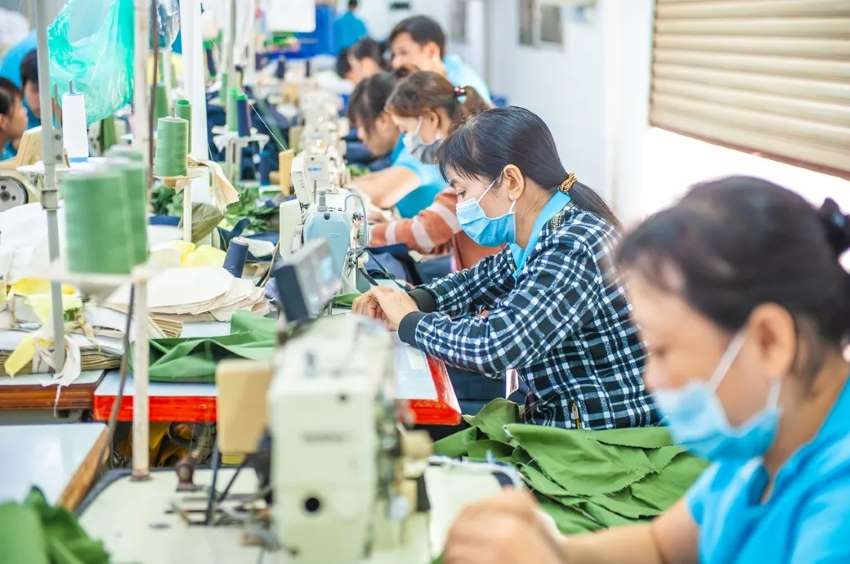
An enterprise from India is creating an ecosystem of thousands of self-employed women, who work where they are than in far-off traditional garment factories. Industree Foundation was founded in 2000. Some 30 million women in India rely on fashion for employment. Industree aims to tackle poverty in the garment manufacturing industry and enable the garment industry to grow sustainably, embracing new technologies and empowering women.
Industree goes to tribal artisans and works with them in mud huts. It helps organise them into production units and create a sustainable business at the lowest possible cost.
In a traditional Indian garment factory, women commute on an average four hours a day. They either have to pay rent if they live away from home, or pay high daily travel costs, and are then vulnerable to having their wages, which are sent home to support the family, taken by a man.
Industree’s goal is to decentralise manufacturing, with the micro-entrepreneurs required to commute no more than five kms. This means women can keep more of the money they earn, and put more into child nutrition, the household, and the local community. This is also linked to a fall in domestic violence. Educating women on ethical production practices could also have an impact on climate change.
- 1
- 2
- 3
- 4
- 5
- 6
- 7
- 8
- 9
- 10
Beyond the DTC Rush: Levi’s hybrid channel strategy sets a new retail benchmark
The global apparel sector is entering a phase where channel strategy is no longer a tactical lever but a core... Read more
The New Rules of Resale: EPR turning secondhand into fashion’s strategic growth …
The global fashion industry is facing a decisive regulatory and commercial reset. What began as a sustainability narrative around reuse... Read more
The 2027 Mandate: Why denim’s future hinges on verifiable data
For decades, the global denim industry has relied on a narrative of durability, heritage, and authenticity. That narrative is now... Read more
Europe’s textile core unravels as costs, imports and policy pressure bite
Europe’s textile and apparel sector, long seen as a benchmark for craftsmanship and industrial depth, is slipping into a prolonged... Read more
Automation, innovation, regulation are the forces shaping textiles in 2026
The global textile sector has entered a new era. Early 2026 saw the industry breach a $1.06 trillion valuation, reflecting... Read more
The new Brussels rulebook, every EU apparel order is now a balance-sheet risk
The humble export order sheet is undergoing a transformation. What was once a straightforward commercial instrument: SKU, volume, FOB price,... Read more
Why 2026-27 could be a defining cotton year for India’s farm-to-fashion economy
The global cotton economy is entering a more constrained phase, and for India, the implications run far beyond the farm... Read more
Luxury resale’s next big battle is no longer digital, it is about who controls s…
For nearly a decade, the luxury resale story was written in the language of platforms. Market leadership was measured by... Read more
Digital Arms Race: Indian apparel giants deploy AI to neutralize tariff crisis
The Indian textile and apparel sector is in a digital survival phase in 2026, shifting from traditional labor-intensive models to... Read more
Europe’s Textile Endgame: Why Project FAE is becoming fashion’s most critical in…
Europe’s apparel majors are no longer treating circularity as a branding layer. With Project FAE or Feedstock Activation Europe, the... Read more