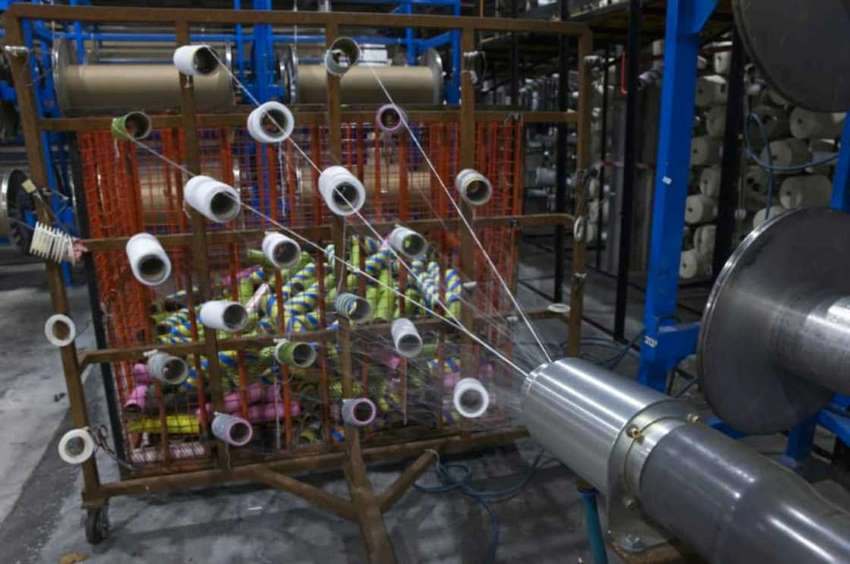
French textile machinery manufacturers are leaders in long fiber spinning, yarn twisting and control, space dyeing, heat setting for carpet yarns, carpet systems, dyeing and finishing, felts and belts for finishing processes, nonwovens, air conditioning of textile plants and recycling processes of textile materials. These technologies will be on display at ITMA Asia + CITME 18.
Among the exhibitors will be Laroche a major player in the textile waste recycling and airlaid nonwoven fields and is now involved in new technologies for turning post-consumer goods into valuable products. NSC Fibre To Yarn has made technological advances to its product range: a new GC40 family drawing machine, the GN8 intersecting drawing machine, an evolved ERA comber.
Superba TVP3 heat-setting line offers the highest pinpoint definition with a saturated steam process. Improvements have been made in Superba’s space-dyeing technology, like bicolor printing, or dyeing polyester yarn.
Fil Control has been developing and producing electronic devices for both machinery manufacturers and textile industrialists. The company stands as one of the market leaders for yarn cutters, which can satisfy all kinds of bespoke demands, yarn sensors, utilizing capacitive, optical, reflective and piezoelectric technology, and quality control devices, such as the tension sensor and the digital length meter. The new tension sensor MYT-T is a load cell sensor devoted to assembling, winding and texturing operations. The sensor delivers an analog signal proportional to yarn tension. This information can be used by the machine controller to keep yarn tension constant or stop the spindle if the tension is out of the normal operation range.
- 1
- 2
- 3
- 4
- 5
- 6
- 7
- 8
- 9
- 10
The Lyst Reset: Chanel and Dior rewrite luxury’s power index
The global luxury hierarchy has been quietly rewritten, and not by sales alone. In Q1 2026, Chanel rose to the... Read more
Inventory, not expansion, defines winners in global apparel
The 2025 fiscal year has crystallised that revenue growth and operational health are no longer moving in tandem. In an... Read more
From growth-at-all-costs to cash discipline, the new economics of DTC fashion
The global direct-to-consumer apparel market is entering a correction phase, as fashion brands across the US, Europe and the UK... Read more
Britain’s Forgotten Growth Engine: Why policy gaps are undermining fashion and t…
Britain’s fashion and textile industry, often framed through the lens of creativity and design, is emerging as a case study... Read more
Beyond price rallies structural reform can strengthen India’s cotton economy
India’s cotton economy is entering a decisive phase, where firmer prices and tighter arrivals in the 2026-27 season have given... Read more
Polyester volatility redraws India’s textile industry competitive map across Asi…
India’s synthetic textile industry has entered a phase of cost instability as polyester staple fibre (PSF) prices rise across domestic... Read more
The £7 Billion Question: Who pays for fashion’s ‘free rental’ habit?
The global fashion industry is facing an uncomfortable paradox: its most valuable customers may also be its most destructive. A... Read more
India, China Bangladesh face fresh headwinds as global apparel markets rebalance
Global apparel trade is entering a more uneven recovery phase, with demand growth persisting but losing uniform momentum across major... Read more
Global cotton enters a deficit year in 2026 as supply drop meets logistics risk
The global cotton economy has entered a fragile and sensitive phase. Early projections for the 2026-27 season suggest that world... Read more
India’s textile trade gets a Pacific push as New Zealand FTA removes tariff barr…
India and New Zealand have inked a ‘once-in-a-generation’ Free Trade Agreement (FTA), one that will have a profound impact on... Read more