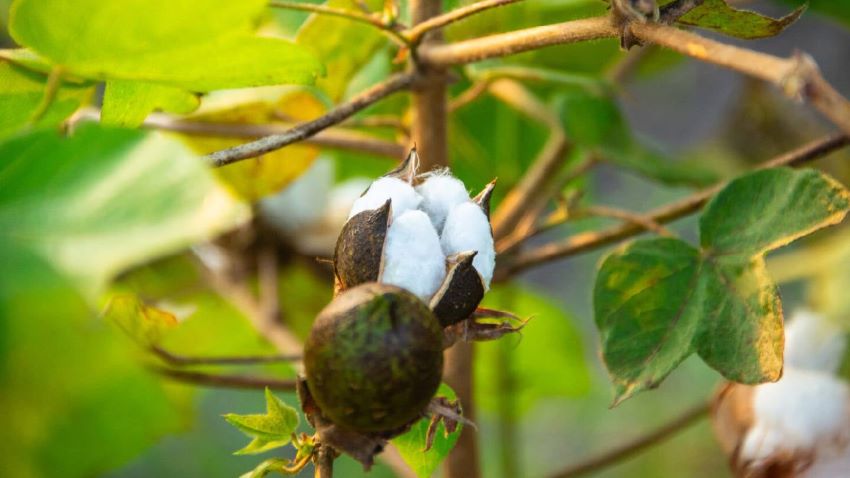
China is helping Texas, US, to improve cotton production. Reason: Many of the challenges Texas faces are similar to those encountered in cotton-producing areas of China. One of the critical issues facing Texas is water-use efficiency of major agronomic crops and how to adopt better irrigation management strategies. To accomplish this, there has to be a better understanding of soil-crop water relations and the physiological processes and crop traits that regulate crop water use.
The Chinese are interested in studying the response of cotton plants to limited water use and drought stress. They have been investigating water use and root development in cotton crops. The data will be important toward developing models to determine crop water use over the entire growing season of cotton crops.
There is a lot of clay soil in areas of Texas, which is also characteristic of soils in many of China’s cotton-producing areas. So it’s important to understand soil differences and how the water gets to the plant roots. That way it’s possible to determine if there are better ways to plant crops and to direct the flow to maximize the amount of water getting to the roots.
Adding the soil dimension to the crop-water-soil dynamic will allow researchers to have a more complete picture of how cotton yield might be improved and how the amount of irrigation needed can be reduced.
- 1
- 2
- 3
- 4
- 5
- 6
- 7
- 8
- 9
- 10
India’s textile trade gets a Pacific push as New Zealand FTA removes tariff barr…
India and New Zealand have inked a ‘once-in-a-generation’ Free Trade Agreement (FTA), one that will have a profound impact on... Read more
Lululemon’s world-first nylon circularity push signals a new apparel arms race
The global apparel industry’s circularity narrative is entering a more technically demanding phase. Polyester recycling once the flagship of sustainable... Read more
Beyond the DTC Rush: Levi’s hybrid channel strategy sets a new retail benchmark
The global apparel sector is entering a phase where channel strategy is no longer a tactical lever but a core... Read more
The New Rules of Resale: EPR turning secondhand into fashion’s strategic growth …
The global fashion industry is facing a decisive regulatory and commercial reset. What began as a sustainability narrative around reuse... Read more
The 2027 Mandate: Why denim’s future hinges on verifiable data
For decades, the global denim industry has relied on a narrative of durability, heritage, and authenticity. That narrative is now... Read more
Europe’s textile core unravels as costs, imports and policy pressure bite
Europe’s textile and apparel sector, long seen as a benchmark for craftsmanship and industrial depth, is slipping into a prolonged... Read more
Automation, innovation, regulation are the forces shaping textiles in 2026
The global textile sector has entered a new era. Early 2026 saw the industry breach a $1.06 trillion valuation, reflecting... Read more
The new Brussels rulebook, every EU apparel order is now a balance-sheet risk
The humble export order sheet is undergoing a transformation. What was once a straightforward commercial instrument: SKU, volume, FOB price,... Read more
Why 2026-27 could be a defining cotton year for India’s farm-to-fashion economy
The global cotton economy is entering a more constrained phase, and for India, the implications run far beyond the farm... Read more
Luxury resale’s next big battle is no longer digital, it is about who controls s…
For nearly a decade, the luxury resale story was written in the language of platforms. Market leadership was measured by... Read more