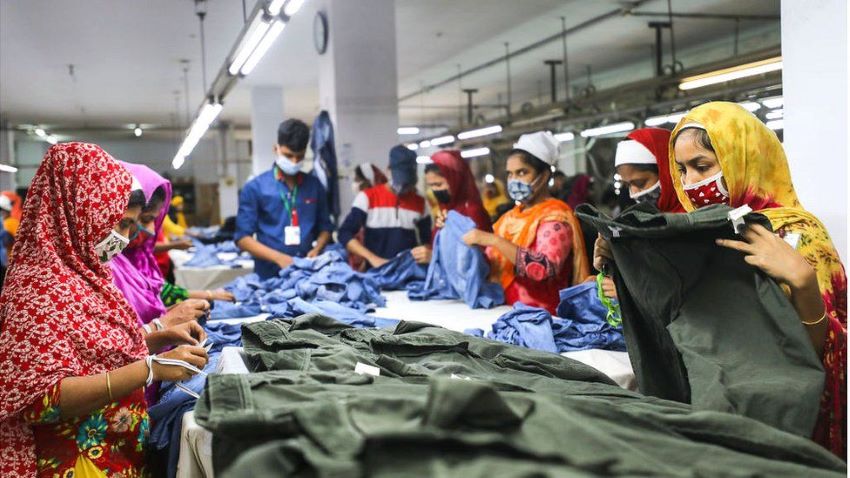
Bangladesh’s receipts from merchandise exports declined 7.3 per cent year-on-year. This is the second consecutive month export earnings declined. September’s earnings were also 7.78 per cent lower than the month’s target. The decline of exports in September was mainly due to the non-utilisation of full production capacity on the occasion of the holidays. A significant number of factories have also been shut down since February 2019, resulting in job losses.
Overall, export earnings in the first quarter of the current fiscal year declined 2.94 per cent year-on-year. Earnings from almost all major sectors, such as garment, leather and leather goods, and frozen foods fell. Garment shipments between July and September fell by 1.64 per cent. Earnings from garment shipments, which account for more than 80 per cent of national exports, were 11.52 per cent below the quarter’s target. Shipment of cement, pharmaceuticals, terry towel, ceramics and home textiles also performed poorly.
Shipments are expected to rebound as international retailers and brands are coming over with a lot of work orders because of the ongoing trade war between the US and China. Apparel retailers and brands are also coming to Bangladesh for the brighter image created through a lot of improvements at factories and strengthening of workplace safety.

- 1
- 2
- 3
- 4
- 5
- 6
- 7
- 8
- 9
- 10
UK fashion sourcing shifts south as Bangladesh overtakes China
The UK’s apparel sourcing has seen a realignment in recent years, as retailers increasingly diversify production away from traditional East... Read more
Why European consumers are spending more but buying less fashion
For much of the last two decades, the European fashion industry operated under the assumption that rising consumer wealth would... Read more
Why US apparel prices defied inflation while product quality improved
As inflation reshapes nearly every aspect of American household spending, one consumer category continues to stand apart. Housing costs have... Read more
The Resale Revolution: Vinted’s marketplace model reshapes European retail
The French fashion market has reached a turning point. In a development that highlights the growing influence of circular commerce,... Read more
France declares war on ultra-fast fashion with new green law, will reshape globa…
France has become the first major economy to legislate specifically against the ultra-fast fashion business model, a watershed moment for... Read more
France declares war on ultra-fast fashion with new green law, will reshape globa…
France has become the first major economy to legislate specifically against the ultra-fast fashion business model, a watershed moment for... Read more
Click-and-Collect: Why retailers are turning pickup counters into sales machines
Modern retail has changed the role of the physical store. Once viewed primarily as a point of sale or inventory... Read more
Why fashion e-commerce returns persist despite smarter sizing technology
For over a decade, the fashion sector has invested heavily in virtual fitting rooms, AI-powered size recommendations, and 3D body... Read more
A Quest for Essence: Unveiling the 2027 A/W Trends at Intertextile Shanghai Appa…
As the global textile industry looks toward the upcoming season, the Intertextile Shanghai Apparel Fabrics – Autumn Edition stands ready... Read more
Beyond globalization, local consumer behavior rewriting fashion retail strategy
The traditional blueprint for global fashion expansion is being rewritten. For decades, apparel companies assumed globalization would gradually create a... Read more