FW
Stäubli technology woos audience at ITMACH India
Stäubli presented a selection of latest products from its range of textile machinery for weaving and knitting at ITMACH India. Visitors experienced the new Tiepro warp tying machine and saw Stäubli’s S1692 cam motion and S3260 electronic rotary dobby in action. A collection of latest technical fabrics woven on Stäubli TF weaving systems enticed many visitors.
With core competencies in shedding machinery (cam motions, rotary dobbies, Jacquard machines) and weaving preparation (drawing-in, leasing and warp tying), Stäubli plays an important role in the design and quality of woven end-products. Based on over a century of experience in the traditional textile industry and its continuous R&D activities, Stäubli constantly offers new and improved high-performance systems and solutions for processing fabrics for fashion, home textiles, automotive, protection and carpet solutions, as well as highly complex technical textiles.
Stäubli India offers in-house training for machine operators and support for customers’ production teams as part of change management.
During the exhibition, weavers discussed and learned more about Stäubli’s broad range of Jacquard weaving machinery, which is renowned worldwide for top reliability and very high weaving speeds.
ITMACH India 2019 was another ideal platform for Stäubli experts and customers to discuss the benefits and potential of automation in high-speed weaving and to learn the latest details about machinery and solutions that can enhance the overall efficiency of weaving mills.
Philippines to upgrade industry
The Philippines has prepared a roadmap for the garment and textile industry.
The plan covers the period 2020 to 2029. In the short term, the hope is to be among the top 20 garment exporters with an annual growth of 12.3 per cent in garment exports and a 3 per cent -5 per cent increase in textile exports. This will be made through the utilisation of natural and synthetic textile fibers by five per cent to ten per cent. In the medium term, the roadmap forecasts the Philippines to improve its world ranking in garment exports into the top 15 largest globally. It is expected to increase its garment exports by 21.7 per cent annually and natural and synthetic textile fiber exports by ten per cent. Infrastructure gaps and logistical bottlenecks will be addressed. High-quality infrastructure and logistical services will enhance production efficiency, transportation, communication and distribution. In the long term, the roadmap expects the Philippines to be among the top ten of the world’s garment exporters with an annual 45.8 per cent annual increase in the exports of garments.
The Philippines is already known for everyday wear global brands as the industry has already upgraded to original brand manufacturer with homegrown Filipino labels.
Marks & Spencer appoints Paul Babbs as new supply chain officer
Marks & Spencer, the British department stores group has appointed Paul Babbs as the new chief supply chain officer. He was formerly associated with Adidas. Marks & Spencer aims to strengthen its fashion division after suffering several inventory issues during the last year.
The group, which employs a thousand people in its clothing division, announced in May that it will close around one hundred stores before 2020, speeding its closure plan scheduled for 2022. At the same time, the group reorganized its fashion team by simplifying its structure and announcing 47 layoffs.
In July, British executive Jill McDonald, head of the clothing and home division, left the company after four years in the position. After his departure, it was the current chief executive officer of the group, Steve Rowe, who took this position. Marks & Spencer reached a revenue of 3 billion euros (3.3 million dollars) in the third quarter of its fiscal year, down 3.9% compared to the same period the previous year.
Hong Kong retail sales suffer
Some 7,000 licensed retail establishments out of 64,000 in Hong Kong may close down in the next six months.
Social unrest and sometimes violent anti-China protests are deterring tourists, threatening the survival of smaller operators. Retail sales fell by a quarter in October from a year earlier, the steepest drop on record, while tourist arrivals fell by a whopping 43.7 per cent in the same month, squeezing malls and restaurants.
Hong Kong ranks among the world’s top five luxury destinations. It has long been a magnet for brands attracted by the flow of visitors from mainland China and accounts for between five per cent and ten per cent of the annual global sales of luxury goods. Watchmakers in particular are likely to be hurt – Hong Kong is a major centre for high-end timepieces. Hermes has been forced to temporarily shut some of its five stores as well as an airport shop in Hong Kong.
Hong Kong, which once accounted for around five per cent of global luxury sales, is now closer to two per cent. While the demonstrations might be a temporary disruption, a more structural shift is at play in the shopping habits of well-off customers from the Chinese mainland whose Hong Kong spending have long been buttressed sector sales.
CPTPP opens up opportunities for Vietnam exports
The Comprehensive and Progressive Agreement for Trans-Pacific Partnership (CPTPP) has opened up multiple opportunities for Vietnam’s export industries.
Markets of the eleven economies participating in the agreement offer great opportunities for many Vietnamese export items. This includes furniture, garments and footwear. Specifically, with zero import tax tariff, the CPTPP is expected to bring great opportunities for the lumber industry, as once the CPTPP is implemented, 95 tariff lines will be reduced to zero. For that reason, timber enterprises will benefit from importing raw materials from markets such as Canada and Japan which are in the CPTPP. And while exporting products within the bloc they will also enjoy the zero per cent tax rate. In addition, the benefit of zero import tax is also a great opportunity for businesses to cut their costs for renewing machinery and equipment by 20 per cent to 30 per cent. Growth opportunities await the textile sector too.
However, there are challenges. The CPTPP with commitments on market opening can also result in considerable competitive pressure for enterprises. The detailed and complex conditions of CPTPP’s rules of origin would be another obstacle for businesses. The CPTPP includes commitments on labor, environment, intellectual property, etc. that could increase the cost for businesses.
Azerbaijan records an increase in cotton production
Azerbaijan recorded a cotton harvest of 293,880 tonne according to the agriculture ministry, which is a 31.9 per cent increase over the figures during same period last year, when production was 222,748 tonne. This is the result of the agrarian reforms, include measures to increase cotton harvesting, carried out in the country.
Cotton production in the country is most developed in Saatli, Bilasuvar, Barda, Aghjabadi and Sabirabad regions.
The country’s State Program for 2017-2022, approved in early 2017, aims at strengthening measures to develop cotton growing, increase export potential in the field, ensure employment of the rural population and increase cotton production.The new goal of the government is to boost cotton production to 500,000 tonnes by 2022 from the current 260,000 tonnes.
There are 23 cotton processing plants, seven yarn factories and three cotton oil enterprises in Azerbaijan.
RICOH shares DMF concept workflow at ShanghaiTex 2019
"RICOH shared its Digital Micro Factory (DMF) concept workflow at the 19th International Textile Industry Exhibition (ShanghaiTex 2019), held from November 25-28 at the Shanghai Expo Center. Ramp up-RICOH’s partnership by Universal Platform was officially launched at the M2 Conference Hall on Nov 26 with a ceremony and press conference marking the new alliance and its fashion manufacturers"
 RICOH shared its Digital Micro Factory (DMF) concept workflow at the 19th International Textile Industry Exhibition (ShanghaiTex 2019), held from November 25-28 at the Shanghai Expo Center. Ramp up-RICOH’s partnership by Universal Platform was officially launched at the M2 Conference Hall on Nov 26 with a ceremony and press conference marking the new alliance and its fashion manufacturers. Tetsuya Morita, Corporate Vice President of Ricoh Co and General Manager of Industrial Printing, Koji Miyao, Chairman and General Manager of Ricoh China Co and others of the Ricoh Group maintained a unified presence throughout the exhibition and conference.
Koji Miyao said Ricoh aims to expand its China business into a core market, as Europe and the Americas, following impetus from this year's China International Import Expo and 83 years of comprehensive market deployment. The Ricoh Group would continue to develop technologies and experience in Commercial Printing, but incorporating sustainable development and opening greater possibilities in Industrial Printing, with comprehensive and new, innovative technologies.
Tetsuya Morita, General Manager of Industrial Printing, announced that digital micro-factory DMF, a very important concept to the Group, and RAMP-UP the apparel consortium had officially launched, answering to social issues in the future such as environmentalism and safety within the apparel ecosystem. Ricoh would strive to create an open global business environment, so as to push forward social problems such as water pollution, electricity consumption and excess inventory, maintaining a comfortable and safe living environment, a common issue for all human beings.
Morita elaborated the proof of concept and the positive steps to be taken in testing from the first and second quarter 2020, with details on the company's website. His next remarks were given to the Ricoh Group's unremitting contribution to achieving sustainable development goals (SDGs) advocated by the United Nations, and to the role the DMF digital micro-factory so vigorously launched will play in solving various social problems and providing new customer value to more and more people in the garment and related markets.
Three additional companies including Hangzhou Dianshi Clothing Co also confirmed joining the consortium, while many companies were in the process of joining the consortium as well.
Morita acknowledged the highly developed nature of the Chinese apparel industry, but suggested the DMF concept was for the world market, including China. Ricoh hopes to expand sales of DMF workflow cloud solutions and textile printers, with a goal of JPY10 billion in revenue by the year 2025. DMF will produce significant social benefits using the advantages of industrial inkjet technology, such as diversity, customization, differentiation, multi-type small lot production and leading the industry trend.
Stepping up efforts to deploy the DMF concept itself, Ricoh entered a collaboration with Sweden's Coloreel (March 2019) to develop an on-demand thread dye and inkjet printer. Ricoh also acquired LAC Corporation (2018, renamed Ricoh Digital Painting Company, Ltd.) and ColorGate Digital Output Solutions GmbH, (2018) a leading software provider with strength in color management. The ColorGate acquisition marked an important first step in active capital cooperation, eliminating self-efficiency, and permitting Ricoh to RAMP-UP its partnership programs.
China looks at increasing its exports, creating opportunities for others
"The Chinese textile industry has become a key player after decades of reform. In 2018, Chinese production of chemical fibers made up over two thirds of the global production. “Textile exports from the country also increased by 3.5 per cent to reach 37.6 per cent of the world’s total in 2018, while apparel exports accounted for 31.3 per cent of the total world’s total exports"
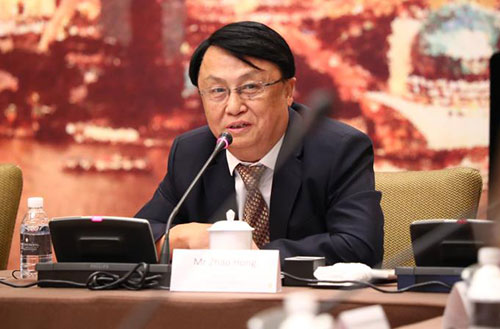 Advanced manufacturing and additional investments in companies across the world, have made China the world’s biggest textile market. To exploit the growing potential of this market, the 25th Autumn Edition of Intertextile Shanghai Apparel Fabrics organised a private round table meeting on September 25, 2019. The conference included a keynote speech and a panel discussion. Olaf Schmidt, Vice President of Textiles & Technologies at Messe Frankfurt delivered the welcome speech. “Through this fair, we aim to curate a fringe programme that will inform, engage and connect thought leaders from across the world,” he said.
Xu Yingxin, Vice President of the China National Textile and Apparel Council and Chairman of CCPIT-TEX (co-organiser of the fair) delivered the keynote address, titled: The Current Situation of China’s Textile Industry. The main takeaways from the keynote address and the panel discussion were:
High demand from the domestic market
The Chinese textile industry has become a key player after decades of reform. In 2018, Chinese production of chemical fibers made up over two thirds of the global production. “Textile exports from the country also increased by 3.5 per cent to reach 37.6 per cent of the world’s total in 2018, while apparel exports accounted for 31.3 per cent of the total world’s total exports,” noted Yingxin 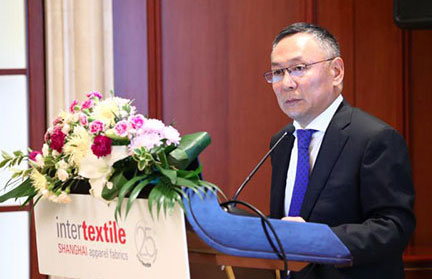
Although the purchasing power of Chinese consumers has slowed slightly, country’s textile industry is still experiencing high demand from the domestic market. “Our huge population offers our apparel industry a huge safety net as clothing is a necessity rather than a luxury,” Yingxin observed. However, though apparel sales have continued to grow in 2019, the pace of growth slowed.
Emphasis on creating a strong consumer economy
The panel discussion also focused the importance of a strong consumer economy in order to maintain high domestic purchasing power. Paul Alger, UK Fashion & Textile Association warned of the social consequences and lack of purchasing power caused due to a weak consumer economy. KV Srinivasan, TEXPROCIL indicated that India’s consumer economy benefits from their strength, including a rich textile heritage and skilled technical workforce.
Three missions to develop the textile industry
China’s textile investments in 2019 focused on technology and innovation, resulting in increased productivity. The Autumn edition of Intertextile Shanghai Apparel Fabrics noted three key missions for China’s progress including technology and innovation; culture and local talent; and sustainability.
The panel discussion further focused on sustainability. Carol Hanlon, Textile Clothing Footwear Resource Centre, Australia pointed out “As a leader of textile production, China has the capacity to drive change in circularity. There will be a demand for sustainability in the future as younger generations are increasingly associated with climate activism.”
Burgeoning investments strengthen manufacturing, increase co-operation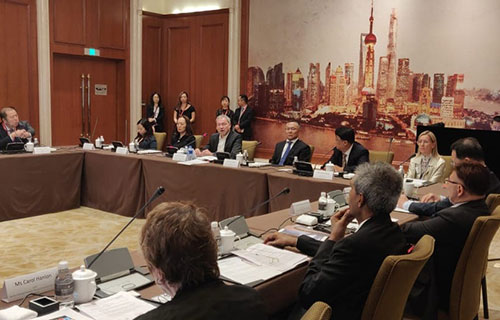
During the first five years of the Belt & Road initiative, total trade volume between China and other countries along the Belt & Road route exceeded $6 trillion, accounting for nearly a third of China’s total trade in goods during this period. By 2018, the country reportedly invested $6.5 billion in countries along the Belt & Road route. These investments offer a two-fold benefit to China. They build efficient manufacturing bases along the Belt & Road route besides increasing international co-operation to strengthen resources throughout the supply chain.
China creating opportunities for other countries
China exports around 18 per cent its textiles to the US. It is also the largest exporter of textiles and apparel to the US, accounting for 38 per cent of the nation’s total imports. This is creating new opportunities for other countries to explore the US market. Ade Sudrajat, Indonesian Textile Association noted, “We aim to develop our local e-commerce and start-ups.”
Autumn 2019 Edition of Intertextile Shanghai Apparel Fabrics was held from September 25-27, 2019 in Shanghai. The event was co-organised by Messe Frankfurt (HK) alongwith Sub-Council of Textile Industry, CCPIT; and the China Textile Information Centre.
Nippon Koei to invest Cambodian silk industry
Japanese company Nippon Koei plans to invest in the Cambodian silk industry. This investment will improve the domestic silk market which is currently facing competition from increasing imports.
The Cambodian silk sector currently faces challenges such aslack of raw materials, human resources and financial resources. Secondly, handmade Cambodian silk cannot compete with low cost imported silk products.
The country imports silk and cotton yarn from China, Vietnam and Thailand due to the lack of locally produced raw materials. As the National Silk Strategy Report 2016-2020 reveals, the country’s silk yarn production accounts for only one per cent of total domestic consumption, while its imports accountfor 99 per cent – equivalent to more than 400 tonne per year. This imported silk can be used to make a wide range of products such as ties, clothing, bags, and items for home decor, hotels, shops and others.
EU engagement with Myanmar gets deeper
The Smart Myanmar project launched by the EU aims at improving social and environmental performance at more than 100 garment and textile factories across the country.
With support from engineers and local and European experts, the project will deliver on-site assessments and training on topics such as human resource management systems and workplace communications, occupational safety and health, chemicals and waste management, and energy efficiency. The aim is to foster decent work conditions and responsible business practices in Myanmar. The initiative has carried out training and consultancy programs with 299 garment, textile and footwear factories since 2016, implementing thousands of improvements related to safe workplaces, effective HR management and energy efficiency. Now the focus is on further strengthening sustainable production practices and responsible supply chains in Myanmar and Europe.
Since 2013, Myanmar’s garment sector has witnessed a staggering export-oriented growth. The garment industry has served largely the European market and created job opportunities for thousands, mostly women. Europe is one of the world’s largest consumer markets and European consumers pay a lot of attention where the products they buy come from and how they are produced. Sustainable production and respect for international labor standards are therefore important topics in the EU’s trade relations with Myanmar.