


FW
Southeast Asia's garment trade declines
Garment and footwear trade between Southeast Asia and the United States is declining due to high inflation, casting a gloomy shadow over the industry. Recent analysis of U.S. customs data indicates a 20% to 30% drop in the value of apparel and footwear shipments from Cambodia, Bangladesh, Myanmar, and Vietnam during the initial four months of this year.
Exports to the European Union are also showing signs of slowing, with Bangladesh experiencing a 3% decline in garment exports and Cambodia witnessing a slight dip. Although Vietnam initially saw growth in garment exports to the EU, the latest figures for April demonstrate a significant decrease compared to the previous month.
The decline comes after a strong recovery in shipments following the pandemic, but Southeast Asian nations heavily reliant on garments, footwear, and travel goods, such as Cambodia, have faced an overall 30% export decrease during the first four months of this year. Industry insiders attribute this decline to inflation and the economic repercussions of Russia's invasion of Ukraine.
Additionally, the failure of the U.S. Congress to renew the Generalized System of Preferences, which offers duty-free access to certain goods, has affected exports of travel goods. Despite stable employment figures thanks to new investors, ongoing uncertainties and the clearance of retail backlogs contribute to a cautious outlook for the rest of 2023.
Fashion companies are grappling with a challenging sourcing environment due to shrinking demand caused by inflation and reduced consumer spending. Many U.S. fashion companies have responded by cutting sourcing orders and reducing inventory, resulting in a decline in trade volume.
Ongoing trade tensions, including the continuation of tariffs on Chinese exports, further compound the challenges faced by U.S. brands. In response, fashion companies are prioritizing sourcing flexibility and diversifying their supply base. While they consider near shoring in the West, Southeast Asian countries remain attractive despite the difficulties of finding new production capabilities.
India: UK removes duty benefits, concerns rise
The UK's removal of duty benefits for Indian garment exporters under the new Developing Countries Trading Scheme (DCTS), replacing the previous Generalised Scheme of Preferences (GSP), raises concerns amidst sluggish global demand. Industry officials argue this withdrawal is reasonable, considering the potential benefits of future Free Trade Agreements (FTAs).
The withdrawal of duty benefits under the DCTS adds to the challenges faced by the Indian garment industry due to weak global demand. While Indian industry organizations support the decision, exporters worry about the impact until an India-UK FTA takes effect. Previously, as a member of the European Union, the UK provided GSP benefits to Least Developed Countries (LDCs).
However, post-Brexit, the UK introduced the separate DCTS scheme, particularly affecting labor-intensive sectors like textiles and leather. Indian textile exporters are expected to receive duty benefits through the ongoing FTA negotiations with the UK, explaining India's removal from the LDC list. The negotiations, which began in January 2021 and completed ten rounds by June, aim for a swift conclusion.
Certain Indian exports exceeding the specified limit in the UK market make them ineligible for GSP benefits. However, sectors like metals will continue to receive benefits. The timing of benefit withdrawal is significant, as developed countries, including Europe and the US, face high inflation from supply chain disruptions due to the Russia-Ukraine war, reducing demand for garments and textiles. Exporters from Ludhiana note cautiousness from global brands in making new purchases.
With the UK's withdrawal of duty benefits coinciding with sluggish international demand, exporters face challenges until the India-UK FTA is finalized. The timeline for signing and implementing the agreement remains uncertain despite ten rounds of negotiations.
Indian textile sector to rebound with falling inventory
Indian textile companies are set to experience improvements in the latter half of the fiscal year due to declining global inventory levels, despite subdued global demand. Major retailers like Walmart and GAP Inc. have confirmed their ongoing efforts to reduce excess stock.
Analysts at JM Financial Institutional Securities Ltd have stated that Indian home textile and apparel exporters anticipate muted demand in H1FY24 due to inventory liquidation. However, they expect a recovery in export demand from 2HFY24, as global retailers' inventory normalizes in CY24.
The textile sector has faced challenges including low demand, inflation, and global supply chain disruptions, resulting in lackluster sales in FY23.
Nevertheless, lower cotton prices and declining logistic costs offer a lifeline to the sector's operating margin. Analysts believe that companies with strong product portfolios, robust export clientele, integrated business models, and expanded capacity are poised to achieve substantial earnings growth of 20-41% over FY2023-25E. They have upgraded their outlook on the textile sector from neutral to positive, citing a favorable medium to long-term outlook.
Furthermore, the Indian textile sector is expected to benefit from the China+1 strategy, as China's declining market share prompts a shift in apparel exports to other Asian countries. Investor confidence is returning, as key stocks like KPR Mills Ltd, Gokaldas Exports Ltd, and Alok Industries Ltd have recorded significant gains of over 20% this year.
The industry's future will depend on the pace of demand recovery, underscoring the importance of the upcoming half-year period.
"Seamless" Sustainable Scheme Advances Australian Fashion
In a recent report, the Australian Fashion Council (AFC) revealed that Australia discards 227,000 tonnes of clothing annually, with only 7,000 tonnes being recycled. To address over-consumption and lack of end-of-life solutions, the AFC launched the National Clothing Product Stewardship Scheme called "Seamless" with funding from the Australian Federal Government.
This initiative aims to enhance clothing design, recovery, reuse, and recycling, with a goal of achieving circularity in Australia by 2023. However, only six out of 30 leading brands approached, including Big W, David Jones, and Lorna Jane, signed up as founding members. The AFC emphasizes the need for industry collaboration to drive real environmental improvements.
The launch of Seamless coincides with an ACCC report on greenwashing, exposing misleading sustainability claims made by 57% of companies. The government's threat of direct regulation urges fashion businesses to act.
By joining Seamless, companies can demonstrate genuine commitment to sustainability, gaining an advantage in a competitive market. Observing how the founding members incorporate the scheme into their sustainability marketing may provide insight into its impact.
As pressure for improved sustainability credentials grows, fashion brands doing business in Australia should consider supporting Seamless alongside their existing initiatives and scrutinize their sustainability-focused advertising claims.
Male fashion aesthetic melds casual with gorpcore
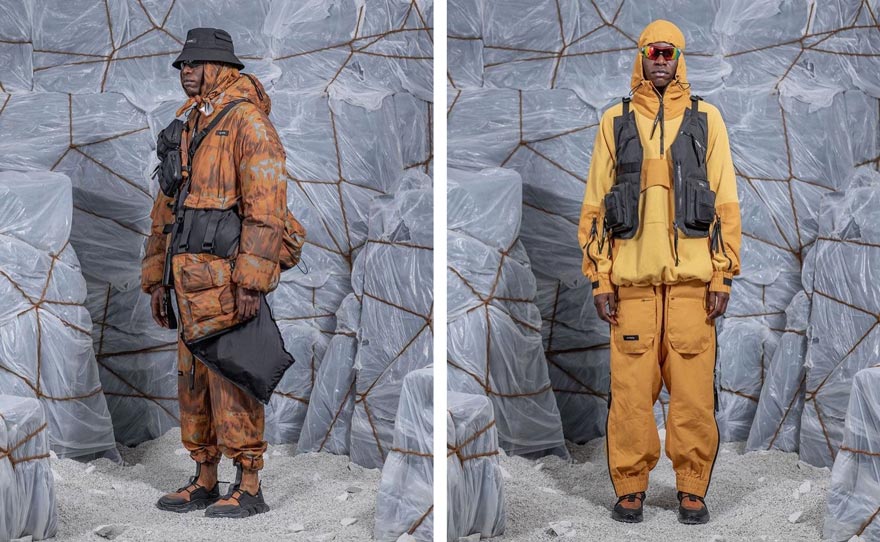
Bespoke casual fashion has always been around in men’s category, hinting at a less formal, sporty, outdoorsy lifestyle wear. The trend took off in the 70s and with each passing decade, transformed to suit mainstream fashion of that time. But now, casual wear or more precisely, bespoke casual suits that are tailored and crafted to suit the customer’s self-expression rather than the expected mold is what the rich and the famous are after. This attitude seems to go down well with the latest core ‘Gorpcore’.
Gorpcore beautified and trending
Gorpcore is all about embracing hiking-inspired pieces like vests, cargo pants, fleece jackets, hiking boots, and other outdoor wear. While gorpcore fashion tends to lean towards baggier silhouettes, it is also versatile and customizable, and that is part of its appeal.
At its root, gorpcore is all about mixing outdoor gear with your own personal style. “Gorpcore is wearing functional outdoor wear in an urban, trendy style,” says Shalev Lavàn, Los Angeles-based fashion stylist in an interview with a leading international fashion magazine. The term was coined by writer and editor, Jason Chen back in 2017 but was initially used ironically to describe “defiantly ugly” outdoors fashion. Now, gorpcore is fully in vogue, and fashion’s and it people are rocking the look.
Jian DeLeon, men’s fashion director at Nordstrom, described the prevailing trends in menswear as seen at Pitti Uomo earlier as a mixture of comfort with casual elegance. The most popular pieces as seen on gorpcore men are over-sized cargo pants in all eclectic hues and puffy quilted jackets paired with block-colour T-shirts underneath. The other cores that have been trending in men’s fashion is the biker core and normcore. In biker core, men have popularized the legacy leather trousers and multizip leather biker jackets with matching cut-off gloves. Normcore is more focused on simple baggy silhouettes including straight leg and baggy jeans and trousers teamed with unstructured, long and flowing coats or cardigans.
It may be noted that Pitti’s semi-annual Florence trade show in June 2023 saw a more contemporary take as collections featured soft suits that spoke of style in a comfortable way and relaxed way, casual shoes and T-shirts of expressive shirts that created a chic, casual look that had a bit of the relaxed gorpcore in it. Euromonitor has hailed the growth of menswear globally moving ahead at a CAGR of 5.8 per cent for the next four years valued at $548 billion.
Revisiting the formal tailor
The new-look tailored offering is just more contemporary in silhouette and stepping away from too much structure that has been its hallmark. Premium fabric known for drape and fall are being given a more versatile job to do – relaxed, casual and with a focus on free-flowing lines. Former Valentino and Zegna designer Aldo Maria Camillo presented his namesake brand’s second collection at Pitti this year as did the fledgling brand AMC run by former Valentino designer Aldo Maria Camillo and United Arrows co-founder Hirofumi Kurino (AMC). Storied Florentine tailor Liverano and Liverano made its debut at the trade show to much excitement among buyers, signaling a shift of traditional brands catering to more casual suiting consumers.
Trio fashion event returns to NYC showcasing trends & sustainability
Texworld NYC, Apparel Sourcing NYC, and Home Textile Sourcing are set to make a grand return to New York City from July 18-20, 2023. The co-located events will showcase the latest textile, apparel, and home trends, with a focus on innovation and sustainability.
Featuring curated showcases and presentations, the event offers designers, buyers, and industry professionals an opportunity to explore the cutting-edge fashion textile trends. The Texworld Trend Showcase, curated by trend agency DONEGER | TOBE, will present the Fall/Winter 24-25 themes. Additionally, the Home Trend Showcases curated by Nancy Fire will provide a journey through color, pattern, and material trends for Fall/Winter 24/25.
The event also includes educational programs such as Textile Talks, the Lenzing Seminar Series, and the Lenzing Innovation Pavilion, highlighting sustainable exhibitors.
Networking opportunities and interactive elements like "Dye-It-Yourself" workshops by Sodhani Biotech will enhance the visitor experience. With the inclusion of partnership shows Printsource and Global Footwear Sourcing, this event becomes a comprehensive destination for global sourcing.
Female sports boost $305.67B sportswear market
Global sportswear market to reach USD 305.67 billion by 2030, growing at 6.72% CAGR. In 2022, it was valued at USD 182.01 billion and is expected to reach USD 193.89 billion in 2023. Popularity of sportswear due to breathability and sweat-wicking capabilities drives market growth. The "Sportswear Market, 2023-2030" report by Fortune Business Insights™ analyzes market trends, growth factors, and strategies of key players.
Factors contributing to market growth include increasing female participation in sports like basketball, athletics, and football, as well as rising popularity of events such as Women’s FIH Hockey World Cup and FIFA Women’s World Cup.
Counterfeit products in several countries pose challenges. COVID-19 pandemic negatively impacted sportswear industry with decreased sales and delayed shipments due to lockdowns. Market is expected to recover as precautions ease. Market segmented into apparel, footwear, and wearables. Apparel dominates due to high demand in activities like tennis, basketball, and football.
Men's segment shows significant growth with outdoor activities like trekking and cycling. Distribution channels include retail stores and e-commerce. Retail stores to expand due to global popularity of sportswear brands.
Geographically, market divided into North America, Europe, Asia Pacific, South America, and the Middle East & Africa. Sportswear market poised for robust growth, driven by demand for products and increasing women's sports participation.
China's World Factory Status Under Threat
China's "world's factory" status is challenged by a ten-month decline in its US exports due to supply-chain reshoring. Weak demand, a sluggish economy, and inflation have reduced overall US imports, with China experiencing a more significant decline compared to Mexico. Notably, China's share of major US imports, especially in textiles and apparel, has dropped by 4 percentage points from 2022 and nearly half of its level a decade ago.
Factors like Covid disruptions, US-China trade tensions, and the Uygur Forced Labour Prevention Act discourage sourcing from China. China's dominance in low-cost consumer goods, such as furniture and toys, has diminished. Chinese companies have shifted furniture assembly to Mexico-focused industrial parks near the border.
China's share of US imports for mechanical and electrical products has also decreased. While no country can replace China entirely, low-cost Asia-Pacific nations and Mexico can benefit from changing supply chains.
The trend of declining Chinese exports to the US will persist, impacting China's economy in the short term and necessitating a focus on domestic demand. In the long term, China's export advantage relies on high-tech products.
Bangladesh Flourishes in Non-Traditional Markets
Bangladesh's apparel exports to non-traditional markets surged to $7.68 billion in FY23's first eleven months, a 32.74% YoY increase. Non-traditional markets, including Japan, Australia, Russia, India, China, South Korea, UAE, Malaysia, Brazil, Mexico, accounted for 18.04% of the ready-made garment (RMG) sector's earnings during July-May. In FY22, non-traditional markets contributed $6.37 billion, representing 14.96% of Bangladesh's total RMG export revenues.
As major markets face saturation and economic uncertainties, Bangladesh aims to diversify by exploring non-traditional markets and capture a larger global market share. Noteworthy growth was seen in exports to Japan (45.80% YoY increase, $1.46 billion), Australia (41.82% increase, $1.06 billion), India (46.44% surge, $947.86 million), South Korea (28.85% growth, $501.01 million), and Mexico (29.41% rise, $313.94 million).
Bangladesh's potential inclusion in the BRICS economic group (Brazil, Russia, India, China, South Africa) opens doors to significant non-traditional markets. Apparel exports to BRICS countries reached $1.87 billion in July-May, a 16.38% increase from the previous fiscal year. By focusing on non-traditional markets, Bangladesh aims to increase exports, diversify products, and leverage geographical proximity to countries like China, Japan, India, and Australia.
This strategy taps into the purchasing power and growth potential of these markets, while major markets face economic challenges. In the current fiscal year, Bangladesh earned $42.63 billion from global apparel exports, reflecting a 10.67% growth compared to FY22.
As apparel imports by US, UK and EU falls, Japan bucks the trend with a rise: Wazir Report

Wazir Advisors in its June 2023 ‘Apparel Trends Scenario in key global markets and India’ report reveals Japan’s apparel import in April was $1.8 billion, 6 per cent higher than that in April 2022. On YTD basis, imports are 4 per cent higher than in 2022. In Japan’s apparel imports, Vietnam’s share increased by 2 per cent, whereas that of China declined by 7 per cent compared to 2021. From January to April 2023, China was the largest apparels supplier to Japan, still holding on to more than half of the total imports, at 51 per cent. Vietnam during that period supplied only 16 per cent whereas Bangladesh and Cambodia supplied 6 per cent and 5 per cent respectively. The total supply from other countries to Japan is again bucking Western trends as its diversification of supplier countries is considerably less than that of the US, the UK and the EU. The latest Wazir report covers the period April and May 2023
Imports down, retail up in the US
April 2023 has been a tumultuous one for the US economy with many banks failing and national debt in crisis mode. Therefore, apparel imports were 19-months down at $5.8 billion in April, which is 28 per cent lower than in April 2022. On YTD basis, imports are 21 per cent lower than in 2022. China’s share in the US market has reduced by 5 per cent since 2021, whereas India’s share rose 2 per cent. Moreover, April performed slightly better than March 2023, YOY. China continues ruling the roost at 18 per cent with Vietnam catching up at 17 per cent. US’ near-shoring is evident as other supplier countries form the bulk at 42 per cent. The good news is that in May 2023, the US monthly apparel store sales were estimated at $18.5 billion, 1 per cent more than in May 2022. On YTD basis, sales were 4 per cent higher than in 2022. With home furnishings showing negative sales were down by 9 per cent in May 2023 compared to May 2022. In Q1 2023, online clothing and accessories sales grew 2 per cent over Q1 2022 and were 32 per cent lower than Q4 2022.
The UK and EU mirror the US
UK apparel imports in April 2023 were $1.4 billion, 22 per cent lower than in April 2022. On YTD basis, imports in 2023 are 16 per cent lower than in 2022. In the UK apparel market, China’s share has decreased by 5 per cent, since 2021 and it now has only 17 per cent of import as do Bangladesh. Again, like the US, the UK is definitely spreading its buying basket wider as other countries constituted 47 per cent, the largest amongst the four markets discussed.
The EU’s diversification is lesser than that of the US and the UK as others form 30 per cent whereas China and Bangladesh are the two top suppliers pegging at 24 per cent. This is due to China losing 6 per cent and Bangladesh gaining 4 per cent. The EU’s apparel import in April 2023 decreased by 16 per cent, compared to April 2022, and was valued at $6.3 billion. On YTD basis, imports are 3 per cent higher than in 2022.
As for e-commerce, in Q1 2023, online sales of clothing registered a growth of 13 per cent over Q1 2022. In April 2023, the UK’s monthly apparel store sales were £3.6 billion, which is 9 per cent higher than in April 2022. On YTD basis, the sales were 13 per cent higher than in 2022.
Indian apparel exports still down
In May 2023, India’s apparel exports are estimated to be $1.2 billion, 14 per cent lower than in May 2022 exports. On YTD basis, exports were 13 per cent lower than in 2022. The US remains India’s top destination with 31 per cent of its apparel exports.











