


FW
Low market confidence for cotton yarn globally
The unstable China-US relationship suppressed market confidence for cotton yarn in December. For Vietnamese cotton yarn, orders were at a large amount (China’s orders are centered on Vietnamese cotton yarn) and ordering price was volatile. In December, Vietnamese cotton yarn mills are heavily burdened. Some made efforts to develop other markets and succeeded. Thus exports to China may fall. If Chinese buyers keep ordering negatively, the price of forward Vietnamese cotton yarn may further drop.
For Indian cotton yarn, the forward price fluctuated in a narrow range and the transactions were scarce. Indian exporters did not find great opportunities to export. Indian cotton prices remained weak. Cotton yarn consumption has improved, pushing up cotton yarn prices, so exporters do not have room to operate. In the short run, forward Indian cotton yarn prices will be well supported.
For Pakistani cotton yarn, forward prices in December tended from stable to weak. Calculated on the basis of export price to China, Pakistan cotton yarn mills suffered significant losses, but with an increase in cotton yarn consumption in Pakistan’s local market, mills can maintain production. In addition, the Pakistani rupee sustained depreciation, providing downward room for the export price of Pakistan cotton yarn. Due to limited stocks in China ports, regional transactions continued and traders ordered cautiously amid a bearish market concerning about the further decline of forward cotton yarn prices.
Lenzing appoints Florian Heubrandner new strategy head
Florian Heubrandner is the new Vice President, Global Business Management Textiles at Lenzing. He replaces Amit Gautam who will start a new venture and work closely with Lenzing in the textile value chain. Heubrandner will be leading Lenzing’s global strategy and development across the textile value chain, bringing to life Lenzing’s transformation from a B2B fiber producer to a business-to-business-to-consumer (B2B2C) brand following the rejuvenation of Tencel earlier this year and the launch of Ecovero, Lenzing’s sustainable viscose brand, last year.
Over the past few years, he has played an integral role in Lenzing’s global leadership team. Tencel is Lenzing’s textile specialty brand. Drawing on the synergies of the R&D center in Austria and the Application Innovation Center in Hong Kong, Lenzing will continue to empower the industry value chain with high quality fibers and value-added fiber and fabric innovation.
One of these initiatives is the expansion of production capacity for Tencel Luxe branded cellulosic filament. A renewed focus on branding to drive stronger demand for Tencel and Ecovero branded fibers in the industry value chain is expected to foster increased awareness of Lenzing’s brands among consumers and therefore generating demand for its fibers in the value chain.
Lenzing has been on a fast track to a B2B2C brand transformation while garnering steady growth via collaborations with consumer brands and participation in various fashion shows around the world.
Egypt’s cotton exports up 181 per cent in December
Exports of Egyptian cotton grew 181.6 per cent from December to February this year. However, deceptive practices by some manufacturers have damaged the reputation of Egyptian cotton. The plan is to reinforce the credentials of genuine Egyptian cotton as an ethical and sustainable brand, the cultivation and production of which supports whole communities.
The integrity of supply chain will be policed to ensure full compliance, traceability and transparency. Egyptian cotton is still widely recognised as a luxury brand. Americans associate Egyptian cotton with quality and are prepared to pay a premium for it, ahead of Pima cotton, Turkish cotton and Supima.
In the past two years, Egypt has taken measures to restore seed purity and cotton quality. Egyptian cotton’s length, strength, firmness, color, trash count and maturity have all improved. If Egypt’s cotton industry returns to its previous glory, the economy would flourish, spinning and textile industries would boom, and stalled factories would reopen.
Egypt is keen on upgrading the system of cotton cultivation. A classification map for Egyptian cotton has been prepared and distributed in the governorates, showing the cultivated varieties in each governorate, their productivity, and a map of the cultivars and the approved varieties for each fork.
Color wave comes to denim
Denim is getting colorful. Intense color has become a key ingredient in many influential trends, including maximalism, the ’80s reboot and fashion’s role in activism. All three trends rely on bold color to make a statement, forcing designers to reconsider their traditional light and pastel spring/summer color palettes.
The colors to watch out for in 2019 are: orange and neon yellow which inject a zesty youthfulness in Cristiano Burani’s and Bode’s collections. The citrus hues speak of the season’s laid back surfer cool denim—a look that MSGM summed up in its street wear homage to retro, seaside fashion. And when one color isn’t enough, there’s always tie-dye. Pink and bright red maintain momentum, cropping up in Alberta Ferretti’s and Off-White’s spring collections.
While Pantone’s color, Living Coral, offers an animating and life-affirming coral hue with a golden undertone that energizes and enlivens with a softer edge, the spring ’19 runway glowed with colors that already have a positive track record at retail. The millennial-driven color wave washed over women’s and men’s apparel and accessories in 2018.
Gap trims store count to focus on healthier stores
Gap is closing hundreds of its stores. These are stores that don’t fit Gap’s expectations, whether in terms of profitability, customer experience or traffic trends. Instead focusing on higher-performing shops, Gap hopes to save some $100 million and strengthen healthier stores.
Gap offers apparel, accessories, and personal care products for men, women, and children under the Old Navy, Gap, Banana Republic, Athleta, and Intermix brands. Its products include denim, tees, button-downs, khakis, and other products; and fitness and lifestyle products for use in yoga, training, sports, travel and everyday activities.
The operating model improvement process at the company’s namesake brand has been fraught with inventory problems. As a result, the company was saddled with excess inventory coming into the first quarter, which consequently impacted the company’s sales from this brand as well as its ability to optimize its margins, since it forced the brand to be more promotional.
The company has one platform for all of brands ensuring customers can purchase items for any of them in one place. This has also ensured its new brands get the recognition that would not have been possible if they had had a separate web presence. An upshot of this is that the company was able to deliver strong growth from its online and mobile channels in the second quarter.
Pakistan to benefit if China makes, exports apparels from there
Pakistan hopes to benefit from the US-China trade war. If businessmen from China bring fabrics to Pakistan for making finished products, and export those to the US, then they will not only able to maintain their client base but Pakistan will also benefit. Turning fabrics into finished products needs resources like manpower, machinery and factory premises. And Pakistan have all these.
Enabling Chinese textile exports this way will give a boost to Pakistan’s exports and deal with the balance of payments situation. When Chinese businessmen carry out their exports jointly with Pakistan, making use of the raw materials as well as Pakistan’s human resources, it will add to the earnings of Pakistan.
Pakistan is the fourth largest producer of cotton across the globe. Textile products have a 60 per cent share in Pakistan’s exports. The textile industry contributes almost a fourth to industrial value addition and employs 40 per cent of the country’s industrial labor force.
Also China is helping Pakistan's spinning mills become more cost efficient and competitive. Almost 80 per cent of the yarn and other textile products will be re-exported to China for value addition to sell the finished goods at better prices in the international market.
Center for excellence opens in Tirupur
A center for excellence has been set up in Tirupur to take up research and training in apparel production. The center will be involved in research in apparel manufacturing technology and processes, conducting short-term management development programs, supervising development programs for those employed in apparel units. It has the capacity to train about 30 members for a course and accommodate 100 candidates at a time. The aim is to give candidates the experience and exposure to best practices and skills in the industry.
The facility has machinery for the entire apparel production process, including automatic cutting machines, sewing machines, embroidery machines, and finishing equipment. There is machinery for made-ups and home furnishings and trainings will be conducted for personnel working in these units too.
It will function on a paid model, with industries paying for the training and courses will be conduct by the center’s own resource personnel. The center has been set up by the Apparel, Made-ups, and Home Furnishing Sector Skill Council.
So far some 6.5 lakh candidates have been trained across the country, covering jobs such as tailoring, ironing and cutting. The plan is to train another eight lakh workers this year. Another such center will be opened in New Delhi. While the one at Tirupur is mainly for knitted products, the one in New Delhi will be for woven products.
Dependence on China fickle, India needs to formulate its own strategies
"Textile industry in China maintained a moderate rise in the first quarter of 2016. Textile exports grew by 22.16 per cent reaching EUR 24.6 billion. Exports to the European Union and the United States declined to 9.7 per cent as the set quota limits reached the sum of EUR 7.3 billion, 47 percentage points lower than the growth rate of the same period last year. According to a EUSME Centre report, textile exports from Mainland China to Japan, Hong Kong, Republic of Korea and the Association of Southeast Asian Nations (ASEAN), increased to 28.38 per cent."
 China’s textile and apparel exports, since the last 10 years, have been increasing at a CAGR of 5 per cent. The country’s exports in 2017 were valued at $266.97 billion, of which 59 per cent were from apparel and 41 per cent textiles. Textile and apparel imports during the period were $28 billion.
Exports to EU and US decline
Textile industry in China maintained a moderate rise in the first quarter of 2016. Textile exports grew by 22.16 per cent reaching EUR 24.6 billion. Exports to the European Union and the United States declined to 9.7 per cent as the set quota limits reached the sum of EUR 7.3 billion, 47 percentage points lower than the growth rate of the same period last year. According to a EUSME Centre report, textile exports from Mainland China to Japan, Hong Kong, Republic of Korea and the Association of Southeast Asian Nations (ASEAN), increased to 28.38 per cent.
The major export destinations for China’s textile trade, USA and Japan, have a share of 16 per cent and 8 per cent with trade value of $42.5 billion and $19.7 billion respectively in 2017. China has a strong finishing and apparel manufacturing infrastructure alongwith a strong presence in retailing. It also has a strong base for man-made filaments and staple yarns. Despite having the highest labor wages amongst the competing nations, China has developed sufficient training infrastructure to meet the industry requirements.
China’s textile trade is declining due to high labor cost and shift of focus on other more profitable sectors. China has overcome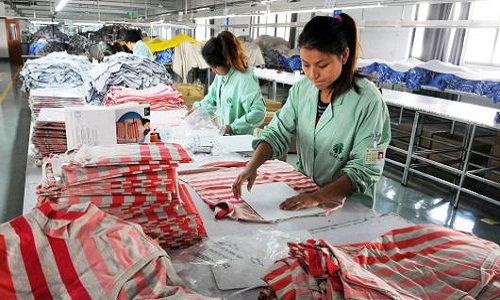 this problem by strategically investing in other countries like Vietnam, Cambodia and some other African countries for the manufacturing needs. This has helped it to provide competitive prices by retaining their share in global market. Technological advances, especially complete automated operations have helped China to increase productivity and lower per capita cost.
Unpredictable reactions deter Indian investors
However, Indian textile entrepreneurs are unsure of what strategy to adopt as most often China’s reaction can be quite unpredictable. For instance, a decade ago, China began expanding its business in other areas apart from textile indicating its slow exit from textiles; since the last three to four years, the country has again started procuring huge quantities of yarn from India. This resulted in the country setting up many new yarn exporting spinning companies in India focusing only on China as their export market. These Chinese markets were not concerned with the quality of yarn leading to the supply of inferior quality yarns by their Indian counterparts. Export of inferior yarn from India continued only for about two to three years before China stopped all imports from India. The units, setup for supplying only to China, started suffering the consequences.
Around six years ago, China started exporting fabric at very cheap rates. This impacted a large number of textile corporates in India who were planning to invest in the country. But, of late China has almost stopped exporting fabric to India due to which the Indian weaving industry is growing. Due to China’s constantly changing strategy, India is not able to strengthen its weaving, knitting and finishing processes thereby damaging the entire value chain. Therefore, instead of depending on another countries strategy, India needs to formulate its own strategies to maximise its strengths and overcome its weaknesses.
Under Armour refocuses attention on sportswear
Under Armour is returning to its roots as a sportswear company, refocusing its attention on making clothes for athletes. This refocus comes at a critical time for the Baltimore-based company. Earlier this month it issued an underwhelming financial forecast at an investor day, while its culture has also been in the spotlight after a report that employees put strip club visits on expenses.
Under Armour, started in 1996, expanded aggressively and took on the likes of Nike and Adidas. But its shares have fallen by 68 per cent since 2015 while sales have flagged in North America. Under Armour seeks to capitalise on rising demand for athletic-themed clothing. The company’s ventures into sports-inspired fashion included a tie-up two years ago with designer Tim Coppens, known as Under Armour Sportswear. It has since been discontinued.
Vietnam’s labor cost higher than Southeast Asian neighbours
Labor costs are higher in Vietnam than in other Southeast Asian countries. Wage costs per worker for the median Vietnamese firm are about twice as high as in Laos, Myanmar and Malaysia and about 30 to 45 per cent higher than in Cambodia, Thailand and the Philippines. Labor cost for a firm is defined as the cost of payments to workers divided by the number of workers.
But Vietnam’s high labor costs are in line with productivity levels and thus do not seem to be a major obstacle to competitiveness. The value-added per worker per year in an average manufacturing firm in Vietnam is higher than in most countries in southeast Asia.
Vietnam’s relatively high value appears to be partly driven by high and growing use of capital. The north-central and central coastal regions have the highest productivity while the southeast comes in second.
Foreign-owned firms are generally more productive than domestic firms, which can be explained by their easier access to technology and finance through their parent companies. Capital productivity is low in Vietnam. The ratio of sales to value capital in Vietnam is around 160 per cent, lower than in any of its peers in southeast Asia. It could be that capital is not used very efficiently in Vietnam.











