FW
Santoni’s introduces new seamless circular knitting machines
Italy-based textile machinery company Santoni has come up with seamless circular knitting machines, together with sock knitting machines, large diameter fabric knitting machines, and process finishing technology. Added to these are the brand new, patented X Machine and XT Machine with their ingenious intarsia technology, a new automatic finishing system for seamless boxers, and the innovative K Fabric Project that introduces a completely new type of knitted textile process. The TC Cut machine is a round-shape toe closer with an integrated slitting device to prepare stockings for manual assembly.
Santoni was founded in 1919 as a socks machine manufacturer. It is now a leader in the production of electronic machines for garments without seams and caters to manufacturers of underwear, sportswear, beachwear, medical wear, denim wear, smart textiles, socks and footwear.
Mec-Mor machines are equipped with needle-shifting movement of the needle beds. This technology enables the production of weft double-face knitted garments with high quality designs and record production times. It is also used to produce accessories, such as 3D backpacks, where various yarns can be knitted into ad-hoc positioned areas, in order to obtain a seamless structure that guarantees superior product performance. The SM8-TOP2V cut and sew machine applies a gusset into each boxer with a four-needle sewing head, completing the whole process automatically and offering the finished boxer ready for the final packing stage.
North Indian farmers return to cotton
Farmers in North India have made a comeback to cotton this year. The fiber crop helped growers across the country get decent prices last year. So, sowing in Punjab and Haryana is expected to increase by about 10 per cent. In Punjab, cotton acreage has increased by around 41 per cent, to about four lakh hectares this year over the previous year, while the growth in acreage in Haryana is around five per cent, at 6.35 lakh hectares.
Untimely rains in the month of May in Punjab and Haryana did impact planting and force farmers to resow patches. However, cotton sowing prospects in other regions will depend on multiple factors such as the monsoon as well as alternate crops such as castor and soybean. Farmers have multiple alternates available for cotton. So they will opt for the higher return crop especially when there is still an uncertainty over the monsoon. Despite the crop size being smaller than the previous year’s, the prices supported by higher MSP have given better returns to cotton growers. While it is premature to estimate the sowing prospects in central, western and southern India before the onset of the monsoon, there is an optimism about the cotton crop this year.
Western Hemisphere emerges alternative sourcing destination for US denim apparels
The Western Hemisphere is becoming an important alternative to Asian sourcing, particularly in light of the US-China trade war and the threat of 25 percent tariffs on jeans imports from the country. According to the Commerce Department’s Office of Textiles & Apparel (OTEXA), denim apparel imports from the Western Hemisphere increased by 13.41 per cent in the first four months of the year to reach a value of $323.68 million. This represented a 27.4 per cent market share of all U.S. imports of denim apparel, 97 percent of which is jeans. The market share gained 8.17 percent for the year through April.
Countries such as Mexico, Nicaragua and Guatemala are leading growth in the region as a more local, faster-turn and generally duty-free option to sourcing from the Asian production giants like Vietnam, Bangladesh and Pakistan. Nicaragua’s jeans shipments to the U.S. jumped 23.57 percent in the period to $32.38 million, while imports from Guatemala rose 36.58 percent to $10.77 million.
The two countries are part of the Central American Free Trade Agreement (CAFTA), which allows duty-free treatment under certain input stipulations and has boosted exports for U.S. yarn and fabric manufacturers. Jeans imports from the CAFTA countries rose 26 percent to $43.75 million in the first four months of the year compared to the year-ago period.
Chinese polyester plants scale down
From April to May, many polyester plants in China scaled down or suspended production. Polyester feedstock price also weakened. The inventory burden has been obviously eased. Cash flow of PFY and PET bottle chips slightly improved, and PFY plants turned to be profitable but PSF plants still suffered losses with falling prices. The polymerization rate has increased to around 90.5 per cent from 87.8 per cent. In addition, some PFY and PSF plants have presold some orders. The polymerization rate is expected to be supportive to the upstream feedstock market in the short term.
Players lowered their run rate to slow down the accumulation speed. Orders improved sporadically after PFY price firmed up, but the overall weakness has not changed, supporting the run rate of twisting units and fabric manufacturing plants. The intensified Sino-US trade conflict has made downstream plants cautious in purchases and the situation is not expected to change in the short run.
Replenishing of downstream plants in June has improved compared with April or May. Polyester plants witnessed decreasing stocks. Actually, the inventory was transferred to the downstream market and partially to traders. Downstream demand has been continuously weak. Stocks of feedstock and finished goods are expected to be high in the short run.
Child labor plagues supply chains
Child labor is still prevalent in global supply chains. This is true of manufacturing hubs like Bangladesh, China, Cambodia and Vietnam. So says research consultancy Child Labor Index, which first began compiling comparable data in 2016.
Nearly f 27 out of 198 countries—accounting for more than 10 per cent of the world’s population—were found by the index to pose an extreme risk, with North Korea, Somalia and South Sudan the top three worst offenders. Ethiopia, Bangladesh Turkey and Vietnam reveal no change in their high risk of children being exploited or forced to work out of necessity. Venezuela saw the highest risk in child labor risk. However, 52 countries registered significant improvements between 2017 and 2019. Those include Liberia, Myanmar and Madagascar.
Child labor is defined as employment that limits or damages the physical, mental, moral, social or psychological development of children. Assuming the minimum age for work is 15, there are roughly 150 million child laborers around the world, particularly on farms in Africa and Asia. The economic momentum of many countries is yet to trickle down to the poorest in society and any meaningful headway on labor rights issues, including child labor, remains elusive.
China exporting goods to the US through Vietnam
Goods are arriving in the US claiming to be made in Vietnam while they are in fact made by Chinese companies. They are indulging in this practice to avoid high tariffs. Many of them have shifted production from China to Vietnam to avoid the 25 per cent levy imposed by the US on Chinese goods amid a spiraling trade war.
Dozens of fraudulent product-origin certificates have been discovered on goods including textiles, fisheries, farm products, tiles, honey, iron, steel and plywood. Chinese plywood was discovered being shipped to America through a Vietnamese company. Vietnam says the trend has affected the reputation of its businesses and goods. The country has threatened to crack down on Chinese companies illegally using made in Vietnam labels on goods shipped to the US to avoid high tariffs.
Vietnam has long been a manufacturing hub for cheaply-made goods from Adidas sneakers and H&M dresses to Samsung smart phones and Intel processors. Those exports have soared this year as China and the US have escalated tit-for-tat tariffs on billions of dollars worth of goods. In the first three months of this year, US imports from Vietnam rose 40 per cent from the same period last year.
Birla Cellulose does product mapping
Birla Cellulose has completed a life cycle assessment (LCA) of products in its portfolio. The LCA exercise has assessed the environmental footprint and its effects on human and animal health and the environment, such as ozone layer depletion, mineral use and use of nitrogen and phosphates.
A member of the Sustainable Apparel Coalition, Birla Cellulose uses the Higg Index Tool to monitor manufacturing units’ performance on environment and social scales. The index monitors energy and water consumption, reduction in effluent discharge and transport distance. For all 11 of Birla Cellulose’s manufacturing units, Higg scores have been completed along with a benchmark analysis.
Birla Cellulose works with global brands to drive initiatives to trace the source of raw materials and help them trace their complicated supply chains in India. From Forest to Fashion is the first supply chain mapping project of its kind in the apparel industry. It has provided clarity on value chain sourcing from India and improved transparency of different players involved in the supply chain of some major brands. The next step will be to digitise the entire process. Birla Cellulose is now focusing on projects within the supply chain to reduce resource use, especially water and chemicals, in different stages of the Forest to Fashion process.
Mimaki Engineering to showcase digital print technologies at ITMA 2019
Mimaki Engineering, a leading manufacturer of inkjet printers and cutting systems, will showcase its broad portfolio of cutting-edge digital print technologies at ITMA 2019. This will include the first global showcase of its new hybrid digital textile printer featuring both direct-to-textile and direct-to-transfer print capabilities. These features enable textile and garment manufacturers to achieve unparalleled flexibility and enhanced application opportunities for increased business growth. To facilitate these benefits, the new Mimaki printer also allows multiple sets of inks to be loaded simultaneously, supporting increased fabric range versatility and maximum product variety.
TA Job Controller Software: Specifically designed for textile production environments, this TA Job Controller enables users to connect one-on-one to the RIP and other devices, for an automated workflow from design to pre-print, print and post print processes.
Mimaki Tiger-1800B MkII : This industrial digital textile printer combines Mimaki’s Japanese expertise in electronics with La Meccanica’s know-how in building solid and robust belt printer bodies with ‘made-in-Italy’ design. It enables users to produce extremely high-quality products at up to 385sq m/h print speed, without the need to compromise on production and throughput.
From its advanced TR series, Mimaki will also showcase the TR300-1850C coating machine and the TR300-1850S steaming machine, and the benefits of a total solution for textile print production. Providing the equipment needed to operate the entire digital textile workflow, Mimaki’s all in on solution ensures complete technology compatibility, as well as increased productivity, print quality and reduced production costs.
Mimaki will also use ITMA 2019 to showcase its wide range of flagship solutions addressing different textile market segments. These include:
Mimaki TS55-1800: This dye-sublimation business-enhancing printeraddresses the entry and mid-level markets offering continuous operation and an unprecedented price-quality ratio. Equipped with Mimaki’s core technologies, the printer achieves high productivity and high-quality print with vibrant colours and vivid imagery and is suitable for interior fabrics, sports and fashion apparel and soft signage.
Mimaki UCJV300-160: A roll-to-roll UV LED inkjet integrated printer/cutter, featuring a white ink capability. A versatile printing system, the UCJV300-160 uniquely enables four-layer printing for transformative backlit applications, and five-layer printing, allowing different designs to be viewed on both sides of a substrate simultaneously. Visitors at ITMA 2019 will see the UCJV300-160 printing wallpapers live.
Bangladesh: Future of RMG exports is positive, albeit with a few challenges
"The RMG sector in Bangladesh has witnessed tremendous growth over the last one decade. The country has emerged as the second largest RMG exporter to the world with around 85 per cent of its export earnings achieved through this sector. This growth in the country’s RMG sector has created many new employment opportunities in the country with around 4 million Bangladeshi people currently being employed in the sector reveals an exclusive study by Wazir Analysis and Textile Magazine."
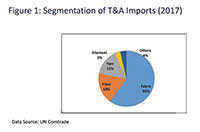 The RMG sector in Bangladesh has witnessed tremendous growth over the last one decade. The country has emerged as the second largest RMG exporter to the world with around 85 per cent of its export earnings achieved through this sector. This growth in the country’s RMG sector has created many new employment opportunities in the country with around 4 million Bangladeshi people currently being employed in the sector reveals an exclusive study by Wazir Analysis and Textile Magazine.
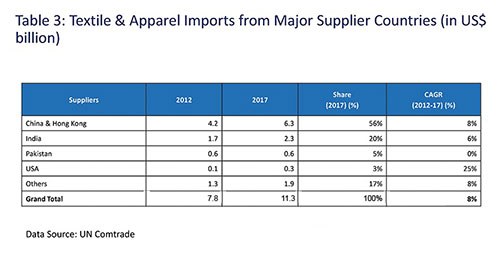
The textile and apparel exports of Bangladesh increased at a CAGR of 8 per cent from $25 billion in 2012 to $36 billion in 2017. The country, which enjoys preferential access in the European Union (EU) under the ‘Everything but Arms’ (EBA), gained around 61 per cent market share in the region for textile products. Other than the EU and US, Japan and Russia are the other flourishing countries with their market share growing at a CAGR of 36 per cent and 28 per cent, respectively. Through its export competitiveness and duty free access, Bangladesh has attracted many international brands in recent years, reveals the study. The country’s apparel exports have grown at a CAGR of 14 per cent since 2005. These are further likely to grow at a CAGR of 12.5 per cent to reach $100 billion by 2025.
Fragmented textile value chain hampers growth
The Wazir Analysis and Textile Magazine study also reveals, Bangladesh faces many challenges that affect its export growth. Firstly, the country has a fragmented textile value chain which is highly dependent on import of raw material for textile and apparel commodities. Also, issues like increasing wages, lower output, low product quality, etc plague export growth in the country. To counter these issues and remain competitive in the global market, Bangladesh needs to focus on the following aspects:
Integration of operations to enhance market power, position
Backward & forward integration could help Bangladesh companies to control not only their buyers but also their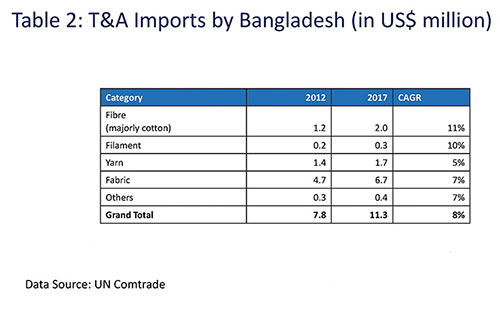 suppliers, distributors and customers. It can also enhance their market power and position, reduce import of fabric and yarn and internal consumption of products, increase value-addition at all stages of the textile value chain, reduce in costs, lead times, increase employment avenues for local population and better margins for the manufacturers.
Dealing with quality, design and delivery issues
Another area that Bangladesh needs to focus on is offering superior quality products with innovative designs, customisation, on-time delivery, technology innovations and after-sales service. This can be achieved through major transitions in manufacturing set-up and workforce development. The main components of this transition include Streamlined manufacturing process can help Bangladesh deliver high variety, low volume orders
Reducing mishaps through concepts like Right First Time, Zero Defect, Quality Control can help the country to improve its products and processes Operaters need to take ownership of their equipment and also simply their processes to increase their capacity and also improve the quality of their offerings.
The manufacturing units should adopt information systems like Business Process Management (BPM) to improve their capacity. They should also involve their employees in their production processes
Companies need to adopt market intelligence to keep up with the latest trends and developments along with competitor analysis. They need to introduce low-volume high fashion products. They also need to create a proper work culture in their companies by training their labor as well as middle management.
Lastly, Bangladeshi apparel manufacturers should focus on catering to the demand of Indian market which is expected to grow at 12 per cent CAGR by 2025.
Kornit Digital to launch Kornit Presto System at ITMA 2019
"Kornit Digital, global market leader in digital textile printing innovation, will commercially launch the new Kornit Presto, the only industrial single-step solution for direct-to-fabric printing at ITMA 2019. The Kornit Presto solution eliminates the need for pre and post treatment of fabric and allows for high-quality printing on an extraordinarily broad variety of fabric types and applications."
 Kornit Digital, global market leader in digital textile printing innovation, will commercially launch the new Kornit Presto, the only industrial single-step solution for direct-to-fabric printing at ITMA 2019. The Kornit Presto solution eliminates the need for pre and post treatment of fabric and allows for high-quality printing on an extraordinarily broad variety of fabric types and applications. The Kornit Presto does not consume water in the printing process, making it the most environmentally friendly solution available for direct-to-fabric textile printing today.
The new Kornit Presto comes with the ground-breaking NeoPigment Robusto, the best Pigment-based ink  available in the Industry. Implemented into the renowned Kornit NeoPigmentTM process, the Robusto provides above industry standard wash and rub results and exceptional color fastness across a wide fabric and application range. The Robusto enjoys faster physical and chemical bonding characteristics, enabling a significantly shorter curing time, while providing industry-leading quality and a wide color gamut. The NeoPigment Robusto ink was developed with sustainability priorities and is ECO PASSPORT and GOTS V5 approved.
The Kornit Presto solution suits a wide range of business and application needs in a variety of industry segments, including fast growing segments within the on-demand fashion and home décor markets. It is a highly productive solution, available in multiple configurations and able to print 450 square meters per hour.