


FW
“Brands need to incorporate sustainability in their business models.”
Bimal Arora, Honorary Chairperson, Center for Responsible Business, Aston Business School
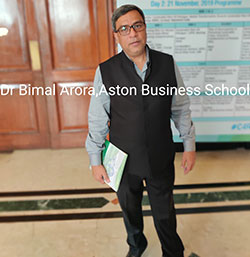 Bimal Arora, Chairperson, Center for Responsible Business, Aston Business School believes that over the last few years, the Indian garment industry has become more resourceful and skilled. “However, it needs to pull up its socks and be more competitive,” he said at the sixth edition of CRB’s Flagship Annual Conference. The conference was held from November 20-22, 2019 in New Delhi.
Sustainability fuels innovation and competition amongst brands
“The Indian fashion industry faces circularity issues that need to be addressed resiliently,” he said. “Rather than changing the economic or financial bottomlines of brands, we need to revamp their operations inherently and incorporate sustainability into their business models,” he added.
According to Arora, sustainability can be a big asset if used correctly. “It is not just about cost anymore,” he says further adding that several manufacturers have changed their buyers’ perception of sustainability through their operations. “Sustainability is helping these manufacturers to innovate and become more competitive. Brands that adopt cyclical changes in their business models are not affected by the slowdown.”
A neutral space for discussing challenging issues
Elaborating on the program of the CRB conference, Arora said, “Now in its sixth year, this conference has come a long way. It acts as a platform for garment industry professionals by offering them an independent neutral space for dialogues, deliberations and discussions on complex and challenging issues. Having a complex design program, the conference covers diverse issues over three days. Each of its session is covered by specialists.”
Gants appoints Patrik Soderstrom as new CEO
Gant has appointed Patrik Söderström as new chief executive officer starting February 1 of next year. The executive until now held the position of vice president of global markets and sales.
The appointment of Söderström comes after Brien Grevy, current chief executive officer of the company, announced his resignation last October to return to German sportswear Adidas. Söderström joined Gant in 2016, after holding the position of general manager of Luxottica for northern Europe. Prior to that, he had positions in Reebok and Levi Strauss.
His understanding of how to lead the commercial business and channel landscape and navigate in today’s rapidly changing retail environment, while having an understanding of the power of the brand has already proved invaluable to Gant’s growth. Looking ahead, his passionate leadership will be vital for Gant’s future growth.
Gant was founded in 1949 by Bernard Gantmacher and his children Marty and Elliot. The company has 600 directly operated stores in seventy markets around the world, in addition to having a presence in 4,000 multibrand stores and corners in department stores. The company’s revenue is around 1 billion dollars.
Mercedes Benz Fashion Week Australia to reserve 25% seats for final public
To be organised by IMG from May 11-15, 2019 in Sydney, Mercedes Benz will reserve 25 per cent of its seats for the public. The trade show will gather 26,000 visitors during the day and 1,600 professionals from more than twenty countries.
Australia’s industry-facing event that previews the resort collections each May, six months before they go on sale, has previously only been open to media, influencers and other invitees.
The Australian fair follows in the footsteps of other events that have also opened their doors to the public. The British Fashion Council created a program of events parallel to the runways to open the event to the final public.
The fair sector has also joined the trend of opening its doors to the public on foot. The Parisian intimate fair, Unique by Mode City, opened its doors to the final consumer in its latest edition in July.
The Ikat Story collaborates with Pause for collection
Handloom apparel brand The Ikat Story has collaborated with clothing brand Pause for its upcoming festive collection and will launch the range at the Magnetic Fields Festival in Rajasthan on December 13.
The Ikat Story, a brand known for its modern use of heritage handloom textiles, will launch an exclusive collection at the upcoming Magnetic Fields Festival. The collection is the brand’s first collaboration with Pause and mixes both brands’ contemporary and androgynous aesthetics.
With a color palette of navy and white, the collection mixes loose, relaxed tailoring with modern details such as sportswear inspired embroidery. The free-form sets and modest silhouettes appear designed for the Rajasthani desert where Magnetic Fields will take place. The collection showcase will also feature jewellery from Bhavya Ramesh featuring bold, tribal-inspired silver pieces.
The Ikat Story will take part in the Magnetic Fields Festival from December 13 to 15 in Alsisar Mahal, Rajasthan. The music festival will feature musicians from around the world and a number of vendors. The event’s sponsors include Ray Ban, Jameson, Red Bull, Bumble, and Shoes on Loose among others.
Blackstone invests huge capital in Ryka Commercial Ventures
Blackstone, globally the biggest private equity firm, has invested a whopping Rs. 1,750 crore in Ryka Commercial Ventures, the holding company of Future Lifestyle Fashion, through debentures which will be used to retire or pre-close all existing financial obligations.
Blackstone is infusing capital by combining equity and structured debts. This will fund the capital expansion of Kishore Biyani’s deep-discount retail format ‘Brand Factory which is modeled on American retailer TJ Maxx’
In July 2019, Blackstone acquired around 6 per cent stake in Future Lifestyle Fashion for about Rs. 545 crore in a secondary market transaction. Kishore Biyani and his family own 53.4 per cent of Future Lifestyle Fashion through various entities including Ryka Commercial Ventures. Though the Future Group generates its biggest chunk from food and grocery retailing, its apparel and lifestyle segment generates higher margin business. The company grew by 27 per cent last fiscal with revenues of Rs 5,728 crore. The firm also manages nearly 30 brands including Indigo Nation and Lee Cooper, through 339 stores across 7.2 million square feet of retail space.
Bestseller to focus on digital operations and sustainability
To deal with its falling profits, Bestseller aims to innovate its digital operations besides incorporating sustainability in its operations. Danish fashion retail giant’s sales rose by 7 per cent to €3.5 billion in its 2018/19 financial year but its pre-tax profit declined by 3 per cent to €372 million.
The group, which owns its eponymous chain, plus Vero Moda and Jack & Jones among other labels, also hinted that conditions are tough in the market, even though its sales are up.
The firm’s approach of creating close partnerships with its wholesale customers has paid off in a market affected by changes and new realities. The company’s 2,750 stores in 38 markets worldwide are complemented by its products in over 20,000 multi-brand and department stores.
Gujarat to host Itmach India
Itmach India will be held in Gujarat, December 5 to 8, 2019.
This is a textile machinery and accessories exhibition showcasing the latest textile technologies and machinery to the Indian textile industry. So the Indian textile industry can experience world class textile manufacturing technology under one roof. Weaving machinery and technology supplier Picanol will showcase its airjet Omniplus- i loom with Smartshed, which will be displayed working on denim fabric with warp beam from Arvind Mills and operate at production speed above 1000 rpm.
The Indian textile industry has continuously invested in innovations and technology upgradations as global opportunities open up. The backbone of the Indian textile industry, the spinning sector has of late been facing a tight demand situation due to the US-China trade war, China’s trade agreements with Pakistan and Vietnam, as well as high domestic cotton prices. This has resulted in slower investment in the spinning sector this year. However, the trade war has also brought new opportunities to weaving, knitting, dyeing, printing and wet processing and garmenting. Global brands and retailers are looking for Indian suppliers with economy of scale plants with state-of-the-art process technology. Therefore, the Indian weaving, processing and garmenting sectors are still in the investment mode and resource efficient technologies are in demand.
Bangladesh opts for digital payments
Bangladesh plans to bring its 3.6 million garment workers under a digital wage system by 2021.
Already 1.5 million garment workers receive their wages under the digitised system. Another 2.6 million will soon join them. Transitioning from cash is expected to significantly increase the security and efficacy of payments not only by saving time handing out payments but also minimising productivity disruptions on payday.
Using digital and electronic payments instead of cash has the potential to empower workers by improving their access to financial services, savings, credit and insurance.
This, in turn, can result in additional economic opportunities and independence, particularly for the women who make up 80 per cent of Bangladesh’s garment workforce. Women in Bangladesh with digitised wages are half as likely to report handing their salaries over to their spouses on a monthly basis. Shifting from cash to digital payments also improves the likelihood of women participating in household financial decisions by 15 per cent. By ensuring traceability of the payment process, digital payments are also expected to reduce corruption, fraud and theft and make it easier to check compliance with core labor standards and to measure how factories comply with ILO’s decent work agenda in relation to living wages.
Burberry phases out harmful chemicals
Burberry intends for every single product it sells to have at least one positive attribute by 2022.
Some products might be made out of an environmentally-friendly material, like its newly introduced Econyl made from recycled fishing nets. Others might use traditional materials, but they are manufactured at a carbon-neutral factory.
Burberry has also set a goal of removing harmful chemicals from its products by 2022 and has trained more than 1,000 employees in chemical management to facilitate that goal. In 2017, the company sourced 21 per cent of its cotton ethically through the Better Cotton Initiative, but that’s increased to 68 per cent this year. In the two years since the five-year plan was put into place, 36 per cent of Burberry products have been made to have at least one such attribute. The goal is for all of its products to meet the criteria by 2022.
On the operations side, the brand’s major focus is on the raw materials stage of the supply chain, which is responsible for 50 per cent of all Burberry’s carbon emissions. Burberry intends to cut emissions by 95 per cent by switching as much of its supply chain to renewable energy as possible. From 2018 to 2019, Burberry obtained nearly 60 per cent of its energy from renewable sources, a 43 per cent reduction from 2016. The brand is already carbon neutral in its retail stores in the Americas and parts of Europe, the Middle East and Africa.
Spanish brand comes to India
Spanish fashion brand Desigual is coming to India.
It will first be available on Myntra and thereafter in outlets across the country. In the first phase six stores will be opened in metros, followed by stores in Tier II.
The Desigual essence is characterised by its individuality and the unique character of its creations, which are always different and designed to authentically dress anyone who wants to be 100 per cent themselves and show their most creative side. The brand offers clothing for women, men, and children as well as a collection of unique accessories. The brand is Mediterranean, and this is where its inspiration comes from. The lifestyle is conveyed through its designs, stores and communication. The brand’s clothing exudes a character that is unique, which helps people express themselves and be the most authentic. Desigual’s characteristic vibrant designs come with a flamboyant splash of colors.
Desigual is being brought to India by Tablez. This retail group has introduced several leading global brands in F&B, toys, lifestyle, and apparel to India –– including Springfield, Build-A-Bear, GO Sport, and Yoyoso. In the F&B vertical, Tablez holds the India franchise rights for Cold Stone Creamery and Galito’s, in addition to successfully developing its home-grown brand, Bloomsbury’s. Tablez currently operates more than 70 outlets globally and plans to expand to 300 outlets by 2020.











