


FW
Ricoh unveils innovative micro factory concept
Ricoh has unveiled its Digital Micro Factory (DMF) concept. The micro factory is expected to solve various social problems and provide new customer value to more and more people in garment and related markets. Ricoh hopes to expand sales of DMF workflow cloud solutions and textile printers. DMF is aimed at producing significant social benefits using the advantages of industrial inkjet technology, such as diversity, customization, differentiation, multi-type small lot production and leading the industry trend.
Ricoh will continue to develop technologies and experience in commercial printing, but incorporating sustainable development and opening greater possibilities in industrial printing, with comprehensive and new, innovative technologies.
Ricoh will strive to create an open global business environment, so as to push forward social problems such as water pollution, electricity consumption and excess inventory, maintaining a comfortable and safe living environment, a common issue for all human beings. Ricoh aims at expanding its China business into a core market. Ricoh has been providing print head services to garment manufacturers for many, many years. Ricoh brings an environmental protection system and business model that conforms to trends of domestic production and domestic consumption. It is a manufacturer of print heads, the manufacturer of ink, and the manufacturer of complete systems.
European group calls for textile strategy
The European Recycling Industries’ Confederation has called for an ambitious strategy on textiles. This will include: extended producer responsibility legislation and incentives to boost end markets. The confederation says the strategy is needed because of increased tonnages from kerbside textile collections and has called on the European Commission to introduce a strategy to render textiles circular throughout the value chain.
The development of fast fashion has deeply changed textile consumption patterns across the world, which has impacted the clothing recycling sector. While EU law obligating authorities to separately collect textiles by 2025 will increase the supply of used textiles, it means there is a need to complement the separate this with equally ambitious measures aiming at pulling the demand for re-use and for material.
Resources charity Wrap has released an update on its Sustainable Clothing Action Plan, launched in 2013 aiming at reducing carbon, waste and water reductions. Retailers such as Marks & Spencer and Next have both signed up for SCAP. Under the commitments, signatories have pledged to reduce carbon, water and waste to landfill by 15 per cent alongside a 3.5 per cent reduction in the amount of waste arising per ton of clothing by 2020. While water and carbon targets have been achieved, there has only been a four per cent reduction in waste going to landfill since 2012.
Global garment steamer market grows at five per cent
The global garment steamer market is growing at five per cent. Garment steamers have been witnessing a significant demand among professional and residential users across the globe. They are also known as clothes steamers, and these appliances use high-temperature steam to remove wrinkles. They have profound applications among residential and professional contractors. Increasing product diversification, coupled with the increasing demand for product reliability, is expected to contribute to the long-term value for professional users. Changing lifestyles and the increasing availability of consumer appliances via online channels are expected to favorably affect the clothes steamer market growth.
Upright clothes steamer equipment is ideal for heavier garments as it is bulkier than hand-held streamers. These appliances have a large capacity and can steam clothes for a long duration. They are exceptionally stable and provide powerful and quick removal of wrinkles and creases. The presence of a large water tank at the base of the device enables steam to stay for a long duration. The availability of the built-in hanger makes upright steamers convenient for both residential and commercial consumers.
Over the past few years, the dynamics of the clothing manufacturing industry has changed. Clothing vendors are increasing their investments in enhancing the productivity and resilience of their products.
Chinese luxury goods market grows 26 per cent
The market for personal luxury goods in China grew 26 per cent in 2019. Sale of luxury goods in China accounts for around nine per cent of all global luxury spending. Chinese consumers remain some of the most active buyers of luxury items in the world. In 2019 some luxury brands in China kept a close eye on the value of the yuan and shifting travel and shopping patterns or working to adjust their China pricing. Others turned their attention more closely to their efforts within mainland China after years of trying to attract Chinese tourist-shoppers overseas.
Luxury market in China were buoyed this year by brands efforts to adjust pricing more in line with European or Japanese markets, which convinced Chinese shoppers who would otherwise jet off to France or the US for their luxury hauls to shop closer home. The question now for luxury brands is whether to invest more in mainland China next year or maintain current efforts (perhaps investing more in e-commerce or refurbishing any existing brick-and-mortar locations).
China’s economy is expected to encounter greater downward pressure and face a more complex situation in the year ahead despite signs that the country’s Gen Z is ready to spend more on luxury street wear collaborations.
WBHA celebrates 125 years of the Indian knitting industry in Kolkata
"West Bengal Hosiery Association recently celebrated this glorious journey of the Indian knitting industry with an event in Kolkata. This event was attended by various dignitaries like Smriti Irani, Minister of Textiles and Women & Child Development, Government of India; Rakesh Biyani, President, CMAI; Dr A.Sakthivel, Vice Chairman, AEPC; Ashok Kumar Todi, President, WBHA; Sandeep Seksaria, Hony Secretary, WBHA and Kunj Behari Agarwala, President, FOHMA"
 Starting as an innerwear industry 125 years ago, the Indian knitwear industry has gradually evolved with multiple segments like swimwear, kidswear, thermalwear, home textiles, under its kitty. Bolstered by a strong domestic consumption, the industry is now poised for a promising future ahead.
West Bengal Hosiery Association recently celebrated this glorious journey of the Indian knitting industry with an event in Kolkata. This event was attended by various dignitaries like Smriti Irani, Minister of Textiles and Women & Child Development, Government of India; Rakesh Biyani, President, CMAI; Dr A.Sakthivel, Vice Chairman, AEPC; Ashok Kumar Todi, President, WBHA; Sandeep Seksaria, Hony Secretary, WBHA and Kunj Behari Agarwala, President, FOHMA.
Government plans new schemes for the industry
At the event, Irani highlighted the schemes that the government aims to introduce for the industry. “Besides setting up a knitwear cluster, we plan to upgrade and equip our MSMEs with modern machines. We also plan to introduce a credit scheme to offer timely financial assistance to our women entrepreneurs,” she said. “We have decided to form a group of the textile industry association to enhance our productivity,” she added. 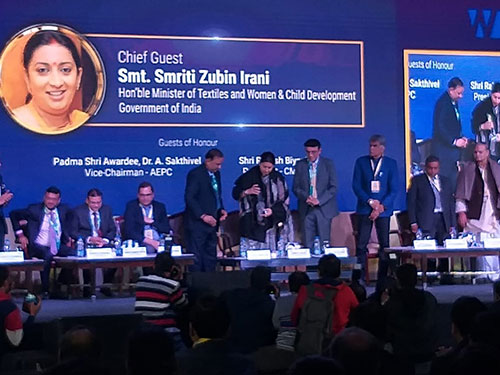
The ministry recently also announced a skilling program for around 10 lakh people in the industry. “For years, we focused on entry level skilling. We need to improve our skill levels to compete on a global level. For this, we recently signed MOUs with 18 state governments and industry partners,” Irani revealed.
Encouraging entrepreneurs with new initiatives
Outlining the role of WBHA in the industry, Todi said, “The association encourages entrepreneurs across the country. We have developed a hosiery park for MSMEs and large groups and also upgraded our machineries. Besides, we have trained our employees to compete with the best and make it a true make in India success. We offer good quality and eco-friendly products.”
The session ended with the felicitation of key players for their contribution to the knitwear industry over the last 125 years. Rupa & Company, JG Hosiery, Dollar Industries, Lux Industries, Mira Knitting Works, TT Ltd and Parrot Hosiery Factory were recognised as the path breakers of the industry.
Inculcating new thoughts into the industry
Seksaria delineated the growth of the knitted industry. “As the demand for knitted apparels is growing, the industry is escalating at a rapid speed,” he said. “Not just brands even designers are incorporating knits into their clothing. To tap this demand, we plan to inculcate new thoughts and unique designs in our array of knitwear products,” he added.
The Indian knitwear cluster is the largest cluster in Asia. “We currently serve the domestic market. However, if we organise our operations, we can expand to the market also,” noted Sanjay Jain, Chairman, CITI.
Turkey’s denim brand Isko wins STeP certification
Turkish denim manufacturer Isko has earned the STeP certification from Oeko-Tex. This is a modular certification system for production facilities in the textile and leather industries. STeP grades a company across six categories—chemicals management, environmental performance, environmental management, social responsibility, quality management, and health protection and safety at work—and looks for long-term implementation of sustainable processes.
Isko is the first denim producer in the world to be recognised with the Nordic Swan and EU Ecolabel certifications. The company has a production capacity of 300 million meters of fabric a year with 2000 high-tech automated looms. Isko has a global presence with offices in 35 countries, and is part of Sanko Tekstil, the textiles division of the Sanko Group. Responsibility and innovations go hand in hand at Isko. Isko’s latest series of performance fabrics is made with certified recycled materials. These textile concepts are all woven, even if many have the look and hand feel of knitted fabrics, ensuring superior durability and great recovery. They provide a broad range of performance properties, such as moisture management, UV and wind protection, heat retention, water and stain repellency. Nylon is used for the first time, presenting super light woven and cozy outdoor fabrics, reversible and packable styles.
Drought affects Australian wool growers
Australian wool growers are continuing to face the hardships of drought, causing brokers’ receivals to be way down. Buyers, exporters and traders are faced with earlier stock and trade losses, while machinery owners, garment makers and retailers face slow demand, sales and inventory devaluation.
However, the past seven days has been the best week of positive news that the season has produced. The USA and China came to some sort of understanding over their trade imbalance dispute. The UK election result has forged the path for pushing Brexit through, with that problem more relevant given the premium market that Europe is for apparel wool products. Another contributing factor to the market gains was the lack of the advertised quantity once again failing to materialise at auction. A little over 34,000 bales, or 12 per cent lower volume, eventually saw their way to the selling rostrum. Brokers passed in just 7.7 per cent of bales offered, as price levels gained rapidly. Purchasing was again dominated by the big players of each segment. Significant though was the step up by Chinese top makers on all Merino types and descriptions.
Significant quantities of wool have been held back by growers and decision making as to how and when that is dispersed will need close monitoring by their wool selling brokers.
How UK retailers tackled the blues
UK retailers chose different ways of surviving 2019. Some prospered and some struggled. For Boohoo group revenue jumped 43 per cent year on year. Its adjusted ebitda was up 53 per cent while gross profit grew 40 per cent in the first half of 2018-19. Adjusted profit before tax was up 45 per cent on last year. Primark has continued to expand its impressive retail footprint over the past 12 months, opening 14 new stores in the year. It now has 161 UK stores. Primark’s revenue rose 4.2 per cent for the year driven by its ongoing store expansion. The company is now focusing on international expansion as well as investing in customer experience and service.
Sportswear giant JD Sports’ revenue almost doubled for the six month period. Group revenue jumped 47 per cent compared with the same period last year. Operating profit increased 61 per cent on the previous year. Profit before tax grew by seven per cent. JD Sports has branched into the wholesale market over the past 12 months.
British mother and baby retailer Mothercare is expected to wind down its UK business by February 2020. All of Mothercare’s 79 stores are expected to close. Business rates and rent prices, in addition to a decline in sales, are all part of the issues facing the retailer. An outdated business model and failure to invest in online retail have also contributed to its downfall.
Lenzing, Duratex JV builds wood pulp plant in Brazil
Lenzing and Duratex are building a dissolving wood pulp plant in Brazil. The joint venture with Lenzing’s 51 per cent stake and Duratex a 49 per cent stake is financed through long-term debt. The corresponding financing contracts are expected to be concluded at the end of the first quarter of 2020.
The new dissolving wood pulp plant strengthens Lenzing’s backward integration and cost position as well as its specialty fiber growth. The single-line dissolving wood pulp plant with an annual nameplate capacity of 5,00,000 tons will be the largest and most competitive production facility of its kind. Dissolving wood pulp is a key raw material required for manufacturing Lenzing’s bio-based fibers. The joint venture will supply the entire volume of dissolving wood pulp to Lenzing. In planning the new production facility, particular importance was given to sustainability aspects. The joint venture secured certified plantations covering an area of over 44,000 hectares to provide the necessary biomass. These plantations operate completely in accordance with the guidelines and high standards of the Lenzing for sourcing wood and pulp. The plant will operate among the highest productive and energy-efficient in the world.
Lenzing is a leader for wood-based cellulosic fibers, and Duratex a producer of industrialised wood panels in the southern hemisphere.
UK brands reduce Chinese imports
UK’s fashion brands and retailers are gradually reducing imports from China and diversifying their sourcing base. At one time China was the largest apparel sourcing destination for UK fashion companies. Affected by a mix of factors ranging from the increasing cost pressures, intensified competition to serve the needs of speed-to-market better, the market share of China in the UK apparel import market dropped significantly from its peak of 37.2 per cent in 2010 to a record low of 21.4 per cent in 2018.
The value of UK’s apparel imports has only grown marginally over the past decade. Specifically, between 2010 and 2018, the compound annual growth rate of UK’s apparel imports was close to zero.
Despite Brexit, trade and business ties between the UK and the rest of the EU for textile and apparel products are strengthening. Thanks to the regional supply chain, EU countries as a whole remain a critical source of apparel imports for UK fashion brands and apparel retailers. More than 33 per cent of the UK’s apparel imports came from the EU region in 2018, a record high since 2010. On the other hand, the EU region also is the single largest export market for UK fashion companies.











