


FW
COVID-19 has Italian fashion industry in a squeeze
Italy’s fashion sector is at risk due to COVID-19 , stores of fashion companies in the country such as H&M, Inditex and Uniqlo have been closed.
Spanish group Inditex has 390 stores across Italy, of which 101 stores are that of Zara. Stradivarius, another Inditex brand, has 84 stores, followed by Bershka, which has 67 points of sale. Oysho, Zara Home, and Pull & Bear operate with 41, 33 and eight stores respectively. Inditex entered the Italian market in 2002 and the territory remains a key market for the company. H&M operates 181 points of sale and Primark has five stores.
Fashion sales in Italy are five per cent of the Gross Domestic Product. The country is home to many luxury brands such as Prada, Dolce & Gabbana, Versace, Armani, Valentino, and many more. Brunello Cuccinelli counts 15 stores in the country. Italy is currently the country that is most affected by the Covid-19 in Europe. The number of fatalities now amounts to more than 800 and the number of people infected has increased to 10,500. The situation continues to escalate with a nationwide lockdown. The shuttering excludes those that meet basic needs such as pharmacies, supermarkets, and food stores, as well as kiosks and tobacconists.
Textile Forum on schedule despite COVID-19
Exhibitors noted a quiet yet positive turnout as the latest edition of fashion fabrics trade show Textile Forum defied Coronavirus panic by going ahead as planned. The show took place at One Marylebone, London from March 11-12, 2020. Despite Brexit challenges to the fashion market and the new threat of Coronavirus, mood remained quietly positive.
Around 40 exhibitors – mills, and manufacturers of textile products, trimmings and buttons – showcased at the event. They ranged from specialist lace manufacturers and leather producers to luxury garment makers, who were exceptions at the textile-focused show. Sustainability remained a buzzword across the show and shimmery tweeds, heavy textures, lace and florals were popular trends.
Although exhibitors said the show was much quieter show than usual, as a result of travel fear stemming from the coronavirus outbreak, they were positive about the buyers and businesses that they had seen. Most buyers in were from UK-based small-to-medium-sized businesses, and exhibitors were pleased with the presence of interesting start-ups. Bridal buyers made a notable appearance – despite fears over whether upcoming shows in their market would be going ahead.
For the third season running, the UK Fashion and Textile Association supported a manufacturing zone, where brands looking for UK product of garments and accessories could find those offering development and production services.
Sri Lanka proposes measures to minimise the virus impact on apparel industry
At a recent multi-sectoral meeting chaired by Sri Lankan Prime Minister Mahindra Rajapaksa, Joint Apparel Association Forum (JAAF) Secretary General Tuli Cooray proposed three key measures on behalf of the apparel industry to combat and minimise the impact of the pandemic. The industry seeks assistance from government in various areas such as extending over-time (OT) hours from legally permitted 60 hours to 90 hours for four months beginning from June and ensuring minimal disturbances to logistics.
It also requested for financial support to small and medium industry players to keep up with lost pace as certain fabrics from China would be available for processing in the coming weeks that would kick off operations of bulk manufacturers.
To ensure SME operations, industry requests banks and firms to grant adequate loan facilities subject to the Credit Support Scheme referred to the Central Bank Circular No.1 of 2020. Thirdly, logistics plays an important role in the supply chain so as to provide ontime delivery to its buyers.The industry will negotiate with independent service providers to offer weekly charter flights, the clearance for which is sought from government.
Estimated losses for the coming months round up to $510 million, and the situation is unlikely to achieve or reach near the target of 2019’s $5.3 billion exports.
Mango accelerates sustainability commitment
Fast-fashion retailer Mango is accelerating its commitment towards creating more sustainable fashion. The vertical retailer plans to increase the proportion of sustainable fibers in its collections and use 100 percent sustainably sourced cotton by 2025.
In 2019, it joined the Fashion Pact, a global coalition representing 300 companies and brands with the goal of promoting environmental sustainability in the textile and fashion sectors. A few weeks ago, Mango became a member of the Sustainable Apparel Coalition, which encourages responsible textile practices in the supply chain while measures their environmental impact.
The brand makes all its denim pieces from sustainable cotton and some have been washed using Jeanologia’s technology, which helps Mango save 45 liters of water per pair. These practices minimize the environmental impact of denim fabric, since the use of chemical substances, water and energy is reduced in its production.
Coronavirus halts garment exports in Coimbatore
The Coronavirus outbreak has halted garment exports in Coimbatore, leading to a space crunch for exporters to store their goods. Almost all main vessels coming to Colombo or Kochi and proceeding to the US or EU originate in China. With shutdown in China for almost two months, the number of vessels starting from that country has reduced and the space available for cargo to be taken from other countries is also not much.
The government has issued orders that ports and Inland Container Depots clear imported goods immediately so that manufacturing industries that buy goods from other countries for production are not affected. Nearly 95 per cent of coir fibers from Pollachi in Coimbatore are exported to China. The Chinese who used to reside in Pollachi and inspect the goods before shipment went home for Chinese New Year and have not returned. Therefore exports to China have stagnated for the last two months.
International printing industry trade fair Drupa postponed
The Drupa trade fair scheduled for June 16 – 26, 2020 will be postponed to April 20 – 30, 2021. In doing so, Messe Düsseldorf is following the recommendation of the crisis management team of the German Federal Government to take into account the principles of the Robert Koch Institute when assessing the risk of major events.
Based on the recommendation and the recent significant increase in the number of people infected with the new corona virus (SARS-CoV-2), including in Europe, Messe Düsseldorf has reassessed the situation. In addition, there is the general ruling issued by the city of Düsseldorf on March 11, 2020, in which major events with more than 1,000 participants present at the same time are generally prohibited.
In order to fulfill Messe Düsseldorf’s responsibility for risk prevention, the company primarily had to minimize the increased risk of infection at major events. Measures to reduce the risk of transmission at major events, which the Robert Koch Institute has clearly defined – such as ventilation of the venue appropriate to the risk of infection, the exclusion of persons from risk groups and the comprehensive installation of entrance screening, were practically impossible to implement. Also, comparable measures were and are unreasonable in view of the unforeseeable rapid development and the size of the various events with up to 60,000 participants.
Coronavirus: Spain to announce a state of alert
The President of Spain, Pedro Sánchez has announced that its Council of Ministers will soon declare a state of alert in the country. This situation will last for the next fifteen days, The Government centralises decisions and can decree the limitation of movement of people, occupy industries or factories or rationalise consumption. In addition, this measure also penalises those citizens who do not comply with the regulations.
The community of Madrid and Catalonia has already decreed the closure of all stores in the country except food stores and pharmacies with an aim to halt the pandemic. Inditex has also announced a temporary closure of some of its stores across three regions in Spain. Tendam, owner of Cortefiel, Springfield and Women’Secret also revealed plans to carry out the same measure from today. Desigual also closed all its stores in Spain and Portugal.
ASW2020 woos visitors with partnerships with leading trade associations
India’s prominent trade fare ASW 2020 (Apparel Sourcing Week) has partnered trade associations like Japan External Trade Organisation, Indo Brazil Chamber and the Turkish Indian Chambers of Commerce and Industry to bring visitors from these countries.
Trade associations have always played a key role in enhancing business opportunities for a particular industry or sector they represent their chief focus being on establishing strong collaborations between companies and countries. Some of the significant functions of such associations also known as industry trade groups, business associations and sector associations include developing and boosting networking opportunities; building business relationships; enhancing exchange of ideas through various workshops and similar knowledge forums and establishing consumer confidence in the products or services at display.
Since its inception last year, the concept of ASW 2020 was built on the four pillars of opportunity, knowledge, inspiration and networking which has attracted the attention of various country associations that are looking at the Indian subcontinent either as an emerging market or as a potential window to Asia.
Another prominent name is the Bangladesh Garment Manufacturers and Exporters Association (BGMEA). It is one of the largest trade associations in the country representing the readymade garment industry, particularly the woven garments, knitwear and sweater sub-sectors with equal importance. A large contingent of members from the association are exhibiting at the show.
India: Government formulating new textile policy
 Since the last few years, the Indian textile industry has been facing problems like technological obsolesce, high input cost (power & capital), poor access to credit, fragmented units, absence of fiber neutrality etc. To address these issues, the government has been implementing various schemes over the years.
It is now formulating a New Textile Policy for overall development of the sector. Based on inputs from all the state governments, individuals through e-portal and different associations, this policy focuses on topics like cotton, silk, jute, wool, man-made fibre, handloom, handicrafts, powerloom, technical textiles, technology & machinery upgradation, infrastructure (spinning, weaving & processing) and human resource development.
ATUFS for technology up gradation in the industry
Besides launching a separate scheme to boost production in knitting and knitwear cluster at Ludhiana, Kolkata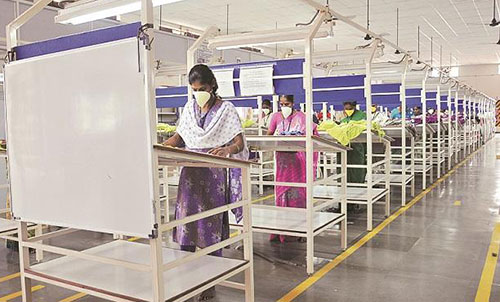 and Tirupur, the government will also implement the Amended Technology Up-gradation Fund Scheme (ATUFS) for technology up-gradation of the textile industry. The scheme will incentivise production with an outlay of Rs.17,822 crore during 2016-2022. This will help the industry to not only attract investment worth Rs.1 lakh crore but also generate 35.62 lakhs jobs by 2022.
Government launched a special package of Rs.6,000 crore in 2016 to boost investment, employment and exports in the garmenting and made-ups sector. The package provided full refund to exporters under Remission of State Levies (ROSL) for the state level taxes. It also provided a production linked additional incentive of 10 per cent under the Amended Technology Up-gradation Fund Scheme (ATUFS).
Some of the other schemes launched by the government include: The National Handloom Development Programme; Comprehensive Handloom Cluster Development Scheme; Handloom Weaver Comprehensive Welfare Scheme; Yarn Supply Scheme; National Handicrafts Development Programme (NHDP) and Comprehensive Handicraft Cluster Development Schemes.
It also launched the Power Tex India - a comprehensive scheme for the powerloom sector; Silk Samagra – an integrated scheme for silk development; Jute ICARE scheme for increasing the income of farmers through different interventions and North East Region Textile Promotion Scheme (NERTPS) scheme for promoting textiles industry.
Scheme for SITPs
The Government is implementing the Scheme for Integrated Textile Park (SITP) which provides support for creation of world-class infrastructure facilities for setting up of textile units. Till date, 56 textile parks have been sanctioned under SITP which are under various stages of implementation.
Apparel sourcing registers dramatic shift in 2020, China’s position threatened
 Apparel sourcing in 2020 started with similar theme of volatility and rapid change amongst major suppliers for US brands and retailers, new patterns are now emerging as the year progresses.
China’s supremacy challenged by smaller countries
One of the most notable changes is the fading of China’s unchallenged dominance as a global apparel supplier. The country’s top spot is being challenged by smaller rivals like Vietnam, Bangladesh and Cambodia whose shipments rose dramatically at the beginning of the year. According to an OTEXA report, skewed by a combination of the end-of-month Lunar New Year factory closing and the onset of the COVID-19 epidemic US apparel imports from China dropped 36.09 per cent in January to $1.62 billion. As a result, the share of Chinese imports declined to 28.9 per cent compared to 33 per cent a year earlier.
Tim Boyle, Chairman, president and CEO of Columbia Sportswear, feels this was due to temporary factory closures and the pace of workers returning to work which impacted the ability of the company’s contract manufacturers to source certain raw materials and to produce and fulfill finished goods as expected.
Apparel imports from Vietnam increased by 4.12 per cent in January to $1.32 billion, reveals OTEXA data. Market share rose to 16.4 per cent for the year ending Jan. 31 compared to 14.8 percent share a year earlier. Bangladesh started the year with a 17.03 per cent increase in shipments to reach $622 million in value. On the other hand, Cambodia’s imports jumped 19.91 percent to $277 million.
Indonesia’s shipments rose 1.45 per cent to $413 million, while share of India’s imports which had reached 4.84 per cent in 2019, declined by 2.81 per cent in January 2020 and was worth $371 million.
Mixed results from countries in Western hemisphere
Countries in Western hemisphere like Honduras, Mexico and El Salvador registered mixed results. Imports from Honduras increased by 0.87 per cent to $154 million while those from Mexico declined by 14.79 percent to $205 million. El Salvador’s imports also declined 3.08 percent to $118 million while those from Pakistan increased by 0.36 percent to 131 million.
The Bureau of Economic Analysis revealed the US monthly international trade deficit decreased to $45.3 billion in January from a revised $48.6 billion in December. The goods’ deficit also decreased to $67 billion. Of this, the goods deficit with China decreased by $2.1 billion to $23.7 billion in January.











