


FW
Microfiber shedding calls for medley of solutions by apparel makers, consumers
 As per a University of California study, on an average synthetic fleece jackets release 1.7 grams of microfibers with each wash. Older jackets shed almost twice as many fibers as new one. Millions of tons of these microfibers contaminate marine and environment every year. The main source of these microfibers is synthetic clothing followed by city dust and erosion of vehicle tyres, says a Vogue Business report. The International Union for Conversation of Nature estimates synthetic clothes account for 60 per cent of global apparel industry’s annual fiber consumption and 35 per cent of microplastics in the ocean. Ellen MacArthur Foundation also believes, clothing care contributes half a million tons of primary microplastics a year.
Caring with consciousness
A likely solution for this calls for collaboration between brands and consumers. Especially, brands need to teach consumers to use their washing machine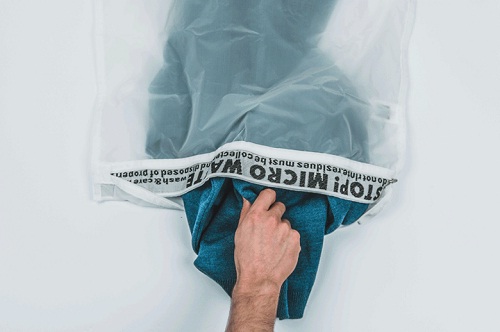 properly, reduce spin cycles and microfibre filters. They further need to phase out the production of synthetic clothing and promote designs that minimize fiber shedding.
Brands also need to teach customers ways to care for their products with minimum environmental impact, says Charlotte Turner, Head-Sustainable Fashion and Textiles, Eco-Age. Global brands like Patagonia, Sweaty Betty and Finisterre have been able to achieve this through Guppyfriend washing bag. Designed by Alexander Nolte and Oliver Spies, the Guppyfriend captures microfibers released during domestic washing cycle inside a mesh bag. These fibers are later released in a sealed container which prevents them from reentering the environment. The bag lasts up to 50 washes, after which it has to be separated from the zip and binding, and recycled. It reduces fiber shedding by an average 79 per cent for partly synthetic clothes and 86 per cent for completely synthetic textiles. To reduce fiber shedding Guppyfriend also advises its customers to use less abrasive detergents, wash similar textures together and lower the spin cycle or air dry garments.
Eco-friendly materials to prevent fiber shedding
However, Francois Souchet, Head-Make Fashion Circular Initiative, Ellen MacArthur Foundation explains, solutions like these have limited success. To prevent microfiber shedding, clothes need to be designed in a particular way.
Though some brands say recycled plastic fibers are highly sustainable; Pascal Burn, Head-Sustainability, H&M opine, recycled polyester has the same impact as virgin polyester regarding microfibers. He shares sustainable clothing care tips and solutions with consumers through the brand’s Take Care website. The website is available in 43 markets while its associated clothing care products and in-store repair services are available in seven markets.
British sportswear brand Tala has also launched its own version of the Guppyfriend. The Fibre Filter Bag uses Q-Nova, a nylon made from upcycled factory offcuts and pre-consumer waste. Independent London brand Birdsong has introduced recycled polyester although the brand also uses eco-fabrics like Tencel and organic cotton.
Though solutions like Guppyfriend help educate consumers about the dangers of synthetic fibers, a proper legislation is required to control them. France has announced that its future washing machines would have built-in microfibre filters. Similarly, Nolte calls for a medley of solutions to address this problem of microfibers.
Rising athlesiure popularity makes way for Hong Kong brands in Thailand
 With increasing apparel imports by Thailand Hong Kong athleisure brands are in a good position to make inroads in the market. As a HKTDC report reveals, many Hong Kong-based brands have entered the Thai athleisure market to enhance customers’ in-store and online shopping experiences.
Social media, new trends spur apparel sales in Thailand
Growing popularity of sports-inspired and performance apparel has given rise to the athleisure trend in Thailand. Thai consumers prefer to wear clothes designed for workouts and other athletic activities in other settings such as workplace, at school or for social occasions. They also prefer clothes with innovative properties like HeatTech technology, AIRism and Ultra Light Down Jackets offered by Uniqlo.
Moreover, social media has had a deep impact on Thailand’s apparel sales. The country launched mobile message app LINE which allows brands to share product updates, promotions and marketing activities. Thai brands also have strong presence on e-commerce platforms such as JD.com, Lazada, Shopee and Looksi.com.
As competition intensifies, many of brands are merging online and offline offerings to increase brand awareness. For example is Pomelo has launched both an online shopping website and three physical stores in Bangkok.
Partners for offering enhanced shopping experiences
A potential partner for Hong Kong brands in Thailand is Camp, a multi brand store that houses many products including apparel, accessories, swimwear, sportswear and footwear. The store has three branches in Bangkok. Catering particularly to middle class women shoppers, Camp often partners in store brands to offer frequent promotions. It uses online influencers and YouTubers, to promote stores. Additionally, it helps brands promote their products or new releases though its own website, Facebook and Instagram.
Camp also uses consumer shopping behavior insights to increase shopping experiences at its store. The store has launched Camp Megabangna, a branch with a community store concept. The store houses a coffee shop which offers recreational facilities to its customers. The multi-brand store is situated in various high traffic locations. And each location targets a different consumer group.
Another potential partner for Thai brands is Winterland Trading, a representative of various fashion brands such as Replay, Penfield, Wemoto and RVLT/Revolution. The company has over 20 years experience in retailing and focuses on casual and streetwear clothing and accessories. It has an experienced team that helps foreign brands enter the Thai market.
TSA partners with PCIAW
The Textiles Services Association (TSA) is partnering with the Professional Clothing Industry Association Worldwide (PCIAW) bringing together two bodies representing commercial laundry and textile rental businesses. The partnership aims to provide end-to-end support across the apparel manufacturers, distributors, and laundry industries.
Both the PCIAW and TSA agree upon reusable isolation gowns being the way forward and that the economic and environmental cases are both strong. The TSA advises that reusable isolation gowns can be laundered up to 75 times. The DHSC admits the cost difference between single-use and reusable is ‘modest’ but as the reusable isolation gowns last up to 74 more times longer because they can be cleaned and reused, the preferred choice should be clear.
While the TSA lobbies the UK Government to make the case for reusable isolation gowns, the products need to be manufactured to a high standard using the optimal materials and the correct stitching if the isolation gowns are going to withstand the expected 75 wash lifespan.
Yvette Ashby, CEO, PCIAW believes the joint network of trusted members can be called upon to offer their experience in manufacturing reusable isolation gowns with the full understanding of the commercial laundry operations to maximise the lifespan of the products and to the cost-effectiveness for health services in the UK and across the world.
Industry hails granting of GSP benefits to Sri Lanka
Government officials, investors and textile union representatives hope that the Generalized System of Preferences (GSP) granted to Cambodia by the UK will help counteract the partial withdrawal of the Everything But Arms (EBA) deal with the EU.
They expect the granting of GSP status to give exports from the Kingdom duty and quota-free access to UK markets starting from 2021.
Oknha Lim Heng, Vice-President, Cambodia Chamber of Commerce said the GSP represents an opportunity to refresh investor outlooks in the UK towards the Kingdom, particularly with regard to Cambodia’s main exports, namely textiles, footwear and milled rice.
Sok Sopheak, Secretary of State, Ministry of Commerce, said that Cambodia officials and business people will engage their UK counterparts in discussions on the import and export process, both during and after the pandemic.
Kaing Monika, Deputy Secretary-General, Garment Manufacturers Association in Cambodia also applauded the move, noting that the GSP is set to deliver a much-needed boost to the textile industry, one of the main exports from the Kingdom to the UK.
Levi Strauss appoints Elliot Rodgers as board member
Levi Strauss & Co has appointed Elliott Rodgers as a board member of Ulta Beauty. He currently is the chief information officer of the company and previously held several supply chain roles since joining the company in November 2013.
Prior to joining Ulta Beauty, Rodgers was director of operations, Target.com and mobile, at Target where he was responsible for Target’s ecommerce website and fulfillment operations and co-led Target’s omnichannel supply chain pilot programs.
With more than a decade of experience in the retail industry, he equally held operational leadership roles spanning retail, financial services, and logistics at Target, Citibank and the United States Army.
In October, Levi announced a series of leadership changes, in an effort to allow the brand to increase its focus on direct-to-consumer (DTC) and the digitization of its business.
Nocta to launch on December 18
Nocta, the new sportswear sub-label created by Drake and Nike will launch globally on December 18. The Nocta collection includes functional co-branded winter jackets, hoodies and tracksuits, while the name ‘Nocta’ is a nod to the Canadian artist’s "nocturnal creative process". The collection is about creating something for people on the move. It comprises functional, comfortable fits that are adaptable from one environment to the next. The collection includes hardest jacket, the hardest tracksuit, the hardest gloves.
Drake, who founded his label October's Very Own (OVO) in 2012 together with producer Noah "40" Shebib and Oliver El-Khatib, also owns a clothing line of the same name. Since its launch, OVO has introduced several label collaborations, including DSquared2, Canada Goose and Bape.
China records deflation for the first time since 2009
China recorded deflation for the first time since October 2009. Its headline CPI contracted -0.5 per cent y/y in November, compared with consensus of a flat reading and a +0.5 per cent gain in October.
Separately, China’s trade surplus widened sharply to $ 75.4B in November, beating consensus of 53.8B and October’s 58.4B. Exports jumped +21.1 per cent y/y, accelerating from +11.4 per cent.
Geographically, exports to the US jumped +46.1 per cent y/y in November, following a +22.5 per cent growth in October. Export growth to ASEAN also accelerated to +10 per cent y/y from +7.3 per cent in October. Exports to EU expanded +8.6 per cent y/y in November, after contacting -7 per cent in the prior month. Shipments of pandemic-related goods expanded last month, resulting from the resurgence of coronavirus cases globally. Exports of textile & fabric goods rose +21 per cent yy, up from +14.8 per cent in October. Meanwhile, exports of plastic articles jumped +112.9 per cent y/y, following a +97.9 per cent growth in October. Regarding working from home-related goods, exports in automatic data processing machines accelerated to +34.3 per cent y/y in November from +26.7 per cent in the prior month. Meanwhile, exports of plastic articles jumped +112.9% y/y, following a +97.9 per cent growth in October.
The sharp widening in trade surplus in November was driven by the strong rise in exports. This could be driven by front-loading of demand amidst concerns over the possibility of further lockdown measures. For now, we believe the strength in exports was an one-off event, rather than a trend in coming months.
Sri Lanka’s apparel exports to decline 25 per cent: JAAF
A Sukumaran, Chairman, Joint Apparel Association Forum estimates a 25 per cent decline in apparel exports this year. Addressing a media round table conference in Colombo, Sukuraman said he expects further demand contractions that could result in reductions in apparel exports by an additional 30-40 percent after June, in its best-case scenario.
He said that COVID 19 affects the apparel supply chain, the export market and due to that the industry is unable to fulfill certain obligations. His Minuwangoda factory is functioning on a small scale even after detecting the first COVID 19 patient in October. His company is looking after all employees and police, CID, PHIs, Labor Department and other relevant parties are closely watching our operations, which follow all Health Ministry protocols.
Noel Piyathilake, Chairman, JAAF said, the disruption of the supply chain due to the global outbreak of the virus affected exporters severely in the first half of this year. There are 81 factories out of which 37 are direct exporters and 41 subcontractors, which provide 25000 employment and 15 percent export earnings. The SME sector is also supporting the informal sector as well.
Sri Lanka last year earned $ 5.3 billion from apparel exports, an increase of 5.1 per cent from 2018. Prior to the COVID-19 pandemic the industry originally expected a 6 per cent increase in exports for 2020. However, its export earnings from apparel and textiles in October declined by 18.93 per cent to $356.52 million and by 21 percent to $3.6 billion in the first 10 months of 2020 from a year earlier.
32nd Milano Unica to be held digitally
The 32nd edition of Milano Unica will be held digitally in February 2021. The event will showcase Spring/Summer 2022 collections of brands. In September, Milano Unica had launched the e-Milano Unica Connect website in partnership with Pitti Immagine. The organizers indicated that the site will be operational again in January, with the Spring/ Summer 2022 collections.
The next physical edition of Milano Unica will coincide with the event’s 33rd edition, and will be staged in July 2021 at the Rho Fiera Milano exhibition centre. Pitti Uomo, originally scheduled in early January, will now be held on February 21-23, 2021, just before the Milan Fashion Week, and will be staged jointly in Florence with its two companion events, Pitti Filati and Pitti Bimbo.
Likewise, the Milanese shows Micam, Mipel, Homi, Lineapelle and TheOneMilano have postponed their February dates to March 20-24.
Meghalaya to set up garment making unit at Ampati
The Meghalaya government will set up an apparel and garment making unit at Ampati. The 45,000 sq ft unit will be set up under the North East Region Textiles Promotion Scheme (NERTPS). The Union Ministry of Textiles has sanctioned Rs 18 crore for the project. It had earlier released Rs 14 crore for the development of the apparel unit’s infrastructure.
The Meghalaya government aims to create a unique brand for the state and is currently exploring various options for promotion of value chain. The new unit is an indication to investors across the country that the Northeastern region is ready for economic engagement and expansion. The unit will employ people once it becomes operational.











