


FW
UKFT greets FTA with EU
UKFT welcomed Brexit trade deal with European Union. The EU being the biggest market for UK fashion and textiles industry, the deal should help secure the £7.4 billion of fashion and textiles that the UK sells to the EU every year. UKFT has urged the government to actively help the sector meet the challenges it will face in the immediate future and to invest in the long-term future of the industry in the UK.”
“I am delighted that a deal has been agreed. While we need to see the detail of the deal to fully understand the implications, UKFT will be working with its members to help the industry maintain and grow its exports to the EU and the rest of the world,” Said Nigel Lugg, Chairman of UKFT. It is being felt, trading environment with the EU will be very different even with this deal ,and there is still much that companies need to do.
Fashion store closures continue in Jordan retail suffers due to pandemic
Nearly 10 per cent of Jordan’s clothing stores are expected to close during 2021 and additional closings are anticipated during the current year. The sector faces protracted financial burdens, such as piled up utility bills, bank loans, taxes and unpaid rent. Currently there are 10,500 stores, many of which have received written warnings from their landlords to evacuate their shops due to being unable to pay rent. The sector is facing an existential crisis.
“It is time for the government to make bold decisions and initiate positive actions,” says Muneer Deyeh, President, Jordan’s Textile and Readymade Clothes Syndicate. He further added “It is important to take effective and swift measures to minimize the economic impacts of this crisis, so that many entities will not be forced to shut down for good. Emergency cash assistance is needed for hard-hit sectors in order to stay afloat.”
The clothing industry had already been suffering before the pandemic with 600 stores closed in 2019.
Bangladesh union leaders want wage increments to continue
Bangaladesh union leaders want the continuation of a 5 per cent annual increment of wages for garment workers. They argue factories cannot bypass this legal requirement and should provide additional facilities to tide workers over through such tough times. Many workers have become jobless since some factories had to shut down production since March 27 last year
However, knitters demand the government let them suspend it for the next two years for mitigating the Covid-19 fallout. Mohammad Hatem, Sr. VP, Bangladesh Knitwear Manufacturers and Exporters Association (BKMEA) says, they have sent a letter to the labour ministry seeking suspension, citing the severe effects on exports. And the government will take a decision as a neutral body, reviewing the export situation of the garment sector. He argues, many factory owners have not been able to ship the goods made over the past seven to eight months.
It maybe recalled that the increment provision was incorporated in the labour law through a 2013 amendment. Currently, nearly Tk 5,000 crore is disbursed as salary to the garment workers in a month. Meanwhile experts say suspension would put workers in trouble in such challenging times. And the labour ministry does not have the jurisdiction to suspend the increment. Only the minimum wage board for garment workers can do it. However, the board has turned defunct as it had already recommended a minimum wage which was implemented earlier. Moreover, once any benefit is given, it cannot be taken away or curtailed under section 336 of the labour law.
Mink losing prized position in luxe wardrobes
Mink coat once epitomizing the height of luxury and elegance has lost its sheen today. As Laura Sophie Cox, a British celebrity and editorial stylist told the Independent “Mink coats have become obsolete.”
In late November, Denmark saw bloated bodies of millions of mink culled on government orders earlier that month because of fears of a potentially vaccine-resistant Covid mutation, rose out of the ground like zombies. As a result of the cull, the world’s largest fur auction house, Kopenhagen Fur, announced closure. Macy’s and Bloomingdale’s are selling off the last of their coats so they can close their fur salons. A year ago, California passed a ban on the sale of new fur products, effective in 2023. Many luxury brands, including Burberry, Chanel, Coach, Giorgio Armani, Ralph Lauren and Versace, have banned fur.
In fact, the Row’s $23,900 shaved mink coat, available at Bergdorf Goodman, is from several seasons ago. And the fur trade is banned in Britain, Belgium, Germany and Ireland. The Netherlands is scheduled to shut down its fur farms by 2024, and France by 2025. Even for those who still love fur, the mink coat has lost its appeal. With millions out of work, the public has turned against extravagant displays of wealth.
While there are still many who buy fur and mink coats, consumers, especially younger consumers, are increasingly demanding fur-free clothing, points out Sarah Willersdorf, global head of luxury at Boston Consulting Group. BCG’s True Luxury survey, too had reported that animal welfare is the most important ethical or environmental consideration for consumers, with half considering it a minimum criteria when buying a product.
For those unwilling to give up completely on their family heirlooms are looking for something less in-your-face opulent.
Jindal Worldwide sees exports grow post-COVID, plans expansion
India’s second largest denim maker, Jindal Worldwide which saw post-pandemic boost in export business and a recovery in domestic demand is now looking at expansion and fund raising plans for the future.
As per the compnay, a de-risk strategy adopted by international buyers against Chinese supplies given a huge flip to Indian exports. Moreover the ‘work-from-home’ culture fuelled demand for denim and casualwear in the domestic market.
As per Gaurav Davda, Head of Corporate Finance & Strategic Initiatives, Jindal Worldwide, is now planning to expand denim capacity from 140 million metres per annum (MMPA) currently to 160 mmpa within next six months and further up to 180-200 mmpa over the next two years. The total capex plan is between Rs 150 to Rs 200 crore for all expansions including spinning capacity and augment denim capacity, premium shirting etc. Funds for expansion will be raised be through a mix of retained earnings, from lenders and through public equity. Davda says for the past 20 years of the company’s listing in bourses, they have not done any public fund raising. And having reached a sizeable number on business side, they can think of it. The company’s sales have bounced back from a washed-out April-June quarter from Rs 56 crore to Rs 414 crore in September 2020. After a loss of Rs 14.9 crore in the first quarter, it turned to black with profits of Rs 17.6 crore. However, they expect to close the fiscal with lower turnover compared to last year. JWW has appointed agents across 1he US and other parts of Asia catering to global brands such as M&S, H&M, Carrefour, JCPenny, Provogue, US Polo Assn, Pepe Jeans, Spyker, Mufti and Future Group.
COVID-19, local brands threaten Europe’s denim exports
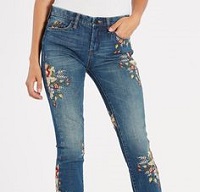 Though the European Union fears a significant decline in denim imports due to COVID-19, it will continue to remain a huge market for international denim exporters. As per a report by the Centre for Promotion of Imports, the Europe Union imported denims worth €9.2 billion in 2019.
Germany: The largest denim importer in Europe, Germany imported denims worth €2.1 billion in 2019. From 2014-2019, the country’s denim imports grew at an average rate of 3.5 per cent per year in value, while their volume grew by 2.4 per cent per year. Men’s denims constituted the larger portion of Germany’s denim imports in 2019 with 65.1 per cent share while women’s denim had a 34.9 per cent share.
The Netherlands: Amounting to €1.2 billion Netherlands’s denim imports grew at an average rate of 7.5 per cent per year in value while they grew by 3.5 per cent in volume. Men’s denim segment grew by 8.2 per cent every year on average while women’s denim overall import grew by 6.3 per cent.
Spain: Spain was the third largest importer of denims in Europe, with imports amounting to €1.1 billion in 2019. In the five last years, the value of Spain’s denim imports grew at an average rate of 7.5 per cent per year, while their volume grew by 7.1 per cent.
From 2014-2019, the value of women’s denim imports grew by 10.1 per cent while that of men’s denim grew by 4.0 per cent.
France: Fourth largest European denim importer, France imported denims worth €953 million in 2019. The country’s denim imports grew by 2.1 per cent in value while they grew by 2.4 per cent in volume. Import of men’s denims constituted 56.5 per cent of its total denim imports while women’s denims constituted 43.5 per cent.
The United Kingdom: The UK was the fifth largest denim importer in Europe in 2019. The country imported denims worth € 750 million in 2019. Men’s denims constituted 53 per cent share of UK’s total imports’ value in 2020.
Italy: Sixth largest denim importer, Italy imported denim worth €634 million in 2019. From 2014-2019, the value of Italy’s denim imports grew at an average rate of 2.6 per cent per year, while their volume grew at 3.2 per cent per year. Men’s denim products comprised the larger denim segment in Italy with 55.2 per cent, followed by women’s denims with 44.8 per cent.
New denim styles
Skinny and super skinny women’s denim jeans transformed into high-waist straight or slouch trousers in 2020. Denim length shortened with new features like split trousers legs, legs cropped from the cuffs and very wide legs being added. Mom’s Jeans high-waist fit of denim trousers gained popularity during this year along with jeans in “used” or stone-washed style.
Online denim brands to surge in 2021
Online distribution of denim jeans is expected to continue in 2021 too. Denim manufacturers need to collaborate with smaller online brands to maintain production standards. Companies from developing countries like India need to distribute their products right to the customer using digital channels.
Athleisure popularity threatens denim
The emergence of athleisure in 2014, has threatened denim sales across the world. Already popular for its leisure features, athleisure sales grew by 12 per cent from 2018 to 2019. However, the industry is uncertain of this trend’s future influence on denim imports.
Discounts on larger orders may help stabilize spandex prices in China
 While polyester, nylon, cotton and cotton yarn prices in China grew strongly during December, spandex saw decline after 40 per cent increase in previous months. As per a CCF Group report, spandex prices were mainly affected by a dip in demand and operating rate of downstream mills which varied from medium-to-high during the year.
Covered yarn dominates spandex application
Accounting for 30 per cent of total demand, covered yarn remained the biggest application area for spandex during the year. Though the operating rate of air covered yarn plants and cotton core-spun yarn moved down slowly, it remained high at 80 per cent. Air covered yarn also snatched some of the market share of conventional covered yarn which enjoyed a stable market share in low-end socks and high-end men’s wear fields. High-end conventional covered yarn mainly used branded spandex and produced according to orders.
Affecting the operating rate of circular knitting plants
Circular knitting market was the second highest application area for spandex in 2020. The operating rate and orders of circular knitting plants declined from September-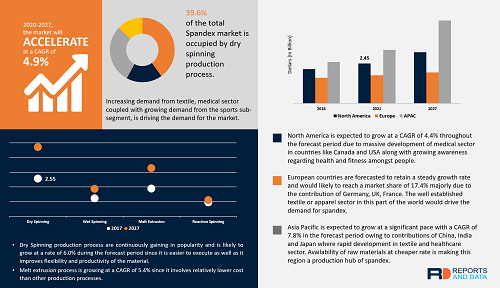 November after they delivered thick fabrics and fabrics for sportswear and sweaters. In December, the operating rate of these plants dipped further after they produced fabrics for yoga cloth, plain fabric, milk yarn and rib fabrics. However, production of fabrics for Roman fabric, sweater and winter sportswear gradually reduced further affecting the operating rate of these plants. Moderate demand from warp knitting plants
Demand for spandex from its third largest application area - warp knitting market was moderate. Operating rate of warp knitting plants remained at 70-80 per cent while orders declined slightly in Guangdong and some other plants. Most of these plants produced fabrics for yoga cloth, sportswear and swimwear etc. Over 50 per cent of warp knitting plants produced fabrics for spring and summer wear in 2021. Low-end warp knitting plants from Haining, Zhejiang and Changshu, Jiangsu, operated at above 80 per cent of capacity. Consumption of Spandex 40 D increased in Haining, Zhejiang and Changshu, Jiangsu. However, the operating rate of these plants declined rapidly after peak-season.
Sharp fluctuations in lace knitting and braid market
Prices of spandex for ear band of mask experienced sharp fluctuations in the first half of 2020 with many companies over-producing 140D spandex for the lace knitting market. As lace knitting fabrics are mainly accessories, sellers ended up with bigger decrement of 140D/210D than 40D in December.
Operating rate of braid mills declined in December as orders diminished. Demand for spandex slowed down with orders for spandex 140D for ear band of mask also dipping. Meanwhile, the demand for spandex 70D and 40D for ear band of mask sustained.
The Chinese population is expected to be more mobile during the upcoming Spring festival holiday in February. This may affect the resumption of spandex production already suffering from the effects of the pandemic. Market players expect spandex prices to rise with loose monetary worldwide. Some of the downstream fabric mills have advanced their production of light which will support demand for spandex in short run. As current spandex stocks are low, their prices may vary. Manufacturers may offer slight discounts on large orders, which may help stabilize prices of seasonal goods.
International conference on Cellulose Fibers to cover entire textile value chain
The 2nd International Conference on Cellulose Fibers will cover the entire value chain from the lignocellulosic feedstock, dissolving pulp, cellulose fibers like rayon, viscose, Modal(R), lyocell, or new developments. The event includes a wide range of applications, woven textiles and non-wovens.
The conference will grant the innovation award “Cellulose Fibre Innovation of the Year” to the innovative cellulose fiber industry for the development of new technologies and applications. Six inventions, including plastic-free absorbent hygiene products and Cellulose nanofibre, assisted biomimetic aerogels for EMI shielding have been nominated for the “Cellulose Fibre Innovation Award.” Three winners will be selected and awarded at the 2nd International Conference on Cellulose Fibres (CCF), to be held during February 2–3, 2021, online.
The six nominations include Bast Fibre Tech (Canada) which has made compostable fiber products from agricultural hemp and flax waste; Empa, Laboratories for Materials Science and Technology, (Switzerland), which created cellulose nanofibre assisted biomimetic aerogels for EMI shielding; Kelheim Fibres (Germany) has created plastic-free absorbent hygiene products; Metsa Spring (Finland) has made textile fiber based on paper grade pulp. OrganicDisposables (Poland) has created FibriTech l from cellulose for soilless farming. And Stora Enso (Sweden) has produced a lightweight cellulose-based foam for packaging.
Iranian researchers invent wool washing system
Iranian researchers have invented a new system to replace traditional wool washing systems with 80 per cent less water consumption. This invention can easily separate dead fibers and greatly increase the purity of wool. In this system, at first and without using water, only by creating electrical charges in wool fibers, we can easily separate high-quality wool fibers from the rest of the waste and dead fibers and produce many by-products.
First of all, plant and animal wastes are collected as chemical fertilizers because they can be separated dry. In addition, dead fibers, which are separated from high-quality fibers due to different density and electric charge, are used in the production of thermal insulation and industrial mats. Another valuable product called wool oil or wool wax, is produced lanolin and is widely used in the cosmetics industry. In this system, cleaned wool only needs one final wash and up to 80% of water consumption, energy and production of industrial effluents are reduced.
A 2.5 to 5 Nm yarn can be spun with dead fibers along with wool fibers, which is suitable for woollen spinning and so-called rug carpets and has a very low value. By separating the dead fibers, the purity of wool fiber is increased and it can be spun in the semi-worsted system to produce 5 to 25 Nm yarns, which are very suitable for the production of machine-made carpets and high-quality handmade carpets.
One of the most important features of this system is the separation of dead fibers and hairy fibers from real wool, which by increasing the purity of fibers and producing wool tops, provides the possibility of spinning fine yarns with a quality of 5 to 20 metric.
In addition, dead and hairy fibers can be recycled to be used in the thermal insulation industry and industrial felts as a by-product.
Accelerating Circularity to recycle textile waste worth million pounds
The Accelerating Circularity program aims to recycle consumer goods to produce home textiles, hotel linens, denim, knit tees, activewear and outerwear. It aims to recycle millions of pounds of end-of-life textiles from landfills. The new venture is funded by a grant from the Walmart Foundation and operates with support from Gap Inc, Nike, Target, Tencel and VF Corporation,etc. Participants in the project include brands, retailers, chemical recyclers, mechanical recyclers and companies producing polyester and cotton.
The program estimates about 35 per cent of post-consumer textile goods are readily suitable for recycling, with 45 per cent potentially suitable and another 20 per cent not likely. Readily recyclable materials contain either pure cotton or pure polyester. This group also includes materials with more than 50 per cent cotton content.
Potentially recyclable materials could be returned into the production stream with the commercialization of technologies that can accept a wider range of inputs such as nylon, man-made cellulosics or a low percentage of elastane, says Janel Twogood, Research Analyst at the organization.
Post-consumer products currently considered unlikely for circular production include those with certain coatings and finishings as well as well as those made from multiple materials and metallic fibers.
Accelerating Circularity plans to start phasing pilots by next summer. The long horizon of the whole project is about 24 months to allow time for testing and business case documentation, she added. The group also plans to invite textile manufacturers, brands and retailers to join in the effort.











