


FW
AEPC appreciates government’s decision to cut cotton prices
A Sakthivel, Chairman, AEPC welcomed the government’s decision to reduce cotton prices. Sakthivel thanked textiles minister Smriti Irani for taking several initiatives to protect and revive the apparel exporting industry since the outbreak of the coronavirus pandemic.
He said, the move will help reduce the burden on garment exporters across the country. Cotton yarn prices have consistently increased in the last four months. High prices of cotton yarn and unpredictability in its availability were affecting the entire value chain and having an adverse cascading effect on garment exports.
Irani met the industry representatives on March 18, 2021, to discuss the issue of yarn price increase. Today, CCI announced that the cotton prices have been reduced by around Rs1,500 per candy.
Cotton prices impact Bangladesh’s knitwear exports
Rising cotton prices is impacting Bangladesh’s knitwear exports. As per RMG Bangladesh, 30 carded yarn is now available at $3,60 to $3,75 per lb whereas just two earlier it was available for $ 2.60 to $2,80 . Local spinners, merchants, millers and consumers mostly import cotton from the future markets, which supplies 50 percent of the annual 75 lakh bales Transportation charges contribute to the expense of the local importers, which also affects yarn prices.
A major cause for inflation is the growth in imports from China, which is the world’s largest market. Furthermore, import targets have risen as a result of high prices in China and lower demand in Pakistan. A report by the US Ministry of Agriculture (USDA) states, in the cotton marketing year (August–July) 2020-21 Bangladesh will slash imports of 5 lakh bales.
As the effect of Covid-19 becomes clearer, global utilization outlook for 2020-21 has shrunk. However, in recent months usage has risen as components of the global economy have stabilized and is just 3 per cent below the February stage now. With worldwide downward projection and production relatively unimpeded, the projected end of the inventory by 2020-21 is 97.5 million bales higher than in February, 19 per cent (15.4 million bales).
Japan’s apparel imports decline in January 2021
Japan’s garments imports declined from $2.66 billion in January 2020 to $1.85 billion in January 2021, reports Apparel Resources. In terms of weight, the country’s apparel imports declined from 643.68 million kg in January 2020 to 492.22 million kg in January ’21.
Of the total imports, the share of knitted garments declined 26.60 per cent to $940 million, while that of woven garments declined to 34.43 per cent to $ 910 million. Compared to December ’20, import of woven garments increased by 10.44 per cent in January ’21. However, imports of knitted declined by 11.90 per cent on M-o-M basis.
In terms of weight, Japan’s apparel imports increased 9.33 per cent in January ’21 over December ’20. Both knitted and woven garments imports by Japan increased by 7.94 per cent and 14.13 per cent, respectively, in the first month of 2021 as compared to the last month of 2020.
CCI reduces cotton prices by 2 per cent
The Cotton Corporation of India (CCI) has reduced the selling price of cotton by 2 per cent as a one-time correction. As per reports, international cotton prices rose almost 12 per cent in the last two months and dropped at the same rate. Pradeep Kumar Agarwal, Chairman and Managing Director CCI, said, however, the corporation increased its cotton prices by only 2 per cent and therefore reduced it by the same rate.
This nominal correction will give a stimulus to the textile industry as those who want to buy cotton can do so now, he added. A Sakthivel, Chairman, AEPC, said, the move by CCI was significant for the textile value chain, especially garment exporter. He appealed to textile mills to reduce yarn prices by Rs 20 a kg as cotton prices had declined.
Archorma, Jeanologia team up to launch sustainable dyeing process
Specialty chemicals company Archroma and finishing technology firm Jeanologia have teamed up to launch Pad-Ox G2 Cold, a sustainable dyeing process that reduces water usage drastically. As per Sourcing Journal, the Pad-Ox dyeing process shortens the dyeing process by combining the oxidation and fixation steps. This enables it to reduce water, cotton and energy use.
Archroma uses Diresul range of low-sulfide sulfur dyes and plant-based EarthColors dyes. Some of these dyes have been awarded with Cradle-to-Cradle Product Innovation Institute’s Platinum Level Material Health Certification.
Jeanologia G2 dynamic technology compounds the benefits of Pad-Ox by using ozone to prepare fabric for finishing treatments including laser. Developed in 2008, the technology works with Pad-Ox at room temperature to improve fabric fastness while significantly reducing water and chemical usage. The resulting garments are softer and have greater color durability.
India’s apparel and textile makers urge for government support
Acute shortage of viscose staple fiber (VSF) and extra-long staple (ELS) cotton has forced Indian textiles and apparel makers to urge for immediate support from the Central government. SRTEPC reports, the industry has been asking for the removal of anti-dumping duty of $ 0.103 to 0. 512 per kg imposed on VSF for the last several years
Ashwin Chandran, Chairman, The Southern Indian Mills’ Association (SIMA), has requested the Prime Minister to withdraw this duty and also the 10 per cent import duty on cotton. Chandran said, both these are high value-added market segments that accounting for around Rs 150,000 crore business and employes over two million people. They fetch GST revenue of Rs. 5,000 crore and forex earnings to the tune of Rs. 75,000 crore apart from catering to the value-added segments.
VSF and superfine cotton value chain supplies to international brands and the price crisis is being utilized as an opportunity by neighboring countries like Bangladesh, Chandran said. He therefore urged the government to withdraw the duties immediately.
Post COVID-19, Bangladesh RMG makers to intensify focus on apparel business
 Like the dawn that comes after dusk, the global fashion and retail industry also seems to be recovering from the aftermath of the past 12 months when one bad news followed another. A report by the Daily Star highlights, the online fashion segment is growing rapidly with most manufacturers switching to digital platforms. One of the world's fastest growing online fashion brands, Zalando has targeted €30 billion in e-commerce sales by 2025. The company recorded 50 per cent growth in online sales during the first quarter of FY21. Online sales of the world's largest apparel retailer Inditex too grew 77 per cent in local currencies to €6.6 billion over a 12-month period.
Adapting to changing demands
The pandemic closed down many industries across the world. The fashion industry managed to survive by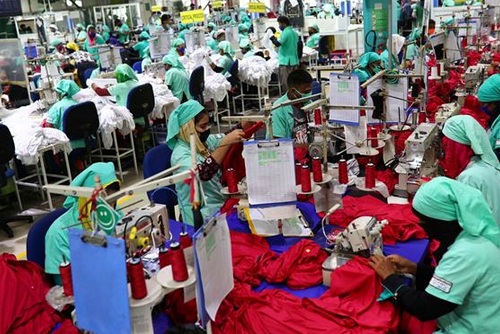 adapting itself to changing demand. To keep a lid on losses, apparel makers shifted to loungewear and leisurewear. Their resilience and ingenuity showed their ability to weather such storms.
Governments across fashion’s biggest markets are optimistic of their economies bouncing back from the shocks of the pandemic. Germany expects its economy to grow 3.7 per cent in 2021 while the Bank of England expects Britain’s economy to rebound by 7.3 per cent. The US Federal Reserve also forecasts GDP grows of 6.5 per cent this year.
Towards a sustainable post-COVID future
All these good news brings cheer to the Bangladesh readymade garment industry which looks forward to a more sustainable post-COVID future. RMG makers in the country plan to urge the government to support ailing business with financial packages. As one of their largest export markets, the United Kingdom slowly reopens for business, RMG makers now plan to intensify focus on their business which is an important source of their livelihood.
Lack of ftas, overemphasis on cotton hinder India’s T&A exports
 India is currently in a sweet spot with regards its textile and apparel exports, opined Sudhir Sekhri, Chairman, Promotion, AEPC in a candid, freewheeling webinar interview with Salil Chawla, Director, DFU Publications. The webinar was organized by the FashionatingWorld and DFU Publications, on the sidelines of Virtual Fashion Tour-Italy, a Virtual Expo. Split over five sessions, the webinar focused on the theme: Fashion Sourcing & Trends during Challenging Times. One session focused on India emerging as the potential souring hub for Europe.
Resilience helps Indian exporters survive
Sekhri, who is also Chairman and Managing Director, Trend Setters Group, shared his views on India’s post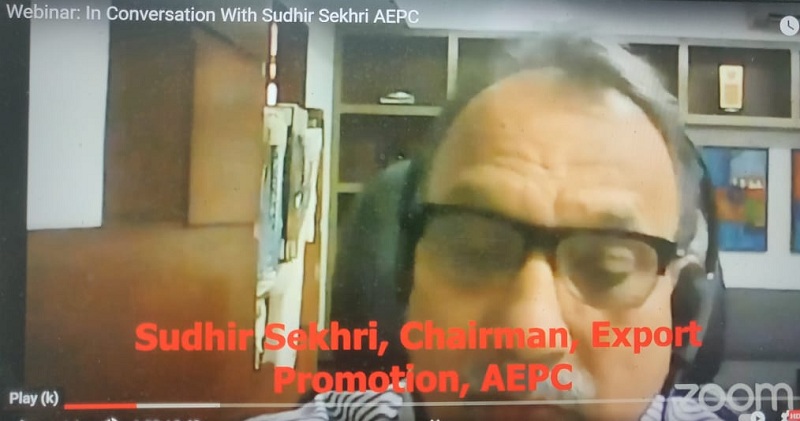 pandemic export scenario and Italy and Europe emerging as top export destination for Indian apparels. He said, though India’s textile and apparel exports took a huge hit last year, the resilience of its export eco-system helped us bounce back. Europe continues to be India’s top exports destination though exports to Italy have dwindled post pandemic. Brexit has also reignited India’s hopes of deepening trade ties with the UK, Sekhri feels.
On AEPC’s role, he said the Council played an important role in getting the anti dumping duty removed in the Union Budget which gave a boost to MMF exports. AEPC also helped in bringing in global technical expertise from Taiwan, Korea. It is also encouraging manufacturers to move away from cotton and switch to MMF garments.
Sustainability, digitization become business imperatives
 Sekhri points out while the rest of the world has moved to MMF exports India is still stuck with cotton. The country also does not have a free trade agreement with the European Union which results in a 9.4 per cent duty disadvantage compared to Bangladesh and other competing nations, who enjoy duty free exports, he opined.
He emphasized, sustainability has become a business imperative with more brands pledging to become responsible producers. The pandemic has also accelerated digitization across global supply chains, and this neo human behaviour change is likely to be permanent, he added.
He also warned, re-shoring may encourage textile manufacturers to move production back to their own countries. However, as there is a light at the end of every tunnel, the global crisis too shall pass and India will emerge stronger from this unprecedented human tragedy, he summed up.
India’s technical textiles market to grow by 7.6%: KPMG-FICCI
Indian technical textiles market is expected to grow at a rapid 7.6 per cent in the Asia Pacific region to reach $23.3 billion in 2027, says a report by KPMG-FICCI. As per the Hindu Business Line, this growth will be supported by increasing awareness about the products, higher disposable incomes, changing consumer trends besides some sector-specific growth drivers.
Numerous factors such as developing end-user sectors, rising awareness, government initiatives, regulations, standardisations, technology upgradation among others are expected to drive considerable growth of domestic technical textiles in coming years.
The domestic technical textile market for synthetic polymer was valued at $7.1 billion in 2020 and is projected to reach $11.6 billion by 2027, growing at a CAGR of 7.2 per cent, while technical textile market for wovens is expected to grow at a CAGR of 7.4 per cent to $15.7 billion by 2027, up from $9.5 billion in 2020.
Technical textile market for MobilTech (automotive textiles) is expected to grow to $3.7 billion by 2027 from $2.4 billion in 2020. Similarly, the market for InduTech (industrial textiles) would grow at a CAGR of 8 per cent from $2 billion in 2020 to reach $3.3 billion by 2027.
Several government initiatives are supporting the growth of the segment. National Technical Textiles Mission (NTTM), from 2020-21 and 2023-24 at an outlay of ₹1,480 crore is expected to help Indian players compete with international players.
Production Linked Incentive (PLI) scheme in textiles sector with focus on MMF segment and technical textiles, will augment scale/capacities in technical textiles sector.
Also, the proposal to set up seven mega investment textiles parks over the next three years to give domestic manufacturers a level-playing field in the international textiles market.
Jeanologia launches H2Zero, first circular water treatment system
Jeanologiahas been a leader in the way that jeans are designed and produced with the integration of its technologies from the material to finishings and the software EIM achieves a true revolution by completely changing the operating model.
The company is rewriting the future of the industry and jean finishing with one of the key technologies: H2Zero, the first circular water treatment system which allows the same amount of water used in the process to be reused, creating the perfect circle.
The main objective of the company is its MissionZero: to dehydrate and detoxify the industry of denim finishings by 2025. All of the technologies they have developed over the years have been focused on this goal.
H2Zero is able to recycle 100 per cent of the water used and guarantees Zero discharge. This is how it reduces water consumption, energy use and eliminates discharge, saving more than 10m3 of water per hour. In 2020 Jeanologia saved about 15.5 million cubic meters of water, the amount needed for the annual human consumption of a city like Amsterdam











