


FW
Pakistan’s textiles exports up 26 per cent
The value of textile and garment exports from Pakistan increased by 26.55 per cent year on year in dollar terms in the first four months of fiscal 2021-22. Knitwear exports rose a sharp 35.45 per cent year on year during the four-month period while exports of non-knit readymade garments were up 22.34 per cent. Among textiles, cotton yarn exports increased 71.39 per cent. Exports of cotton fabric rose 18.54 per cent during the period under review. Bedwear exports jumped 21.30 per cent.
On expenditure side, synthetic fiber imports shot up by 58.56 per cent year on year while imports of synthetic and artificial silk yarn rose 42.80 per cent. Meanwhile, the value of textile machinery imports by Pakistan increased significantly by 109.95 per cent year on year during the four-month period. In fiscal 2020-21 ending June 30, textile and garment exports from Pakistan increased by 22.94 per cent.
Pakistan’s overall exports increased 24.71 per cent in the first four months of the current financial year. Exports of men’s garments increased 32 per cent. Exports of home textiles increased 22 per cent. Cotton fabric exports grew 20 per cent. Cotton yarn exports increased 73 per cent.
Apparel industry needs to clean up its act
The global apparel and textile industryis responsible for water pollution, greenhouse gas emissions and landfill.
The fashion industry contributes more than ten percent to global emissions.Fast fashion – the continual delivery of new styles at very low prices – has led to a big increase in the quantity of clothes produced and thrown away.Around 50 billion new garments were manufactured in 2000, and in just 20 years, the figure has doubled. But the recycling rate of these garments remains less than one percent.Policymakers, scientists and activists have been urging the sector to adopt a science-based approach to reduce massive water, fiber and energy consumption to become sustainable.
COP 26 is one of the most important summits, where world leaders come from all over the world to accelerate action towards the goals of the 2015 Paris Agreement and the 1994 UN Framework Convention on Climate Change. COP26 has set four prime goals, where the first goal is to secure global net-zero emissions by mid-century and keep the global temperature rise under 1.5 degrees celsius, in line with the Paris Agreement.The apparel industry can play a real and effective role with the collaboration and partnership of brands and buyers to reach COP26’s goal.
TrusTrace offers traceability ecosystem
TrusTrace has formed a coalition of industry players to introduce a traceability ecosystem. The ecosystem aims at launching holistic solutions to the fashion industry’s biggest traceability and transparency challenges and this will happen as the development of a powerful integrated solution through seamless data integration and knowledge exchange has been planned.
TrusTrace is a supply chain solutions provider. Among the coalition of industry players are Higg, the Open Apparel Registry, Circle Fashion, Renoon and Haelixa. TrusTrace’s open architecture platform ensures the company is able to integrate seamlessly with other sustainability solution providers within this ecosystem. The first phase of traceability ecosystem launches with sustainability insights platform Higg and global apparel open-source database the Open Apparel Registry and will facilitate the integration of TrusTrace and Higg data sharing. This will help TrusTrace clients understand the social and environmental impact of their supplier facilities and their products by accessing their data from Higg on TrusTrace.
The integration will also help users understand the materials’ footprints in a single location and analyse supply chain and material combinations. Customers will also be able to access the Higg Facility Environmental Module and the Facility Social and Labor Module (FSLM) against their supplier facility profiles on TrusTrace to provide them with a single view of all the sustainability information for a facility.
India pitches itself as preferred sourcing partner at Expo 2020 Dubai
Expo 2020 is being held in Dubai from November 26 to December 2, 2021. India is pitching for becoming the preferred sourcing partner for the global textile industry during the event. Global investors are being invited to invest in the Indian textile value chain and make it a preferred sourcing partner. The Textile Week at the India Pavilion sees many activities including roundtable discussions on India as a sourcing and investment destination for textiles along with the production linked incentive scheme. This scheme is aimed at domestic technical textile firms and manufacturers of fabrics and apparel in the manmade fiber segment.
India is the world’s second largest exporter of textile and clothing and focuses on both quality and scale of production to become a global manufacturing hub. India is recognized as one of the best sourcing destinations for garments, textiles and accessories. The textile share in India’s GDP is estimated at around 2.3 per cent and it is the largest employer, employing about 45 million workers. India’s FDI policy is recognized as the most liberal in emerging economies, which allows 100 per cent investment under the automatic route in the entire textile value chain. The textile industry has been encouraged to focus on speed, skill and scale and get into innovative partnerships.
Supply chain glitches affect Nike retailers
Nike has been affected by the disruption in global supply chain for sneakers. Nike has voiced concerns about its ability to sell seasonal collections for year-end festivities, with half of Nike sneakers are sourced in Vietnam. In the last few weeks, the sector has hinted at the difficulties multibrand retailers might experience on stocks of Nike’s most popular products in the near future. Nike Futures orders for Spring/Summer ’22, and the balance Winter ’21 orders, stand cancelled. Nike has also indicated that re-stocking would not be possible until further notice. A few years ago, Nike announced it intended to prioritise direct sales channel and a limited number of close retail partners but the fact that the group’s retailers are having their orders cancelled is concerning.
Covid continues to impact global supply chain and create transportation disturbances. Like Nike, German groups Adidas and Puma are dealing with closures at their Vietnamese suppliers’ factories in recent months and with difficulties in shipping goods from Asia to the rest of the world. They are expecting stock-outs for some products during the year-end festivities. The same disruption is expected to hit the production of spring/summer 2022 collections.
Performance Days Munich is cancelled
Performance Days Munich which was to have been held in Germany, December 1 to 2, 2021, has been cancelled due to the sharp rise of Covid cases. The event organizers of Performance Days were in the final stages of preparations for the fair and the goal of being able to realize a fully booked fair with a portfolio like in pre-pandemic times seemed to be within reach. But the digital fair on December 1 to 2, 2021, will go on.
As a part of The Loop, there is the opportunity as of now to view online the fabric innovations and news for the winter season ’23/’24, this year’s focus topic, The Sustainable Future of Nylon, and the latest color trends. In the Marketplace, visitors will be able to view the numerous exhibitor products, including the Performance Forum’s curated sustainable fabric highlights.
Throughout the digital fair, exhibitors and fair visitors can look forward to extensive networking opportunities. For example, as part of the digital supporting program on December 1, with various expert talks, there will be discussion rounds and speakers via livestream and Q&A live from the studio. On December 2, the sustain and innovate conference on this year’s focus topic will kick off with discussions and panels.
KPR Mill adds garment manufacturing capacity
KPR Mill has increased its total garment manufacturing capacity to 157 million garments a year. The company is one of the largest vertically integrated apparel manufacturing companies in India. Net profit jumped 115.23 per cent in the quarter ended September 2021 as against the previous quarter ended September 2020. Sales rose 27.39 per cent in the quarter ended September 2021 as against the corresponding quarter last year.
KPR Mill is an integrated textile manufacturing company from India. KPR Mill has opened a garment unit in Ethiopia. The complete set-up of the garment unit took about two months. Extensive training of the workforce took place in both Ethiopia and India. At full capacity, the company will employ 1,500 machine workers who will produce 50,000 garment pieces a day for the world market. So far, employment has been created for 700 people and export shipments have commenced to Europe and the United States.
For the six month period total income was Rs 2166.30 crores as against Rs 1498.74 crores in the previous year. Net profit was at Rs 410.29 crores compared to Rs 172.84 crores in the previous year.
GHCL invests across segments in Tamil Nadu
GHCL will invest Rs 500 crores in Tamil Nadu. The chemical and textile company will set up 40,000 ring spindles in Tiruchirappalli district to produce synthetic and synthetic blended yarn to cater to the knitting and weaving segments. GHCL also plans to develop an extra high tension power transmission facility to ensure uninterrupted power supply. It will install another 40,000 ring spindles with 24 knitting machines in Madurai district to produce 100 per cent cotton yarn and knitted fabrics.
In order to fulfil its commitment towards sustainable business practices and reduce its carbon footprint, GHCL proposes to set up a 20 MW solar power park. At the moment, 52 per cent of the energy requirements of GHCL’s yarn business is fulfilled from renewable resources. Once the project is completed, almost 70 per cent of GHCL’s energy requirement for the spinning business will be from renewables. Going forward, GHCL will further enhance its energy portfolio to fulfill almost 90 per cent of its energy requirements from renewable sources.
GHCL is an Indian group with a footprint in chemicals, textiles and consumer products. It has commenced the new fiscal year on an encouraging note with substantial gains across all its business segments.
Jordan gets Italian, UNIDO support to enhance textile value chain
Italy’s Design and Training Services Centre (GSC) and the United Nations Industrial Development Organisation (UNIDO) have launched Creative Jordan, a project to support and encourage the textile value chain in Jordan. The aim is to create employment and economic opportunities in Jordan. It will directly target textile manufacturers. Besides the provision of technical training to actors of the value chain, one of the objectives of this project is to create new successful brands and collections under two fashion brands, JO! By Creative Jordan and Khayt, which are the storytelling umbrella of the fashion sector and be further promoted in the international markets.
Through capacity building and effective linkages, the project will play a key role in enhancing economic opportunities and job creation in Jordan’s textile and fashion value chains. The prospective outcome of the project is streamlined to be in line with Jordanian law and with targets set in Jordan’s economic growth plan.
The project will enhance income-generation opportunities and job creation in the textile and fashion value chains through capacity building and effective connections in the local market. It will target women and improve their capacities so as to lead an increase in their economic participation, and effectively foster local women empowerment and gender equality. Women will represent at least 40 per cent of the project’s direct beneficiaries.
CMAI launches Arbitration Cell for members
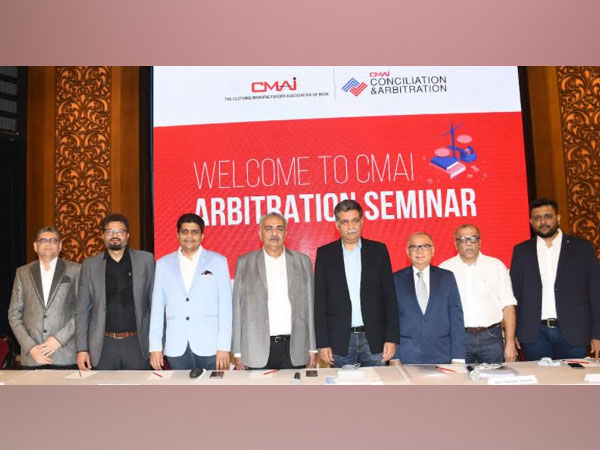
Clothing Manufacturers Association of India (CMAI) has launched the CMAI Arbitration Cell. The Arbitration Award will offer legal strength to the recipient. The cell will provide support to the members, consisting largely of MSME manufacturers. CMAI has designed its Arbitration Rules and Regulations keeping in mind the industry practices and while time ensuring fairness and equity to all stakeholders.
CMAI’s Research on Indian Domestic Market estimates the market size is around Rs 6.5 lakh crores. Even a minuscule if 1 per cent disputed, delayed or denied payments, the amount be around Rs 6,500 crores. This clearly underlines the need for a quick, efficient, and economical mechanism for resolving such disputes and complaints.
Speaking at the launch Shaunak Thakker, Lawyer and Fellow of the UK Arbitrators, underlined the usefulness of the arbitration process, and complimented CMAI for introducing this concept in their activities. Rajesh Masand, President, CMAI, informed the Panel of Arbitrators of CMAI will include leading members of the industry with impeccable credentials, legal luminaries, as well as individuals of high repute. The Panel will also include members from other trade associations from all over the country.
A book on CMAI Arbitration Rules and Regulations was also released by former President Ashok Rajani and other dignitaries. CMAI also launched the CMAI membership card which offers members a variety of benefits and discounts from close to 25 topbnrands and retailers of the country.











