FW
Pakistan hopes to benefit from Heimtextil
Pakistan’s exporters are participating in a big way at Heimtextil. They hope to secure a record number of export orders during the exhibition and hope to find new buyers along with the existing ones.
They are also hopeful that the exhibition would create opportunities for Pakistan’s textile industry, especially in the US market. They derive optimism from the preference American and European buyers give to Pakistan’s products over Chinese products.
Around 2,400 exhibitors from over 120 countries are taking part, including 260 exporters from Pakistan, and Pakistan has the fourth-largest number of exhibitors after China, India and Turkey.To facilitate smaller exporters, the Trade Development Authority of Pakistan (TDAP) has also set up a national pavilion, in which 59 exporters will be presenting their products to global buyers.
At a time when the country is in dire need of foreign exchange, Heimtextil is seen as a great and timely opportunity for not only textile exporters but also for Pakistan to increase exports and earn foreign exchange. Many exporters believe that the country’s textile industry can play an important role in tackling the ongoing foreign exchange crisis if the government resolves their issues.
Heimtexil is on in Germany, January 10 to 13, 2023, and is an annual textile trade fair.
Seasonal shifts boost South Indian cotton yarn prices
Seasonal shifts may help boost the prices of cotton yarn in south India. Production of summer clothing is likely to pick up in a few weeks. The industry is trying to adjust the production at present prices.
Cotton yarn prices have already gained in Mumbai as demand improved from the downstream industry. Buying increased in Tirupur too. Market sentiments improved in Tirupur despite the festival of Pongal during which production and trade are limited.
The weaving industry is buying yarn as it needs to plan for the summer season and cotton yarn prices are likely to pick up after the festival.Cotton yarn prices were up byRs 4 per kg in Mumbai as demand rose. Demand improved because the production of summer clothing is set to pick up in the next two or three weeks.
The industry is trying to adjust present cotton yarn prices. The consumer industry and traders are buying cotton yarn, and sentiments have also improved in the fabrics trade.In Gujarat, cotton prices went down by Rs500. Ginners are still facing a disparity of Rs3,000 to Rs4,000 per candy. Weaker demand from spinning mills and multinational corporates caused the decline in cotton prices. Farmers are still reluctant to sell seed cotton. However, optimism in the yarn trade could be positive for the market.
Bangladesh allows yarn imports from India in partial shipments
Bangladesh has allowed apparel exporters to import yarn from India in partial shipment through Benapole, Bhomra, Sonamasjid and Banglabandha land-ports.
Export-oriented industries having a valid bonded warehouse licence are allowed to enjoy the facility on conditions.They have to import the yarn through back-to-back letters of credit and have to follow the annual import entitlement issued by the Customs Bond Commissionerate offices. Importers must follow the utilisation declaration and should maintain the actual quantity in the customs process.
The move is expected to help Bangladesh’sgarment exporters import yarn according to their requirement, as partial shipment has been allowed.Previously, readymade garment exporters could import yarn through Benapole land-port under the bonded warehouse facility, but they were not allowed to make partial shipment.A partial shipment facilitates an importer to receive the imported goods in more than one delivery, and it was allowed through Chattogram Port.
Apparel and terry towel exporters were demanding they be allowed to import and partial shipment of raw materials, including cotton, yarn and fabrics, under the bonded warehouse facility through all the land-ports between Bangladesh and India.Bangladesh’s textile mills had then opposed the apparel makers’ plea saying that the approval for partial shipment of yarn import would be suicidal since several shipments would take place against one letter of credit, which would create an uneven competition for local mills.
Low pricing a challenge for Bangladesh RMG sector as big brands continue to underpay
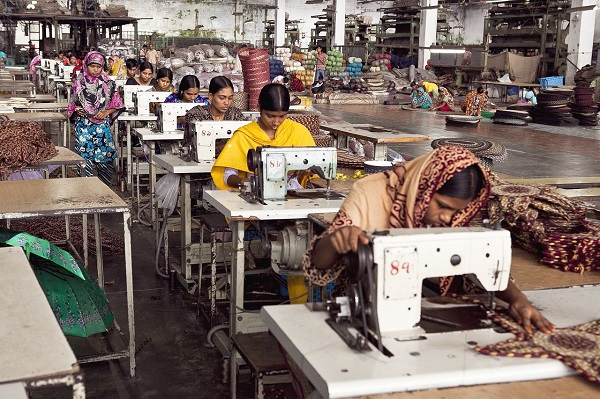
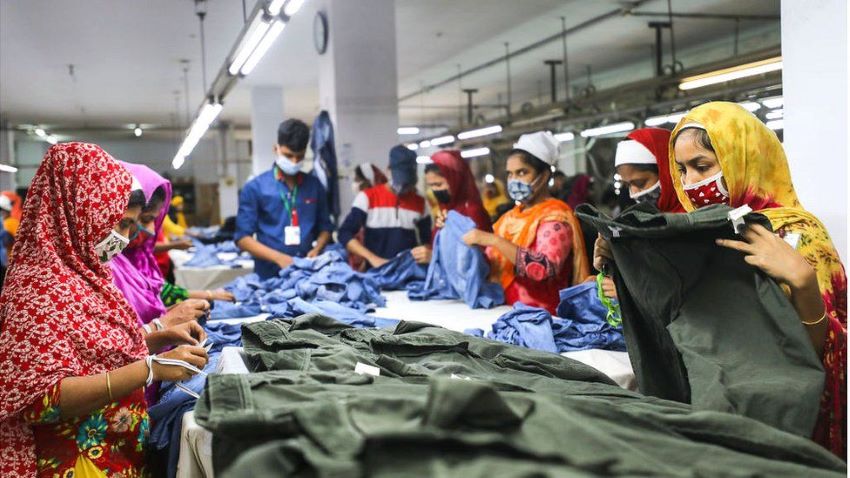
When chips are down due to pandemic and constant floods in Bangladesh, many global multi-million fashion brands are still pulling in their wealth from impoverished suppliers in a subtle form of 21st-century neo-colonialism. Many Bangladeshi factories selling to over 24 of the largest global retailers from the UK and Europe are running at a loss as these big retailers are paying below the cost of apparel production by sticking to pre-pandemic prices and simply ignoring the cost of raw materials increasing.
Workers actual losers
While Bangladesh remains the second largest garments exporter in the world, the country’s garment workers are struggling to survive and local manufacturers are finding it difficult to pay minimum wages while the global sourcing fashion brands turn a blind eye while increasing their profits. Inflation rates soaring around the world have further increased this dismal economic situation.
According to a survey carried out by the University of Aberdeen and trade justice charity Transform Trade titled ’Impact of Global Clothing Retailers - Unfair Practices on Bangladeshi Suppliers During COVID-19’, a lot of malpractices of a large number of high street fashion brands have come to light. More than 50 per cent apparel suppliers have suffered unfair purchasing practices, including cancellations of orders, failure to pay up, payment delays, and discount demands with further effects including forced overtime and harassment.
Bigger brands bigger culprits
The bigger brands buying from many factories were the bigger culprits in unfair purchasing practices more than the smaller brands. Suppliers feel any brand that purchases from 15 or more factories were more likely to be engaging in these practices. This converts around a total of 90 per cent of larger high-street brands buying from four or more factories engaging in unfair purchasing practices in the post-lockdown period. With garment factories employing 75 per cent of their previous workers, the study estimates around 900,000 workers could have lost their jobs and are struggling in their daily lives.
An International Trade Centre (ITC) report reiterates the fact that international buyers are consistently paying lower than the global average price to apparel suppliers in Bangladesh but higher to some of the country's competitors. The ITC study analyzed data for 10 of Bangladesh's most important export items for 2020, comparing their FOB prices with those of their 10 biggest competitors for each product. For each case study, the supplying countries such as Bangladesh, Pakistan, and Cambodia are consistently paid lower than the world average prices while others such as Vietnam, Indonesia, Turkey and Mexico are given higher than the average rates. The study feels that customers -- retailers and brands -- should pay their suppliers a fair free-on-board (FOB) price since they are often paying prices that are below the factory costs.
“The data is clear and many factories have been forced to close because of the lower FOB prices. The conclusion is that the fault lies with the customers and therefore, they should be forced to pay a higher FOB price. They are willing to pay higher prices to some countries but rather less to supplying countries that are unable to meet their needs,”says ITC.
For the same products, such as men's woven cotton trousers made in Bangladesh being sold for $7.01 per piece in 2020, which was 9.20 per cent below the global average of $7.72, a country like Vietnam received $10.76 per piece while Sri Lankan and Indian exporters got $8 and $8.41, respectively. This was the same in other apparel also such as men's cotton jeans, women’s bras and woven cotton jackets among others. Only two products such as women's cotton trousers and men's cotton T-shirts manufactured in Bangladesh got a price that was slightly higher than the global average.
Bangladesh needs to diversify its product basket with 80 per cent garment items still confined to five cotton-made items leading to over-capacity. An all-inclusive and accurate costing and valuing is the primary step to moving up the value chain. The small and medium-sized garment manufacturers remain backward and focused on simple cut and sewing operations and it is time that going hi-tech and a versatile portfolio paves the way forward.
UK to host Source Fashion
Source Fashion will take place in the UK, February 12 to 14, 2023.This is Europe’s newest responsible sourcing show and is the only international fashion sourcing platform of its kind in the UK.
There will be a compelling line-up of dedicated country pavilions and over 150 audited, quality manufacturers from around the world including Peru, India, China, Pakistan, Italy, Spain, Greece, North Macedonia, the UAE, Madagascar, Jordan, Uzbekistan, Turkey, the UK and many more.
The show aims at uniting responsible and sustainable manufacturers from key sourcing regions around the world with high-profile retailers, brands, who are looking to simply source better. The aim is to ensure buyers and sourcing professionals can walk through the door and be certain that each supplier at Source Fashion will be audited, accredited, and ready to work with.
Source Fashion Pavilions will shine a spotlight on curated collections of high-quality producers and exporters from countries including Peru, Pakistan, India and China. Bringing a textile pavilion to the UK for the first time, the Peru Pavilion will showcase six manufacturers specialising in high-quality alpaca wool from the raw material right through to garment production as well as cotton and other natural mixtures.
RCEP unlikely to benefit Cambodian and Indonesian textiles
The Regional Comprehensive Economic Partnership (RCEP) is unlikely to benefit the textile sectors of Cambodia and Indonesia.
Even though both countries are members of RCEP, Cambodia and Indonesia are competitors in the world market in the textile sector and their current bilateral trade in apparel, fabrics and yarn is limited.
Cambodia’s apparel imports from Indonesia are negligible.Cambodia’s home textile exports to Indonesia ended up being negligible in 2021 and 2022. Its import of home textiles from Indonesia is also insignificant. Yarn imports from Indonesia to Cambodia have also showed a decline in recent years.
However, trade ties between Cambodia and Indonesia are expected to rise further and cross $1 billion this year.Cambodia’s exports of goods to RCEP member countries in the eleven months of last year rose by five percent compared to the same period last year.
The RCEP agreement was signed in November 2020 by 15 countries including the ten Asean member states, Australia, China, Japan, Korea, and New Zealand. The agreement is expected to increase competitiveness and strengthen the global production network, promote regional supply chains through better market access for exports of goods and services, reduce or eliminate trade barriers, and enhance transfer of technology.
Noida to host India International Garment Fair
India International Garment Fair will be held in Noida, February 7 to 9, 2023.
The business-to-business event is designed to bring together buyers and sellers to network and boost business.The upcoming edition of the India International Garment Fair will see garment manufacturers from across India showcase their collections for the autumn/ winter 2023/ 2024 season.
The trade show features product categories including men’swear, women’swear, children’s wear, and fashion accessories, among others.The bi-annual trade show draws an international crowd of buyers and retailers keen to network with Indian manufacturers and import their finished garments. Garment manufacturers will display their latest designs at booths and the trade show will facilitate networking with the aim of linking buyers with manufacturers creating the garments they wish to source.
Every year buyers from the world visit the fair and do business worth millions of dollars. Businesses can present their latest products at the trade show. The event is designed to offer manufacturing businesses the opportunity to network with retailers, wholesalers, and retail chains to expand their distribution networks into new areas and markets across India. Trend forecasting and knowledge sharing will also be facilitated. The exhibition is focused on transforming North India into an effective sourcing base for all types of garments.
Meyer is Monforts MD
Gunnar Meyer is the new managing director of Monforts.
He started his career with Monforts and has spent his whole working life in the textile machinery industry. Between 1985 and 2010 he was a key part of the Monforts team in various roles related to sales and commercial issues, including as general sales director.
He returned to the company in 2019 after working for other well-known German textile machine manufacturers in the field of nonwovens.
Working in other parts of the textile industry, he has gained a lot of experience in the management of complex technical textile projects and his special focus will be on challenges like the current energy crisis, alternative heating systems and sustainable textile finishing.
Monforts, based in Germany, was founded in 1884 and today is a leading supplier of textile dyeing and finishing machines as well as coating devices. The company is a market leader for stenters, continuous dyeing ranges, sanforising ranges and special executions for denim and for the coating of technical textiles and other special applications. At its Advanced Technology Center (ATC) customers can undertake fabric trials on the latest Monforts equipment under real production conditions. For over 40 years, the company`s production site has been in Austria.
Cambodia extends tax breaks
Cambodia has extended tax breaks for eligible textile-related enterprises until the end of 2025.
The move is expected to ease the burden on the sector, which has experienced a severe decline and drop in orders as a result of global economic headwinds linked to the ongoing Ukraine crisis. These sharp drops in orders are most likely to persist throughout 2023. Some factories may be temporarily closed and jobs may be cut due to the Russian-Ukrainian war’s effects on the incomes of the peoples of Europe and the US, some of Cambodia’s biggest markets.
The Ukraine and Covid crises have weakened global economic growth, driving up prices for fuel and commodities across the world, eroding incomes and forcing consumers to cut back on spending, particularly so in Europe and the US. So the tax breaks are aimed at maintaining the sustainability of industries as well as safe guarding local employment although global economic conditions have yet to improve.
Cambodia’s exports of garments, footwear and other textile-related items from January 2022 to November 2022 were up 17 per cent year on year. These category of items accounted for 49 per cent of the value of the country’s total exports over the eleven-month period.
Indian shirt exports up 30 per cent
Men’s shirt exports from India from January 2022 to November 2022 increased by 30 per cent. Of total exports, exports of knitted shirts were up by 23 per cent in terms of revenues while exports of woven shirts were up by 35 per cent in revenues.
The US remained much ahead of other export destinations with a large margin. India’s exports of men’s shirts to the US market – almost 39 per cent of its entire men’s shirt export value – grew by 58 per cent from January 2022 to November 2022. The UAE is the second largest export destination for men’s shirts from India; however, the Middle East country sourced 24 per cent less men’s shirts from India in the mentioned period as compared to the same period of the prior year. And men’s shirt exports to the UK from India grew by 24 per cent on year on year basis.
From January 2022 to November 2022 men’s shirt exports constituted around ten per cent of India’s overall apparel export values.