FW
Turkish raw material exports up seven per cent
Turkey’s textile and raw material exports increased by seven per cent in January 2022 to August 2022 compared to the same period of the previous year.
The most important export market in the January to August period of 2022 in terms of quantity was Italy with a share of eight per cent. Exports of textiles and raw materials to Italy, increased by 0.9 per cent on a quantity basis. Exports to Germany, the second largest export market, increased by two per cent in this period. The US is in the third place with an increase of 16 per cent.
When the exports of textiles and raw materials are analyzed in terms of quantity in the same period, Morocco was the country with the highest increase in exports among the top ten countries. Exports to Morocco increased by 30 per cent. The country with the highest decrease was the United Kingdom. Exports to the United Kingdom decreased by 20 per cent.
The yarn product group continued to rank first in exports of the Turkish textile and raw materials sector, with an increase of three per cent in the first eight months of the year. Exports of the cotton yarn product group, the second largest sub-product group, increased by one per cent in this period.
Under Armour to eliminate biocides
Under Armour is aiming at eliminating 100 percent of biocides in its products by 2025. Other objectives are advancing low-impact manufacturing, reducing the environmental impact of its materials, and targeting net-zero emissions by 2050. Under Armour will work toward reducing the environmental footprint associated with its products and operations while accelerating its social and community impact.
The company has a renewed commitment to continuous improvement, industrywide collaboration, and transparent communication with stakeholders in the ongoing sustainability journey. Under Armour’s sustainability approach reflects the company’s mission to make athletes better by focusing on performance-driven innovations that utilize more sustainable materials designed for recyclability and more efficient production processes in its delivery of durable, quality, high-performing products.
The company is embracing material innovations that will enable less waste and more durability, setting the stage for circular systems by 2030, and supporting innovation that reduces fiber shedding from textiles.Single-use plastic brand product packaging will be reduced by 75 percent by 2025.
Under Armour is a global innovator and leader in athletic performance apparel, footwear, and accessories. At the end of 2021, approximately 40 percent of fabrics used in the company’s apparel and accessories were made from materials capable of being recycled.
Spandex market grows by four per cent
The global spandex market is growing by four per cent a year. The increasing demand for the material from the textile sector especially for sportswear, active wear along with high use in medical applications, is likely to propel the growth of the industry. Rising average disposable income of people is another factor driving the market’s growth.
People around the world have become more conscious about their health and are getting engaged in various kinds of sports or fitness activities. This is creating huge demands in the sports wear market which is largely dependent on the availability of spandex. The need for comfortable sportswear is creating huge demands in the market. Rising disposable income of people has led to greater adoption of high quality inner wear and active wear which is another key factor behind the market’s growth.
Spandex fiber offers excellent strength, weight and versatility which makes it so popular among textile manufacturers. It also finds widespread use in medical applications which is also contributing to the sales figures of the product. The material is light in weight, soft, elastic, stretchable and provides effective resistance against body oils, perspiration, detergent and abrasions. It is used in the production of casual clothing, trekking pants, under garments, home furnishing items, among others.
South Korea and Cambodia sign FTA
South Korea and Cambodia have signed a free trade agreement. This is expected to boost Cambodian exports of garments, textiles and footwear to South Korea.
The agreement also presents opportunities for value-added investments in Cambodia’s downstream processing industries through a plus one business model, in which South Korean companies could expand their supply chain network developed in not only China but also Vietnam or Thailand.
The agreement is expected to boost trade between the two countries with South Korea agreeing to remove tariffs on 95 per cent of products imported from Cambodia while Cambodia will eliminate duties on 93 per cent of goods imported from South Korea.
Cambodia-South Korea bilateral trade was valued at $885 million in 2020 and grew by nine per cent to $965 million in 2021. Further, Cambodia imported goods worth over $600 million from South Korea in 2021 while exports reached $341 million to the East Asian nation.
South Korea has a great demand for high-value winter clothing and denim. Other potential products that have good demand in the country include non-leather footwear, home textiles, jute and jute products etc. The biggest markets for Cambodian garments are, in order, the US, EU, Japan, Canada and the UK.
Sitip, Italy offers versatile and durable fabrics
Sitip’s fabric collections for sportswear, urbanwear and athleisure ensure exceptional performance, impeccable style and attention to sustainability.
They perfectly respond to the new performance and design needs required by the market and by the end consumer, who is increasingly in search of comfort. The fabrics conform to the contemporary lifestyle. They are versatile, sustainable and durable. One is a polyamide pre-consumer recycled warp knit fabric. Another is a polyamide post-consumer recycled warp knit fabric. Yet another is a polyamide pre-consumer circular fabric.
Sitip’s sustainability strategy stems from the need to rethink any business field in a green perspective. This development model is based on innovative technologies that allow the company to derive benefits in terms of economic, social and environmental sustainability. Sitip has developed a range of sustainable textile fabrics obtained from GRS-certified recycled yarns produced with chemicals with a low environmental impact and with a lower consumption of natural resources. Continuous innovation goes hand in hand with a far-sighted corporate strategy since Sitip makes use of the most recent technologies and the most advanced machinery to allow continuous production and quality updating.
Based in Italy, Sitiphas over 60 years of experience, specializing in the production of synthetic warp-knitted fabrics, intended for the technical industrial world, and stretch and circular fabrics, intended for clothing.
Domestic or Exports: Opportunities for the Indian apparel industry

Time is ripe for Indian manufacturers and exporters of lifestyle products to leverage fresh opportunities. Post-pandemic, international markets are reopening to exports from India whilst the local market is seeing a buy-in to locally manufactured products.
However, all isn’t hunky dory as the rupee is in a continuous fall, pushing up cost of imported raw material, the reality of ever-growing inflation, and geo-politics contributing to cautious plans and disruption in logistics. Facing these challenges may seem a big obstacle but optimism is in the air as the smart manufacturers and exporters are coming up with solutions on the way forward to ride the wave of growing international markets and rise in local purchase.
In fiscal year 2022, India exported ready-made garments including textiles worth of more than INR 1194 billion. Comparing to the previous year which totaled INR 906 billion, the indication is that of a positive growth trend. According to Invest India reports, India scaled its highest ever exports tally at USD 44.4 billion in Textiles and Apparel (T&A) including Handicrafts in FY 2021-22, indicating a substantial increase of 41% and 26% over corresponding figures in FY 2020-21 and FY 2019-20, respectively.USA was the top export destination accounting for 27% share, followed by EU (18%), Bangladesh (12%) and UAE (6%).
According to McKinsey’s Fashion Scope, the Indian domestic market is also growing in leaps and bounds. Expected to cross $59 billion in 2022, India’s domestic garment consumption will be the sixth-largest market in the world.
Brands have to be omni-channel
Two years of Covid has permanently changed the shopping experience as narrated by the success of brands that leveraged online retail to their advantage. Brands no longer have a choice but to be omni-channel to not only garner repeat purchase but to also get their desired outreach targets.
Is sustainability acknowledged?
Despite nay sayers, fast fashion keeps growing exponentially in India, and the pandemic-lockdown mindset continues to seek instant gratification through the various channels of fast fashion. There is an ongoing debate in India about the trending topic of sustainability which affects fast fashion. Recently, YouGov’s Indian consumer survey reported that most shoppers consider a sustainable manufacturing process important in their decision making for purchase. This new data showed 83% of urban-based shoppers have sustainability on their mind. Whilst the survey showed the awareness and preference for sustainability, the key drivers continue to be price, fabric and design led. Indian manufacturers are trying to bring in sustainable fibres whilst trying to keep costs down, a task that currently seems challenging.
Supply chain will determine market success
Industry experts reiterate the importance of a seamless supply chain to make the sector not only viable but also continue the growth momentum. A robust ecosystem of infrastructural support and capability is the need of the hour according to their projection of the near future. The success of the sector is highly dependent on sourcing of raw material on time as well as keeping the logistical cost viable in times of rise in fuel prices. Supply chains also need to embrace digital transformation rapidly to manage the growth and demand scenario through error-free inventory, production capability and distribution management.
To conclude, Indian manufacturers and exporters have the solutions to be competitive but require more governmental support to give them the winning edge.
Levi Strauss aims at total renewable electricity
Levi Strauss is aiming at total renewable electricity in all company-operated facilities by 2025. Other objectives are 40 per cent absolute reduction in supply chain greenhouse gas emissions by 2025, 90 per cent absolute reduction in greenhouse gas emissions, net-zero emissions of greenhouse gases by no later than 2050 and reducing freshwater use in manufacturing by 50 per cent in areas of high water stress by 2025.
The company is demonstrating its commitment to a holistic definition of sustainability and progress across its key pillars of climate, consumption and community. The goals cover focus areas including greenhouse gas emissions, water stewardship, circular economy and new business models, worker well-being in the supply chain, diversity, equity and inclusion and social issue advocacy. The intent is to leverage the strength of its brands and longstanding company values to inspire employees, communities and value chain partners to join the journey to create a more inclusive and regenerative apparel industry.
Across all goals, the company will continue to pilot new solutions, develop partnerships for impact and accelerate successful tactics to achieve the goals and play its part in addressing climate change.One theme that cuts across all the goals is the need for increased partnership across the industry to meet common challenges.
India swamped by Chinese yarn
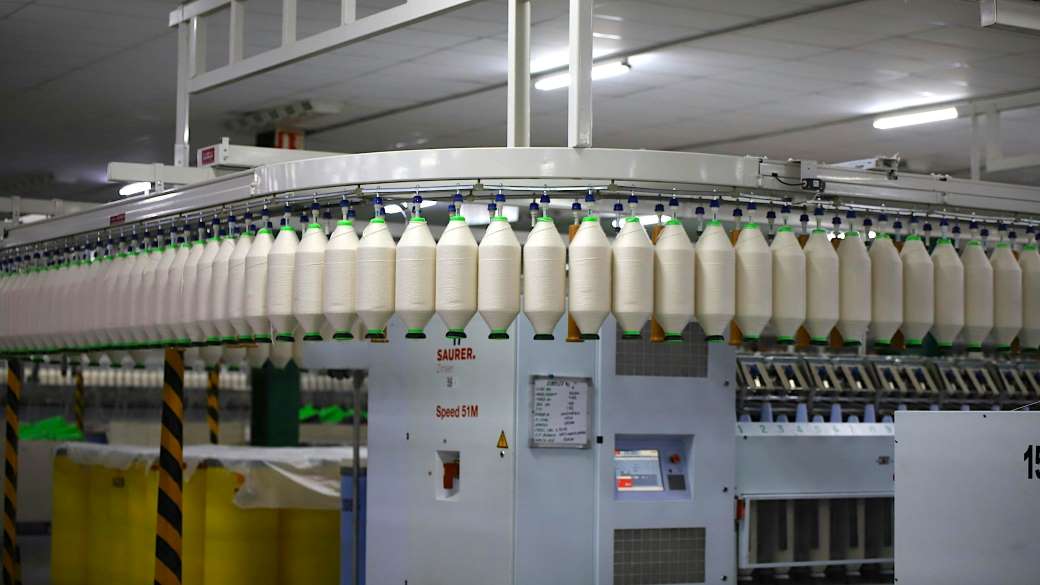
Huge imports of Chinese polyester yarn are dampening market sentiments. Domestic spinning mills are already running at just 70 per cent capacity. There has been no improvement in buying from domestic and export markets and cheaper cotton and cotton yarn are adding to the problems of the polyester value chain. Chinese supply is eating into the domestic market demand.
A slightly improved demand was seen towards the end of the previous week as Vardhman and some other companies had secured sizeable orders of polyester yarn. But the market again turned bearish as buying reduced. Demand improved because the market pipeline had dried up but there was no improvement in consumption.
Prices of polyester-cotton, poly spun, and recycled yarn have continued to fall. PC, poly spun and recycled polyester yarn declined by Rs5 per kg. 30 count PC combed yarn was sold at Rs230. 30 count PC carded yarn was priced atRs200 per kg. 20 count PC PSF yarn was traded atRs170 per kg. 30 count poly spun yarn was sold at Rs160 per kg. Recycled polyester fiber was at Rs90 per kg.
North Indian states recorded a steep fall in cotton prices as arrivals increased.
Global gym apparel market expanding at six percent
Gym apparel market shows good growth, expanding at six percent a year.
During the first few months of the Covid pandemic, gym apparel sales significantly decreased. However some positive effects were crucial in driving up the demand for gym clothing in the years that followed. Many people were urged to start their own personal gyms or join ones in their communities in response to the lockdown’s increasing length. There was a significant increase in the number of people going to the gym every day, which fuelled the expansion of the gym clothing business.
Sweatshirts and tanks are the most popular product segment of the gym apparel market. Online retailers or e-commerce platforms are the rapidly expanding segments for the global gym apparel market on the basis of the supply chain. Gym gear producers are introducing new innovative components into their products to meet the current demands of the burgeoning smart wear trend. One of the biggest breakthroughs for the rising trends in the gym gear market has been the introduction of smart nanotechnology fabric.
Active wear shirts now change color by thermal heat signature. The shirt is a new way to measure workout using one’s body heat since it keeps a comfortable temperature but has the ability to change colors depending on body temperature.
H&M Q3 sales up three per cent despite pulling out of Russia
For the third quarter H&M net sales increased by three percent. The reported gross margin was 49 percent. Increased raw materials and freight prices as well as a stronger US dollar resulted in substantial cost increases for purchases of goods.
A cost and efficiency program is being initiated by H&M to further streamline the business. The savings from the program is expected to become visible in the second half of 2023. Agreements have been signed with developers of new solar farms to secure access to renewable energy for many years to come. This will help the H&M group reach its carbon reduction targets as well as securing energy prices for parts of its own operations.
The autumn collections were well received and sales in September 2022 were up on the previous year.
In the third quarter the company decided to pause sales and wind down the business in Russia. This had a significant effect on the company’s sales and profitability. Sales then gradually improved, despite a heat wave in several European countries and some remaining delays in the supply of goods. H&M has undertaken initiatives to meet customers’ expectations. This involves ensuring the best customer offering for all the brands and the best customer experience.