FW
Yarn Expo 2019 upholds transparency in textile supply chain
"Recent editions of Yarn Expo have been highlighting the growing importance of transparency in the textile chain. The Spring 2019 edition of the expo highlighted shifting sourcing trends, brands’ entry into new markets and initiatives needed to achieve sustainability in the textile industry. The next edition of the fair, Yarn Expo Autumn 2019, will be held from September 25 to 27, 2019 at the National Exhibition and Convention Centre (Shanghai)."
 Recent editions of Yarn Expo have been highlighting the growing importance of transparency in the textile chain. The Spring 2019 edition of the expo highlighted shifting sourcing trends, brands’ entry into new markets and initiatives needed to achieve sustainability in the textile industry. The next edition of the fair, Yarn Expo Autumn 2019, will be held from September 25 to 27, 2019 at the National Exhibition and Convention Centre (Shanghai). It will be held concurrently with the 25th Autumn Edition of Intertextile Shanghai Apparel Fabrics, as well as CHIC and PH Value.
Brands demand transparent supply chains
Organised by Messe Frankfurt (HK) and the Sub-Council of Textile Industry, CCPIT,the Spring edition of the Yarn Expo had a common theme across each case study that included the rise in consumer demand for sustainability and transparency, and its consequent effects across the industry. And as Manohar Samuel, Senior President of Marketing & Business Development at Grasim Industries points out brands are realising the importance of fiber in creating an environment-friendly products. CCI agreed to this viewpoint by observing that trade buyers from further along the supply chain are sourcing directly from yarn & fibre suppliers. They are demanding traceability. The main advantage of using traceable cotton is that it’s easier for brands and retailers to do their due diligence, by starting right from the origin.
Trade buyers focus on improve traceability
Exhibiting at Yarn Expo has enabled companies to attract a wider variety of trade buyers who seek to improve their traceability. One such company, Safilin was able to direct customers to the exact fields that grow flax for their linen. As a result, the company got enquiries directly from brands who want to improve their carbon footprint.
Exhibitors say, sourcing directly from yarn and fibre companies can provide brands an access to innovative yarns and fibers, ultimately offering product differentiation. It can also reduce the risk of costly production problems such as breakage, while creating a product that commands higher premiums at retail.
The success of Autumn edition of the show was reflected in its 9 per cent increase in visitor numbers. The fair also organised its first ever Media Tour that invited textile industry media to highlight the expo’s growth besides emphasing on the growing role of suppliers’ in the industry’s continuously adapting sourcing trends.
Trident expands spinning capacity
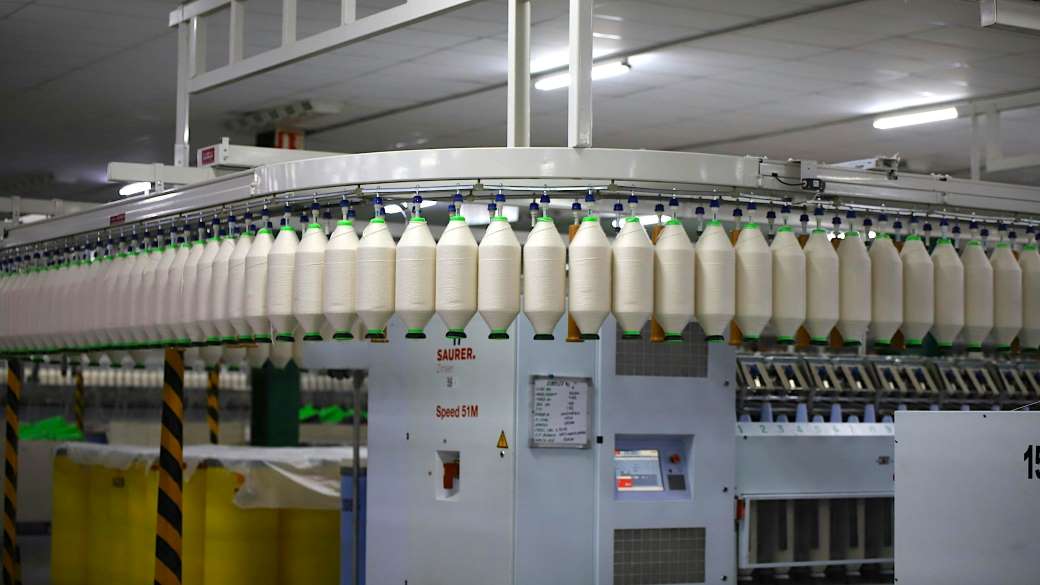
Trident is expanding spinning capacity at its Madhya Pradesh plant. The project, is expected to begin commercial production by January 2021, will help strengthen Trident’s existing home textile business and further expand its market presence. Trident’s existing capacity is 5,43,744 spindles and 6,464 rotors, and the current capacity utilisation is 99 per cent. Trident has planned for maintenance capex at Rs 100 crores for fiscal ’20 and the same will be utilized toward small maintenance capex in the form of de-bottlenecking and upgradation of capacities.
Trident is the flagship company of the Trident Group, an Indian business conglomerate and a global player. Based in Punjab, Trident is a vertically integrated textile (yarn, bath and bed linen) and paper (wheat straw-based) manufacturer and is one of the largest players in the home textile space in India. The company is upgrading its business operating system.
India has emerged as not only the largest producer of raw cotton but also a major cotton surplus and cotton exporting country in recent years. This gives a distinct advantage to Indian home textile manufacturers. Home textile companies which have invested in technology and systems are bound to consolidate and grow, leveraging their capabilities with cost-efficient manufacturing and a strong market presence.
Trade war affects demand for Australian wool in China
Australia’s wool market has crumbled amid heightening US-China trade war. The dispute has led to a slowdown in the Chinese economy and a dip in consumer confidence. Another reason for the recent hesitation from Chinese mills is that stocks of garments, fabrics and yarn in the Chinese wool textile industry are rising. Chinese buyers are reluctant to buy the greasy commodity at auction. As China has a 75 per cent share of Australia’s exports, any reduction in China’s demand will hurt the Australian wool market.
Currently, wool clothing have not been included in the punitive tariffs imposed by the US on Chinese imports. A potential US tariff hike on wool imports from China would have a severe knock-on effects for Australia’s wool trade. If the US imposes a 25 per cent duty on imports of wool clothing from China, that will flow-on back to Australian wool growers given that Australia supplies around half of China’s raw wool requirements.
The US and China have been locked in a bitter dispute since July last year after the US enforced tariff increases on 818 categories of Chinese imported goods worth 50 billion dollars. Tensions threatened to reach boiling point last month when the US threatened to raise tariffs again.
A clutch of LA brands prioritizing sustainability
Several fashion brands have emerged in Los Angeles with a focus on sustainability. They aim at becoming leaders in changing the fashion industry’s longstanding practices.
Christy Dawn exemplifies the essence of LA fashion. It is also completely transparent about its sourcing, design, and production processes. Because it uses a local supply chain, it’s easy to follow. All the pieces are made in LA from dead stock fabric (surplus or incorrect fabrics from other brands that couldn’t be used). Similarly Christy Dawn, Reformation uses dead stock fabric and recycled fabrics. The brand publishes annual sustainability reports, which include its carbon footprint and progress the business has made to improve sustainability from year to year. Alternative Apparel offers sustainable fashion for men, women, and children. The focus is on producing comfortable, casual fashion basics like T-shirts, sweatshirts, and jeans. To minimize waste packaging waste, the retailer uses biodegradable mailers for its online shop. The practice also reduces water use and minimizes C02 waste.
The fashion industry has many long-rooted unsustainable practices that continue to drain the earth of premium resources and add to its pollution problem. The industry’s water consumption is expected to grow 150 per cent by 2030 and its carbon waste to balloon to 148 million tons.
Pakistan: Textile sectors reject move to discontinue zero-rated status
The value-added textile manufacturers and exports association in Pakistan has advised the government t to improve the zero-rated scheme, in consultation with stakeholders. They have advised the government to focus on energy growth instead first collecting taxes and then releasing them in refunds. Besides, the government should also step up a solid plan to increase taxpayers' base to help the country overcome its monetary deficits.
The association rejected the government's decision to discontinue the zero-rated status of five export-oriented sectors, warning that the move will unleash flight of capital, destruction on manufacturing and huge unemployment in the country. It feared the already subdued exports sectors will further nosedive into financial troubles as a result the nation will suffer huge foreign exchange loss and unemployment.
The association also warned that the discontinuation of the zero-rated status of the exports sectors lead to a corruption in connivance with "dubious" FBR officials under the mode of flying invoices, over invoicing, frauds in refunds and such other tactics. The government's attempt to collect interest free money in shape of sales tax will put the country's export at stake. It cautioned that the discontinuation of the zero-rating scheme will result in a 30 percent decline in exports in the first year.
PG ventures into high end denim
Italy-based PG Denim, is expanding its presence in the high-end denim market. There are several novel capsule collections. Garage Denim is the line inspired by the metallised colors of cars in the 1950s and ‘60s, where colored glitter pasted on very dark fabric backgrounds and brightly colored sheets create an imperceptible painted effect. The fluid and flowing fabrics can be finished in various ways to create unexpected forms, resulting in truly customised denim. The Samite range is inspired by the ancient technique of samite fabrics, used in the Middle Ages to produce heavy silk drapes, similar to velvet, as well as to produce luxury clothing. This technique has resulted in the idea to combine samite with viscose flock. Gala Denim develops an indigo and black denim fabric, where the wefts are made of real silver thread, resulting in smart and stylish garments with no limitations in terms of use.
The experiments at PG Denim are also focused on the new 3D print range, based on special relief which are inspired by natural landscape with an amazing result and which interpret the fabric in a truly unique way.
PG Denim offers a completely integrated supply chain. Among its customers are Diesel, Closed, Chanel and Louis Vuitton.
BFC launches new campaign
The British Fashion Council (BFC) launched a new campaign ‘This is London’ that celebrates community, diversity & culture at London Fashion Week Men’s June 2019. Shot by London based photographer Markn, the campaign is a collection of 12 images and includes a diverse selection of people from the worlds of art, music, fashion, film & sport. The campaign features a mix of globally established names and current tastemakers, all driving forward London’s culture and reputation, representing the city in their own unique way. The campaign is a testament of the city’s diversity and creativity and highlights the relationship between the creative industries.
The celebrities participating in the campaign were asked questions about London: what they love most about the city, what separates it from others and how the capital creatively defines them. The campaign will be promoted at the main hub of LFWM, The Truman Brewery, during London Fashion Week Men’s June 2019 which runs from June 08-10, 2019.
London College of Fashion partners Education for Fashion Tech (E4FT)’ project
London College of Fashion (LCF) is partnering the Education for Fashion Tech (E4FT) project funded by the EU. The project aims to create a new training pathway to improve the level of key competencies and skills of students and trainers.
The project is constructing a resource for teachers to include innovative teaching and learning methods. Although a European project, it involves research institutes, companies and higher education centers from across the world.
The project defines fashion tech as a technology that provides a fashion experience to the user and includes smart textiles, wearables and digital technologies. Some examples of where this technology is used include ‘improving health’, ‘enhancing senses’ and ‘personal expression’.
Another way in which LCF supports innovation is through the Define project: https://define-network.eu/. This project has formed a European fashion-innovation network bringing together the fashion-technology ecosystem of incubators, accelerators and the start-ups & SMEs they support, along with financiers and other organisations including universities, to share knowledge and encourage new ideas. As such it forms an open network that can be used within Europe and that can be collaborated with by similar initiatives across the world.
DCTV forms collaboration for circular clothing
DCTV has collaborated with brands, retailers, manufacturers, their associations, knowledge institutes and government bodies for introducing a more circular clothing and textiles value chain in the Netherlands. The DCTV team is run by MODINT, Fashion for Good, Circle Economy, ABN-Amro, MVO Nederland and het Groene Brein.
The aim of the project is to reduce the Dutch apparel and textile’s impact on water, raw materials and climate. It includes stimulation of a more durable way to use clothing, stimulating the second hand market and improving the results of material and fibre recycling to be able to actually use a greater share of collected textiles and clothing. Concretely, the project will focus on creating projects involving fibre recycling techniques, circular design, business and brand development and corporate and workwear.
Indian units set base in Africa
Indian textile units, especially garment manufacturing factories, are expanding to new geographies, mainly Africa. The prime reason is duty-free access to the US and EU markets. Among them are the KPR Group and SCM Garments, both from Coimbatore. The two companies have generated over 1,500 jobs.
For a polycot T-shirt, Indian exporters pay 32 per cent import duty in the US if shipped from India. It is duty-free if exported from Africa. For cotton T-shirts, the duty-free access gives 16 per cent advantage to an exporter. For an industry that works on thin margins in India, this is a substantial advantage even if the buyer does not pass on the entire benefit. By 2030, India is expected to be a net importer of clothing. The African market is also growing. By setting up capacities in Africa, Indian companies can tap the potential in both these growing markets in the coming years.
Indian investments across sectors started coming into Ethiopia after 2008 when Ethiopia came up with an attractive investment policy, and Indian industries were looking at frontiers outside India. Apart from Ethiopia, Kenya is attracting investments from garment manufacturers, while Tanzania and Uganda are also opening up. It is not only Indian factories, but textile companies from China, Sri Lanka, and Bangladesh that are investing in these countries.