FW
Kitex adds socks and diapers
Kitex Garments aims at being a top infant apparel manufacturer in the world. The plan is to diversify into socks for children, baby diapers and baby wet wipes. It is planning to add production capacity across the value chain, which includes an expansion of the knitting and processing capacity. The company is also considering setting up a cotton spinning mill for yarn production with a capacity of 100 tons per day. Plans are also afoot to set up a manufacturing facility for ancillary materials such as trims and packages, which includes cartons, tapes, paper tags, labels, hangers, woven tags etc. Kitex Garment is equipped with latest sewing machinery that ensures stain-free, quality sewing, and a state-of-the-art spectrophotometer that ensures electronic color reading and transmission.
The plant produces knitted fabrics that are of exceptional quality, well appreciated and recognized by reputed children’s wear brands in the US and Europe. Established in 1992 Kitex is totally into export of cotton and organic cotton garments, especially infant wear..
Over the last 10 years profit before tax has grown from eight per cent to 21 per cent and it has progressed in terms of technological, operational, human resources, products and social capabilities. Today Kitex is the second largest infant apparel manufacturer in the world.
Functional fabric center opens in the US
Drexel University in the US has opened a center for functional fabrics. Engineers, designers, and other scholars are developing models and mass-production techniques for smart textiles that emit, transmit, communicate, and actuate using embedded sensors and other digital tools. It's a modern mini-factory with a warp knitting machine, flatbed knitting machines, circular knitting machines, a textile welding machine, a 3-D scanner loom, 3-D printers and laser printers. The aim is to create textiles of the future with tools of the future. The staff includes fashion designers, material scientists, and mechanical and civil engineers. Drexel is also working on a smart fabric belly band, with a configurable antenna and RFID system (like the antitheft tags in stores) that can detect breathing and contractions in patients not under the direct supervision of nursing staff. A handful of doctoral students are based at the center, along with master's candidates and undergraduate interns. The hope is to join electrical and materials engineering students, fashion designers, and biomedical specialists to learn trans-disciplinary teamwork as well as textile and computing design.
Fabric studded with sensors and entire computing systems is a staple of science fiction and tech promotion. But after years of experiments and lab use, there are few such functional fabric products in commercial production.
India: Welspun enters advanced textiles
Welspun is stepping into advanced textiles segment. The big bet on advanced textiles includes making disposable towels out of non-woven textiles and filters for the auto and power sector. Advanced textiles will broadbase Welspun’s clientele by adding sectors such as auto, healthcare and FMCG.
The company is known for bed sheets and towels and has introduced reversible bed sheets and quick-dry towels. It is one of the largest suppliers of home textiles to retailers like Walmart, Costco and others. The company also sells premium licensed brand products like Wimbeldon, Nickelodeon and Disney. Branded products account for 17 per cent of its revenues. Another emerging business segment is flooring. Welspun is looking at offering luxury performance tiles, wall-to-wall carpets and artificial grass for offices and cricket fields. Currently, most wall-to-wall carpets, carpet tiles and luxury performance tiles are exported from China, USA, Belgium and Thailand. But, floorings is a huge market that Welspun now wants to cater to.
Besides retail channels, the company is also eyeing hospitality and e-commerce as future growth drivers. Growth in fiscal ’19 was in single-digit but with new products and a focus on newer channels, Welspun expects a double-digit growth this fiscal. The company expects a revenue of Rs 10,000 crores over the next four to five years.
Indian cotton prices trade easy
Indian cotton prices are trading easy with the prospects of bumper crop, increasing daily arrivals and a financial crunch in the market. Spinning mills have not been able to build cotton inventories yet as the yarn market remains sluggish. Rains in September and October can affect the arrival pace and somewhere some quality concern can be seen, but this will depend on intensity and frequency of rains. Of the daily cotton arrivals, most of the cotton is coming from north India.
This year, Cotton Corporation of India’s sourcing strategies will be very crucial to give direction to the market. The CCI will have to get active and buy a good amount of Indian cotton, failing which Indian cotton will trade lower than the minimum support price. This will create fewer export possibilities and can also give immediate support to Indian spinning mills. Lower cotton prices will make Indian yarn competitive. The ban on trade with Pakistan has taken out around a million cotton bales from expected export numbers for the crop year 2019-20. That will directly be a surplus in India.
Meanwhile, India needs to come up with some export promotion policies for the textile industry and brighten the dull scenario.
Vietnam export turnover up 16 per cent
The turnover of Vietnam’s textile and garment export industry has increased 16.01 per cent against the previous year. Export turnover of the garment sector was up 14.45 per cent. Turnover of fabric exports was up by 25.5 per cent. Yarn export was up by 9.9 per cent. The trade surplus of the garment sector increased 14.39 per cent. The income surge has been attributed to a shift of manufacturing units from China to Vietnam. Foreign investment has also increased in Vietnam.
Once the free trade agreement with the EU comes into force, investments in Vietnam’s textile and garment industry are expected to increase further. The garment export surge seen by Vietnam this year has been the maximum in the past three years. It was 12.1 per cent in 2015, 4.07 per cent in 2016 and 10.8 per cent in 2017. There are over 2,000 textile and garment projects in the country. Vietnam’s supply chain diversification has been happening for a few years already, mainly driven by rising labor costs in China. Even before the trade war, Vietnam was getting attention because of the proximity to China and because of the existing infrastructure in the country. The full supply chain has been set up in the country for the past decade already.
China floods India with cheap yarn
Imports of cheap yarn from countries such as China and Indonesia are hurting India’s textile industry. A large number of small and medium yarn producing units are on the brink of closure.
Owing to the US-China trade war as well as free trade agreements with Asean countries that allow duty-free imports into the country, viscose staple fiber yarn imports into India have surged about 200 per cent in the first five months of this financial year. China, with its excess capacity, has been at the forefront of exports, followed by Indonesia, driving down the price of VSF yarn. At the same time, demand for yarn has remained steady, growing at a compounded annual growth rate of 14 per cent in the past five years. Excess capacity in China is more than the Indian demand for the fiber and with so much oversupply through cheaper imports, domestic manufacturers are forced to match the low price that is taxing them heavily. To have a level playing field the industry wants the import duty on VSF yarn to be hiked from five per cent to at least ten per cent.
There are around 600 small, micro and medium enterprises engaged in the spinning of yarn, which is used to make a fabric that finds use in garment-making.
Comez launches new finishing machine
Comez has launched a new finishing machine for narrow fabrics. The Comez M-REI/600 is a laboratory and sampling machine that guarantees the same capabilities of a production machine. Its reduced dimensions from the feeding group to the collecting area give it a very compact design compared to competitors. This is a compact machinery for thermally varying and fixing the width of knitted fabrics, suitable for the narrow fabric sector, as well as for creating samples.
This finishing device has an on-board unwinder that allows the fabric, previously collected in rolls, to be unwound inside the oven automatically. The fabric is held from the selvedge by means of a succession of points that are fixed to two endless chains of adjustable distance. The fabric is hooked automatically with an electrically operated device while a manual control defines the degree of fabric enlargement before reaching the heat setting phase. The two chains feed the stretched fabric into a heated chamber, where the combined action of heat and ventilation quickly fixes its dimension. The fabric speed can be varied according to the type of fabrics.
Comez is a member of the Jakob Muller Group and a specialist in machinery for the production of narrow fabrics.
Luxe brands lose money in Hong Kong turmoil
Four months of unrest in Hong Kong have hurt retail. Sales have fallen 23 per cent in August from a year earlier - the biggest decline on record - while the value of sales of jewelry, watches and other valuable items decreased by 47.4 per cent. Visitor arrivals dropped 39 per cent, with the number of mainland tourists to Hong Kong falling 42.3 per cent. It is estimated brands like Hermes and Tiffany will suffer sales declines of between 30 per cent to 60 per cent in the third quarter. Tiffany counts Hong Kong as its fourth biggest market. Watchmakers in particular are likely to be hurt – Hong Kong is a major centre for high-end timepieces. Hermes has been forced to temporarily shut some of its five stores as well as an airport shop in Hong Kong. However for those groups that have a well developed retail network across Asia, the Hong Kong protests do not necessarily mean losing money.
Hong Kong ranks among the world’s top five luxury destinations. It has long been a magnet for brands attracted by the flow of visitors from mainland China and accounts for between five per cent and ten per cent of the annual global sales of luxury goods.
Product and service innovations to help US mitigate trade war effects
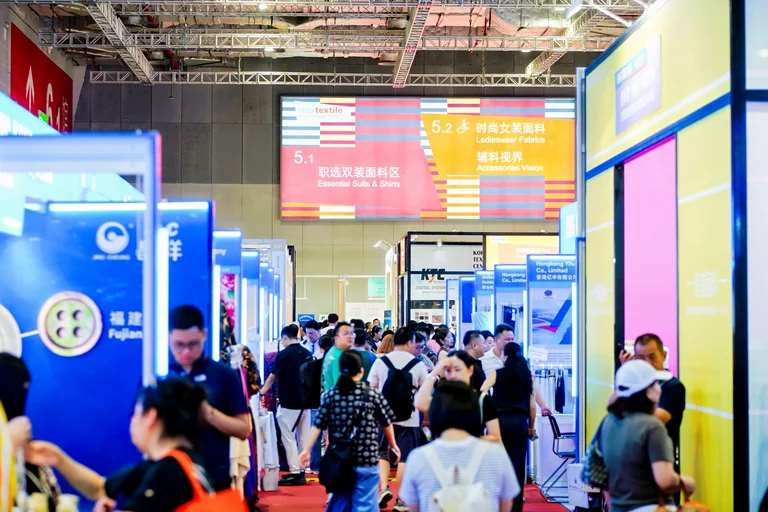
"The past one and half year has been like a roller-coaster ride for the US textile market. During this period, the market witnessed several ups and downs mainly on account of the Sino-US trade war. Stakeholders Exhibitors at the recent edition of New York Show, wished this war to end quickly and the Sino-US economic and trade relations to resume as before."
 The past one and half year has been like a roller-coaster ride for the US textile market. During this period, the market witnessed several ups and downs mainly on account of the Sino-US trade war. Stakeholders Exhibitors at the recent edition of New York Show, wished this war to end quickly and the Sino-US economic and trade relations to resume as before.
Desire to cooperate to sustain trade relations
Since the onset of the US-China trade dispute, the share of the Chinese textiles in the US market has witnessed a substantial drop. An enterprise from Shoaxing attending the show informed the US clients are not only downsizing their Chinese suppliers but also reducing their orders from every Chinese supplier. Small clients are adopting a wait-and-watch approach, while large clients are reducing their number of orders and cutting down the price by a large margin.
Wayne Buchen, Former Operation Senior Manager of Lacoste and Under Armor, emphasised trade relations between the US and China can never come to an end as both countries have a strong desire to cooperate with each other. This suggests that the Sino-US textile trade would not be stopped due to the ongoing trade war.
Some experts feel it is much harder to purchase from other countries than from China as the country offers a superior supply chain and production technology. In addition, its complete industrial chain, infrastructures, logistics, traffic, and policy environment add value to products Made in China.
Many local American purchasers attending the Show noted that though the trade friction has resulted in loss of money, cost and communication between the two countries, it has enabled Chinese enterprises’ to accelerate their industrial structure, upgrade their products, improve their R&D level and productivity, and upgrade their technical services to strengthen their competitiveness in international competition. The trade friction is thus proving beneficial to China as it is encouraging its entrepreneurs to upgrade their facilities.
Product and service innovations to mitigate trade war effects
Many stakeholders are actively pursuing countermeasures and development solutions. They are focusing on product innovation, and strengthening their range of services. As the head of a Hubei-based home textile enterprise noted, every marketplace had developed its own fixed client group, so price changes or increase were hard to achieve. The linchpin for Chinese textile enterprises to maintain their competitiveness is to produce differentiated products so that clients cannot find substitutes of such a high cost performance ratio.
Many Chinese enterprises emphasize though American clients are capable of purchasing ready-to-wear from Cambodia and Bangladesh, they still rely on Chinese enterprises for fabric supply in the short term.
Artistic Denim Mills aims for a green supply chain
Artistic Denim Mills (ADM) aims at 100 per cent sustainability through the entire supply chain. By partnering globally recognized brands and manufacturers, ADM creates sustainable, ethical raw materials and earth-friendly fabrics that meet a wide variety of demands, such as the comfortable and sculpting properties of four-way stretch. An early pioneer of liquid dye technology featuring less sulfide contents than traditional dyes, the company is selective about the chemicals it uses, choosing those deemed to have a minimal impact on the environment, its employees and consumers.
For example, ADM exclusively uses pre-reduced indigo, decreasing its chemical use by 70 per cent when stacked against conventional denim factories. Rather than distressing denim with harmful chemicals and labor-intensive hand sanders, the company employs computerized laser technology to provide those unique fading patterns the fabric is known for. These lasers also have the added benefit of reducing the use of stones and chlorine during wet processing.
ADM makes denim that’s aniline-free—a non-toxic way of producing the traditional, iconic indigo blue that consumers associate with denim and jeans. Aniline appears on the restricted substance lists of some major clothing brands and retailers. To lessen denim’s impact on the planet and to help create a circular economy in textiles, ADM also uses pre-consumer recycled cotton fibers.