FW
Fall in China cotton imports
China’s cotton imports are falling. Reasons include high levels of cotton in consignment, burgeoning industrial and commercial stocks, and stagnant consumption growth. Over a fifth of China’s 2018-19 cotton imports are estimated to have remained in consignment.
Although 2019-20 imports are lower than the previous year, the total quantity forecast to clear customs and enter the free market is expected to grow. Cotton in consignment for 2019-20 is forecast to halve from the previous year with reduced incentives for storage. Cotton stored in bonded warehouses was estimated to have more than doubled at the end of 2018-19 from the previous year. Private enterprises’ incentive to incur costs of storing cotton in consignment is mostly driven by China’s import policies and allocation of import quota when issued. Due to restrictive import policies pertaining to quota licenses for commercial and industrial enterprises, importers prefer to store cotton close to the port of entry. This pertains to uncertainty surrounding the timing and availability of quota for merchants.
China is still expected to be the world’s largest importer in 2019-20, exceeding the second largest, Vietnam, by nearly 4,40,000 tons. This is expected to stabilize domestic supplies, even as total stocks are expected to be the lowest since the country’s formal price support program was initiated more than eight years ago.
Intertextile Shanghai Home Textiles show in March
Intertextile Shanghai Home Textiles will be held from March 11 to 13, 2020. The spring show will showcase a range of home textile products including bedding and towelling, rugs, table and kitchen linen, home textile technologies, textile design and many more.
Demonstrating consistent growth in recent years, the fair is a preeminent annual destination for the best of finished home textile products. The fair gathers leading high-quality suppliers from China, as well as from overseas, featuring a wide range of home textile collections. This is the ideal place for companies to tap into the growing Chinese market and for buyers to source the best of finished home textile products. Last year’s spring show attracted 22,296 trade buyers from 60 countries and regions as well as 291 exhibitors from ten countries and regions.
Despite ongoing trade disputes and the global economic uncertainty, sales of home textile products in China from January to August 2019 grew 4.81 per cent. Thanks to the population size and the purchasing power of the Chinese market, even a slower growth rate equates to good business potential. The Chinese home textile industry is continuing to perform well against all odds. This steady growth injects confidence to the market.
Benetton expands in Myanmar
United Colors of Benetton plans to expand in Myanmar. The Italian fashion brand has two stores in Myanmar now. Worldwide Benetton has a network of 5000 stores.
United Colors of Benetton’s new collection showcases experimental textiles and ecological materials. The brand is creating a balance between its every-man and every-woman image while elevating its styling and innovation and combining ideas, fashion and styling while experimenting in new directions. One is a trench coat made out of paper and recycled fibers and impermeable to rain. A papery cropped top paired with a white skirt that bears a devilish silhouette in the same material is another. Other pieces include a handkerchief skirt featuring a stylized postcard print on the front that can be worn with a flowing silhouette, or tied in the front or back for a straight look in two different prints. A check denim kilt with multi-color pleated inserts can be paired with a rainbow-striped knit top and striped color-sheer hosiery for her and multi-colored pockets on white garments for him. The offerings mostly hew to a watery theme. There are neoprene rompers, tops and mini-dresses with oversized plastic zippers. Bold nautical looks have anchor motifs. There are also preppy outfits in clashing patterns of pink and green.
Arvind in India, redefines cotton cultivation with new initiatives
"It’s popularly said, that ‘leaders don’t do different things, they do things differently. A recent embodiment of this is Arvind, the leading textile manufacturer and the largest manufacturer of denims in India. The brand rewrote the history of cotton cultivation in India when it partnered Better Cotton Initiative (BCI), a not-for-profit global organisation in 2010. The BCI concept enables the company to grow cotton with controlled application of water and use of approved fertilisers and pesticides."
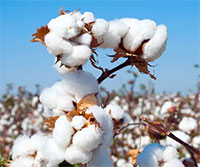 It’s popularly said, that ‘leaders don’t do different things, they do things differently. A recent embodiment of this is Arvind, the leading textile manufacturer and the largest manufacturer of denims in India. The brand rewrote the history of cotton cultivation in India when it partnered Better Cotton Initiative (BCI), a not-for-profit global organisation in 2010. The BCI concept enables the company to grow cotton with controlled application of water and use of approved fertilisers and pesticides. Through this concept, the company has been able to expand its cultivable land from 10,000 acre to 100,000 acre in FY 19 with 26,000 farmers under its ambit. It now plans to scale this further upto 150,000 acre by FY 20.
Initiatives help reduce input cost, increase income
Incepted in 2007, Arvind initially helped farmers to grow cotton as per the global standards besides fulfilling its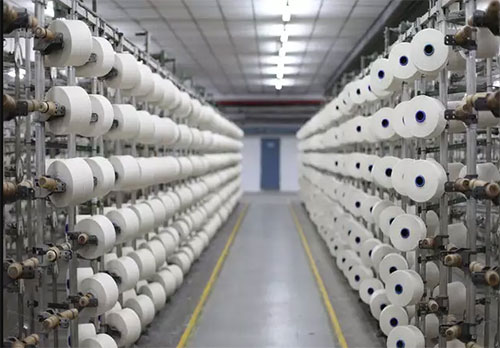 own requirements of organic cotton. Led by Abhishek Bansal, Head of Sustainability, the company embarked upon its first BCI project in India in 2011. Since then, the brand has witnessed manifold growth in both organic and BCI initiatives with Arvind's sustainable cotton operations now spread across four different states of India.
The company’s sustainable initiatives help it to reduce input cost and increase income by increasing the amount of crops it grows. The brand tracks the balance sheet of each of its farmers to note how much profit they make. Bansal says, the company has seen a consistent 15-20 per cent increase in the income by organic or BCI farmers as against conventional farmers. Besides these economic benefits, the initiative boasts of a slew of social and environmental advantages as well.
Consumer awareness leads spikes demand
Consumer awareness and the multiple health benefits offered by this initiative have also led to a spike in demand for BCI cotton from brands in last 2-3 years. Demand for BCI cotton from Arvind has also grown by two to threefold in the past four years. Moreover, the huge amount of data available on the initiative and research by scientists and government agencies on water usage, chemical and pesticide usage in the soil in the cotton fields is fuelling demand for cotton.
Arvind now plans to expand its area under cotton cultivation to 400,000 acre of BCI in the next 4-5 years. The company also plans to undertake more projects besides exploring new cotton sourcing regions in the times to come. The company engages local established NGOs to work with farmers on BCI principles and practices and help them with technical knowhow and purchase of the cotton.
AEPC new experience center focuses on industry 4.0 solutions
AEPC recently organised an industry and media brief bringing the stake holders all on one platform announcing the 'Lectra Industry 4.0 Experience Center' at Apparel House heralding a giant leap towards leading the industry to the way future factories are heading to. The overarching theme ‘The Connected Ecosystem for Apparel Manufacturing’ in association with Lectra Technologies is quite a timely initiative.
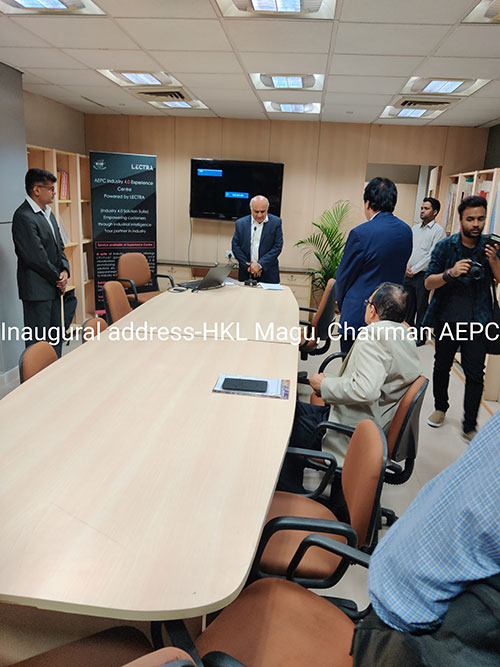
This initiative focused on how Industry 4.0 compliance would facilitate apparel exporters to digitally transform their business enterprise both by hand holding and sensitising the primacy of new normal called digitisation of manufacturing paradigm in the ever evolving global apparel supply chains.
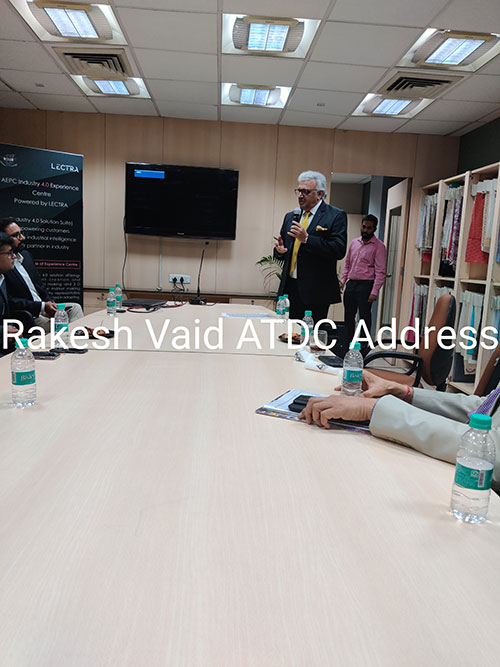
The establishment of the experience zone proceeded with the discussion on the background on industry 4.0. It drew the attention of the entrepreneurs towards how exactly the future factories of tomorrow will look like and how adoption to industry 4.0 would help in constructing the industry future ready and augment competitiveness. It also takes a holistic overview of the challenges faced by today's 'Fashion & Apparel Industry' and how the underlined theme namely 'the world of connected technologies' is playing out and how to build the requisite wherewithal within the MSMEs to overcome the impending challenges.
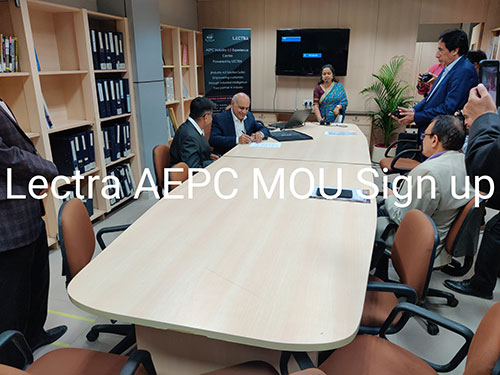
HKL Magu, Chairman, AEPC said, “The industry is facing stagnation. This is a wake-up call for the industry. We have to discard the old machinery and acquire new machines."
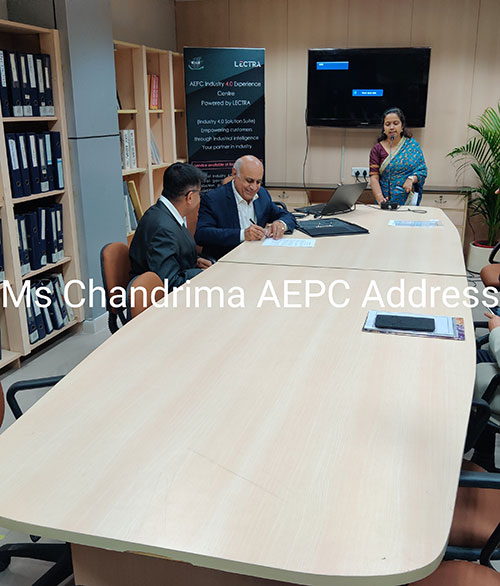
Rakesh Vaid Sr. Vice Chairman-ATDC, emphasised on the importance of storyboard making, Pattern making is not the only important thing. We have to go beyond the basic pattern making. This experience center encourages people to invest in software. He said, “In future, a customer in New York or London will send a garment designed on a computer to an exporter who will send this digital collection to India. A vendor or buyer interested in this collection can directly place his order for the garment with the digital printing department. This will eliminate the role of a merchandiser,” Vaid alluded.

According to him, no one does cutting room solutions anymore. “Sixty percent of the industry doesn’t have a cutting table, where the marker will move up and down. There is a cutting sample. This is the situation in most countries like India, Pakistan, etc,” he added
Rise in Pakistan garment exports
Pakistan’s exports of readymade garments during the first four months of the current fiscal year grew 12 per cent.Knit wear exports were up by 9.49 per cent. Bed wear exports were up 5.72 per cent. Exports of textile products showed an increase of 4.10 per cent. Exports of raw cotton came down in the first four months. The country's merchandise trade deficit plunged by 33.52 per cent during the first four months of the current fiscal year. Exports during the period grew 3.81 per cent. On the other hand, imports into the country witnessed a decline of 19.21 per cent. On a yearly basis exports of the country increased by 6.75 per cent from October 2018 to October 2019. Imports declined by 15.14 per cent from October 2018 to October 2019. On a month-on-month basis, exports of the country increased by 14.41 per cent in October 2019 when compared to September 2019. On the other hand, imports into the country witnessed an increase of 7.64 per cent.
Exports of raw cotton during October 2019 increased by 0.78 per cent compared to October 2018. Cotton carded or combed 100 per cent yarn other than cotton yarn grew by 21.24 per cent.
Lenzing launches Tencel™ Lyocellfibres
Lenzing Group launched the Tencel™ Lyocellfibres with low fibrillation properties.Produced in eco-responsible closed-loop production process, these new fibersare 100 per cent biobased, and are produced of wood pulp from sustainably managed forests and an increase of up to 30 per cent of pulp made from upcycled cottonscraps collected from garment manufacturing process. In addition to having low fibrillation and moisture management properties, the fibers also feature enhanced breathability, along with silky smoothness and strength.
Like other Tencel™ Lyocellfibres with Refibra™ Technology; the fibers divert cotton scraps from entering landfills or incineration; by blending up to 30 per cent of pulp made from upcycled cotton scraps; collected from garment manufacturing process. The bio-based fibers are also produced with high resource efficiency; and low environmental impact, reusing water and solvent at a recovery rate of more than 99.5 per cent.
Moreover, with an innovative special identification technology designed to confirm fibre origin; Tencel™ Lyocell fibers with Refibra™ Technology are identifiable in yarns, fabrics and final garments. This does not only improve supply chain transparency; but also gives fashion brands a seal of confidence; that the fibers of their apparel or home textile products are sustainably sourced and produced.
7th China Homelife & Machinex India 2019 to focus on India-China trade relations
The 7th edition of China Homelife And China Machinex India 2019 will continue to focus on the increasing trade and building sustainable relationships between Chinese and Indian companies to congregate and conduct business. To be held from December 11-13 at the Bombay Exhibition Centre, the event will witness several exciting partnerships and announcements that promise to augur in new trends in the industry.
Confederation of Indian Industry (CII) will organising China-India Economic Forum on December 11, 2019. The objective of this forum is to deepen bilateral relations, enhance economic engagement and explore various trade opportunities between India and China. It is also being supported by associations in FMCG and Core Industry such as BIA, PWAI, ICIB, AFMT, etc.
. The expo will be marked by over 2000 exhibitors including industries players like FPM – Unimold Asia(Injection molds, casting molds), Hangzhou Weijiamei Electric Appliances (Rice cooker, Ceramic cookery), Wenzhou Youlian Machinery Manufacturing(Production Line, Filling and Capping Machine)and Hangzhou Standard Mayo Industrial(Fitness Equipment). The expo will also see participation from countries such as Poland, South Africa, Egypt, Turkey, Kazakhstan, Nigeria, Brazil, Mexico, UAE, Jordan and Kenya. The show also takes place in 12 different countries every year.
South African retailers pitch in
South Africa’s clothing retailers have decided to purchase more of domestically manufactured clothes, shoes and leather goods over the next few years in an attempt to boost the industry.
This undertaking by some of the biggest players in the country’s retail sector will boost the acquisition of locally produced goods from its present level of 44 per cent to 65 per cent by 2030.
In addition illegal imports will be tackled and unions have bound themselves to adjustments in the employment environment, which would increase competitiveness. More than 60 per cent of textile, clothing, shoes and leather products for the local market are presently imported. Manufacturing companies have promised substantial investments over the next five years. The implementation of the textile master plan will create an additional 1,20 000 employment opportunities in the value chain, with 70, 000 of these being in manufacturing.
The textile industry has been pleading for protection and intervention since the 1990s. The industry has lost about 1,20, 000 jobs since the drastic reduction of import tariffs during that period. The industry presently employs about 95, 000 people and contributes 2.9 per cent to South Africa’s GDP. Abundance of cheaper products from China led to the loss of nearly two-thirds of the sector’s jobs over the past two decades.
Kingpins to relocate to Amsterdam
Kingpins New York will relocate its latest edition to Amsterdam. The trade fair will now be held at the SugarCity site instead of Westergasfabriek.
The transfer of the event will involve the expansion of its space by 40 per cent, from 6,503 sq. mt. to 9,290 square meters. However, the new location will not affect the schedule of the event, which is planned between April 22-23, 2020.
Founded in 2004 by American businessman Andrew Olah, Kingpins has established itself as one of the key events for the denim industry. Since then, the fair has been exporting the program to different locations of the planet. The fair is also organized in Amsterdam and Hong Kong.