


FW
Bangladesh is top draw for Japanese companies interested in investing
Bangladesh is top destination for business expansion by Japanese companies in the next one or two years. The country gets the top position among Asian and Oceania regions despite problems in quality control, deregulation and securing labor force. The main reason why Japanese firms are willing to expand their business in Bangladesh is low production cost. Bangladesh provides the lowest wage to manufacturing workers among 19 countries surveyed.
Next to Bangladesh, Japanese firms want expansion in India, Myanmar and in Vietnam in that order. For Bangladesh out of total export earnings from Japan in the last fiscal, 74.8 per cent was from readymade garment sector. And apparel exports to Japan have seen a 13.73 per cent rise. Meanwhile, Japan has shown a keen interest in hiring skilled labor from Bangladesh for its textile industry. Since the garment sector is growing fast in Bangladesh, foreign investors choose it as an investment destination. Ready workforce at a reasonable wage, duty-free market access to major export destination, preferential location in the heart of the Asia-Pacific region and policy support are catalysts attracting foreign investment in the textile and apparel industry.
AEPC organises Fashion Forecasting Seminar
"Apparel Export Promotion Council (AEPC), under the awareness initiatives program organised the first Fashion Forecasting Seminar on March 25, 2019 at the Apparel House in Gurgaon. The seminar focused on the Spring & Summer 2020 & Autumn-Winter 2020-21 collections."
 Apparel Export Promotion Council (AEPC), under the awareness initiatives program organised the first Fashion Forecasting Seminar on March 25, 2019 at the Apparel House in Gurgaon. The seminar focused on the Spring & Summer 2020 & Autumn-Winter 2020-21 collections.
The seminars were organised in association with WGSN, the leading trend forecasting agency of the world. The speaker at the event was Mannino - Head of WGSN LIVE from WGSN London office. She provided insights on key commercial items, colors and trends for spring – summer 2020 and Textile Trends for AW 20/21.
She also covered the methods on which these trends are forecasted at WGSN along with they are dissected into macro trends.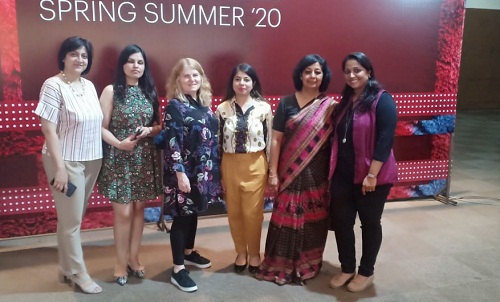 The Spring/summer 2020 season was divided into three broad themes namely Code Create, Empower Up, and Designing Emotion.
The Code Create theme fused science, nature and technology to showcase a womenswear range that embraces futuristic aesthetics grounded by a sense of practicality and reality. The collection featured colors rooted in nature such as clear waters, mint foam and rosewater alongwith rich, earthy reds that highlighted the continuing importance of transseasonal tones.
The Empower Up! theme featured a palette of upbeat mid-tones. Having a nostalgic and sun-faded quality, these tones recalled the 1980s surf culture and cities by the sea, such as Miami, Sydney, Los Angeles and Cape Town.
The Designing Emotion theme explored the interplay between people and technology. This trend combined the industrial with the artisanal with its designs offering a sense of emotional and human connection. The color palette included lean and comforting mid-tones like Yellow and orange that work easily with each other.
These themes were presented on 3D mood boards developed by WGSN.
Revolutionising fashion with biotechnology
"Biofabrication is changing the way clothes are made with four companies leading the revolution. At the helm of is AMSilk which uses genetically engineered bacteria to get around that problem. The company recently launched its first product made with spider silk — a luxury watch strap. It is working on several other products using the spider silk fibers, including biodegradable sneakers for Adidas."
 Biofabrication is changing the way clothes are made with four companies leading the revolution. At the helm of is AMSilk which uses genetically engineered bacteria to get around that problem. The company recently launched its first product made with spider silk — a luxury watch strap. It is working on several other products using the spider silk fibers, including biodegradable sneakers for Adidas.
Making sustainable fashion with algae
The chemicals used to make and dye fabrics often harm and kill thousands of workers. These chemicals can also leach to the skin of the wearer. To prevent this German-Israeli firm Algalife grows fibers and dyes using algae. The clothes made at Algalife are more sustainable in terms of pollution, land, water and energy use. They also nurture the skin of the wearer with the natural compounds produced by seaweed. Algalife aims to reach mass production by 2020, with the first products focused on home and sportswear. The company, in future, plans to customise the specific compounds produced by algae, such as proteins or vitamins.
Fungi to create custom clothes
Another company, NEFFA has created a fabric out of mycelia — the roots of mushrooms. The fungi are grown in discs stuck together to create custom clothes without seams. The company has already created several prototypes of dresses, jackets and purses created using this method.
Bacteria for dyeing clothes
To deal with the environmental impact the fashion industry makes in terms of water use and water pollution, UK firm Faber Futures is developing an alternative dyeing method through fermentation, using bacteria such as Streptomyces coelicolor. The company is developing colorfast dyes that don’t fade with time or washing. It also works with several brands to develop together the best strategies to incorporate this dyeing technology to their individual needs. The first of these products will be launched in the next couple of years.
A distant dream
However, there is still a long way to go before biofabrication replaces traditional fabric producing and dyeing methods. One of the big challenges is the process includes transforming prototype biological processes into industrial-scale production, which will be the key to make these products widely available and affordable.
Another challenge is determining the real impact that these new processes actually have on the environment. For this the company needs to look at sustainability in terms of the input. With the advancement of biofabrication, the fashion industry is poised to change radically. It will need to adjust to longer R&D cycles and slower consumption patterns. Although this will take time, biotechnology will definitely be the future of fashion.
New technology enables customized 3D designs on apparels
Researchers at Carnage Mellon University have written an algorithm that can transform 3D designs into stitch-by-stitch instructions for industrial knitting equipment. The discovery can aid textile manufacturers in producing custom sizes and designs at affordable costs. The algorithm breaks down 3D meshes into step by step instructions for V-bed knitting machines. With the algorithm, garment manufacturers with proficient designing knowledge would be able to input 3D designs or meshes as instruction for the machine to knit. The feature will, therefore, allow manufacturers to work without the requirement of expert knowledge of computer programming. The technology could pioneer the industry towards a new market for custom sized and designed apparel.
Automation is not new to the industrial knitting equipment market or the textile industry. However, it has its limitations. Garment manufacturers can produce thousands of identical-looking knitted apparel in a day with the current machinery. But the current scenario overlooks the demand for custom-designed apparel which has been on the rise. Textile manufacturers, so far, have been unable to cater on the trend owing to the lack of expertise and equipment required to produce custom-design apparel.
The loop transfer technology incorporated in circular knitting machines allows for the seamless transfer of stitches thereby enabling manufacturers to produce structured designs and shaped fabrics.
Now Peta is a stakeholder in Levi Strauss
People for the Ethical Treatment of Animals (Peta) is now a shareholder in Levi Strauss. The animal rights organization has snapped up the minimum number of shares required to submit shareholder resolutions and secure speaking rights at annual meetings.
As a first step, Peta will attempt to persuade Levi’s to drop leather patches made from cow skin and use vegan leather. Cow skin has at least three times the negative environmental impact that using most vegan leather does. Cows killed for leather often endure extreme crowding, electroshock prodding, frequent beatings and castration and tail-docking without pain relief. Animal agriculture, under which the leather industry falls, is responsible for 14 per cent to 18 per cent of all greenhouse gas emissions. On the other hand vegan leather typically comprises petroleum-based synthetics such as polyvinyl chloride or polyurethane.
Levi’s says even though less than 10 per cent of the raw materials in its supply chain is from sources other than cotton, and a small fraction of that percentage is leather, the company strives to source all materials responsibly and that it ensures whenever materials derived from animals are used in its products, their health and welfare are protected, in line with international animal welfare standards.
Leopfe develops new adjustment tool for its YarnMaster Zenit+
To optimise yarn clearing further, Loepfe, a leading manufacturer of sensors and monitoring equipment for yarn spinning and fabric weaving processes, has developed the new adjustment tool P-Matrix for its YarnMaster Zenit+, which increases the clearing efficiency substantially. Extensive tests in a spinning mill in India showed impressive results.
The YarnMaster Zenit+ combines different sensor principles in one single device. This enables the customer to effectively control yarn quality. The P-sensor used for the synthetic foreign matter detection is based on the triboelectric effect. The sensor is sensitive to different materials, and is therefore, able to distinguish between cotton and synthetic foreign matter, such as polypropylene, polyethylene, polyamide (nylon) etc.
The unique sensor principle in combination with the new P-Matrix improves the synthetic foreign fiber clearing substantially. The P-Matrix facilitates the perfect adjustment of the clearing. The result is not only an effective clearing of synthetic contaminations, but at the same time an optimised overall production efficiency with less waste.”
Morocco gets exemptions from the US
The US has a free trade agreement with Morocco. Five classes of woven garments imported into the US can be made with fabrics sourced from outside of Morocco or the US and still be eligible for preferential treatment. These garments include women’s or girls’ cotton corduroy skirts and polyester corduroy manmade fiber blouses, shirts and blouses; women’s trousers of synthetic bi-stretch fabric containing certain percentages of polyester, rayon and spandex, and women’s trousers of woven herringbone fabric containing certain amounts of viscose rayon, polyester, cotton, wool, nylon and spandex.
Morocco had petitioned for these classifications of goods to be exempt from the yarn-forward rule on behalf of a domestic supplier because they were not commercially available in the US. There were other fabrics that Morocco also requested a waiving of the yarn-forward rule but the exemptions were not granted. Qualification of apparel for duty-free entry into the US requires adherence to a yarn forward rule, which limits the benefits that can be obtained from sourcing in Morocco.
Duties on 95 per cent of bilateral trade in industrial and consumer goods have been eliminated upon entry into force, with duties on other such goods to be phased out in stages in the next ten years.
Kornit Digital to host road shows in New York, German and Hong Kong
Kornit Digital will hold a series of events, in New York from April 3 to 4, in Germany April 11 to 12 and Hong Kong, April 15 to 17, 2019. Textile printers, garment decorators, Kornit users, prospective customers and anyone who is curious about latest trends and technology in digital textile printing can gain exclusive market insights, best practices and inspirational thoughts.
Visitors to Kornit Discover will also have the opportunity to get hands-on demonstrations on Kornit’s latest innovations in polyester printing. Based on the company’s signature Neo Pigment Process, the Avalanche direct-to-garment printing system was developed to overcome the limitations and challenges of polyester printing. It allows a wide application variety with no compromises on productivity, design or cost. In particular, it solves the challenge of dye migration. Kornit will also preview an all-new roll-to-roll printing system in the Germany and Hong Kong events and perform live demos of the Kornit Atlas which has been launched in January and is the most cost-efficient direct-to-garment printing system for imprinting hundreds of thousands of garments per year.
Kornit Digital develops, manufactures and markets industrial digital printing technologies for the garment, apparel and textile industries. Kornit delivers complete solutions, including digital printing systems, inks, consumables, software and after-sales support.
Global garment industry to expand by two-thirds by 2030
The global garment industry is expected to expand by two-thirds by 2030 and be responsible for one-quarter of the global carbon footprint by 2050, up from two per cent in 2015. The fashion industry is recognized as the second-most polluting sector in the world after the oil industry. Luxury consumers are expressing a willingness to spend more for garments whose production doesn’t harm the environment or exploit workers.
Ethnic minorities hold just 11 per cent of board seats on the 15 largest publicly traded fashion companies. The case for making the fashion industry more inclusive is both moral and ethical and also makes business sense. The most technically and culturally diverse boards are significantly more likely to deliver higher profits and generate more sales.
While fast fashion industry is considered the main driver of rapid expansion in the textile industry, luxury industry can help raise standards that would put downward pressure on fast fashion. A rigorous best-practice program for garment factory inspectors still does not exist despite a global outcry after the 2013 collapse of the Rana Plaza building in Bangladesh killing more than 1,300 garment workers. An Italian fashion chamber roundtable has called on investors in the industry to make sustainability part of their criteria.
Global investors seek Accord extension
A coalition of 190 global investors has urged the Bangladesh Garment Manufacturers and Exporters Association (BGMEA) to negotiate with the government for the extension of the Accord in the country. The Interfaith Center on Corporate Responsibility (ICCR), based in New York, sent a letter to BGMEA President Siddiqur Rahman, seeking his support so that the Accord can operate until the Remediation Coordination Council (RCC) takes over the charge of inspection and remediation of garment factories.
The ICCR is a coalition of shareholder advocates who view the management of their investments as a catalyst for social change and represents more than $3 trillion in assets under management, according to its website. Its 300 member organisations comprise faith communities, socially responsible asset managers, unions, pensions, NGOs and other socially responsible investors with combined assets of more than $400 billion.
The ICCR says investors are concerned that ending Accord’s work on Building and Fire Safety in Bangladesh would be too risky for the agency's signatory companies to continue to source from unsafe factories lacking a credible and effective regulatory system.











