


FW
Shipments of spinning machinery rise while knitting machinery decline ’18
"The latest results of the 41st annual International Textile Machinery Shipment Statistics (ITMSS) shows, there was an increase 1.5 per cent and 13 per cent in global shipment of new short-staple spindles and open-end rotors to the world spinning industry in 2018. Similarly, shipment of draw-texturing spindles increased 50 per cent while deliveries of shuttle-less looms improved 39 per cent."
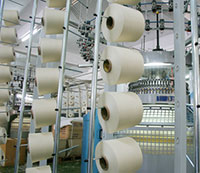 The latest results of the 41st annual International Textile Machinery Shipment Statistics (ITMSS) shows, there was an increase 1.5 per cent and 13 per cent in global shipment of new short-staple spindles and open-end rotors to the world spinning industry in 2018. Similarly, shipment of draw-texturing spindles increased 50 per cent while deliveries of shuttle-less looms improved 39 per cent. However, shipments of long-staple spindles, circular knitting machines, and electronic flat knitting machines decreased by 27 per cent, 4 per cent and 20 per cent, respectively.
The ITMSS report was released in June by the International Textile Manufacturers Federation (ITMF). The report covers six segments of textile machinery, namely spinning, draw-texturing, weaving, large diameter circular knitting, flat knitting and finishing. The 2018 survey has been compiled in cooperation with more than 200 textile machinery manufacturers representing a comprehensive measure of world production.
Circular Knitting Machinery: Shipment of large diameter circular knitting machines declined by 4 per cent to 26,300 units in 2018. Asia and Oceania emerged as the world’s leading investors in this category with 85 per cent. Amongst Asia, China emerged as the largest investor with 48 per cent of the worldwide deliveries to this region.
Flat Knitting Machinery: The shipment of electronic flat knitting machines decreased by 20 per cent to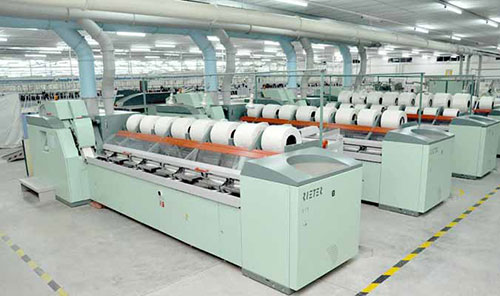 around 160,000 machines in 2018. Asia & Oceania emerged as the major exporters of this category with a share of 95 per cent of world shipments. Here too, China remained the world’s largest investor with a global share of 86 per cent of worldwide shipments despite a decrease in investments from 154,850 units to 122,550 units.
Spinning Machinery: Spinning machinery shipment increased for the second consecutive year, with the total number of shipped short-staple spindles increasing to 126,000 units, leveling off at 8.66 million. Around 92 per cent of these new short-staple spindles were shipped to Asia & Oceania with shipments to Korea, Turkey, Vietnam and Egypt increasing by of 834 per cent, 306 per cent, 290 per cent and 285 per cent respectively.
Texturing Machinery: Similarly, shipment of single heater draw-texturing spindles increased 48 per cent to 22,800 in 2018. China and Japan were the main investors in this segment with a share of 68% and 11% of global deliveries, respectively. The global shipments of double heater draw-texturing spindles by +50 per cent to about 490’000 spindles. Of this, Asia’s share increased to 93 per cent with China accounting for 68 per cent of global shipments.
Weaving Machinery: Shipment of shuttle-less looms increased 39 per cent to 133,500 units. Thereby, shipments of air-jet and water-jet looms increased by 21 per cent to 32,750 and +91 per cent to 69,240, respectively. Deliveries of rapier/projectile looms declined by 5 per cent to 31,560.
The main destination for shuttle-less looms in 2018 was Asia & Oceania with 93 per cent of all worldwide deliveries. The main investors included China and India in all three categories.
Finishing Machinery: In the fabrics continuous segment, shipments of Washing (stand-alone), Singeing Line, Relax Dryers/Tumblers, Stenters, and Sanforizers/Compacters increased by 58 per cent, 20 per cent, 9 per cent, 3 per cent, and 1 per cent, respectively. In the category ‘fabrics discontinuous’, shipments of Air-jet dyeing machines increased by 16% and deliveries of Overflow dyeing and Jigger dyeing/Beam dyeing machines fell by 7 per cent and 19 per cent respectively.
Philippines apparel exports down 16 per cent
Philippines’ apparel exports decreased 16 per cent last year. The entire garment industry, including shoes and travel goods, is estimated to employ 2,50,000 people. The industry is labor-intensive. Right now it’s agitated over a bill which seeks to overhaul the country’s incentive regime to investors. Small firms fear they would be the first to succumb under the bill. For a company with 1,500 workers and below, the impact is expected to be an immediate shutdown, within six months to a year, since their margins are small. For those producing mid-sized products, like jeans, the displacement of workers is expected to be 50 per cent in 12 months to18 months. These are medium-sized firms employing 3,000 to 5,000 per factory. For firms producing higher end products, like suits, the displacement threshold is expected to be 30 per cent to 32 per cent in 12 months to 18 months.
The US accounts for 60 per cent of the Philippines’ garment exports. The rest are sold to the EU and Asian countries. The country lost 70 per cent of its market over 15 years due to a number of reasons, primarily the removal of the quota system that led buyers to source from other countries offering the same products at half the price.
Vietnam export revenues up eight per cent
Export revenues of Vietnam’s textile and garment sector increased 8.61 per cent in the first six months of this year over the same period in 2018. Vietnam’s total export revenue to the US was up 12.84 per cent compared to the same period in 2018. The US is the biggest market for Vietnamese textiles and garments. It accounts for 46.9 per cent of Vietnam’s total export revenue of textiles and garments.
However the country’s textile and apparel firms are facing a shortage of orders. Their orders are just 70 per cent that of 2018. The main reason for the reduction in number of orders include higher and more demanding requirements from buyers, pressure on reducing prices and increasing trade barriers such as import tariffs and quality inspection, among others. The country’s textile and garment sector has grown less than nine per cent in the first half of this year, requiring the sector to expand by 11 per cent to12 per cent to fulfill the export turnover target for 2019.
Vietnam attracted $700 million worth of foreign direct investments in 63 garment and textile projects in the first five months of this year, including 17 Chinese-invested projects, and 12 Korean-invested projects.
7th TANTU seminar in New Delhi to focus on jeans manufacturing
The 7th edition of TANTU seminar, to be held at the India International Center, New Delhi, on September 14, 2019, will focus on ‘Jeans Manufacturing.’ Over the years, the TANTU seminar has established itself as a focused product-based seminar discussing critical issues pertaining to manufacturing.
Ramsons, one of world’s most respected apparel finishing solutions provider, will be the title sponsor of the seminar while Tukatech, USA will be its Gold Partner. The other technology solution providers associated with the seminar include Aeoon Digital Printing Solutions, Rajasthan International, Kalpataru International and Pulcra Chemicals.
Experts from jeans manufacturing organisations and brands around the world will discuss key issues related to cutting, sewing, finishing, dry and wet finishing of Jeans. The seminar will have three panel discussions apart from presentation from technology solution providers. The experts in panel discussion will also focus on the technology and manufacturing processes such as pattern making, fit and construction techniques. On the other hand, technology suppliers will also present their innovative and latest offerings to augment the value of jeans.
Sri Lanka and UK hope for enhanced apparel trade
Sri Lanka hopes to significantly boost its apparel exports to the United Kingdom. Apparel exports make up 46 per cent of Sri Lanka’s total exports to the UK. Last year, Sri Lanka’s apparel and textile exports to the UK accounted for 78 per cent of the country’s exports to that market. The UK market is seen as one with a large unutilised export potential.
Fast moving consumer goods, pharmaceutical and technology services are seen as potential areas for more collaboration and investment between the two countries. Sri Lanka also hopes to increase exports of vegetable products, plastic, rubber, transportation and machinery and electrical products to the UK. Sri Lanka is confident of offering ethically-manufactured, environmentally-responsible high quality products for the British market. Sri Lanka is seeking a preferential trade arrangement with the UK to continue to reap the benefits of GSP Plus, leading towards a free trade agreement in future. The country’s preferential access needs will continue regardless of Britain’s EU membership.
Bilateral trade between the two countries is largely in favor of Sri Lanka. The UK is the fifth largest FDI source for Sri Lanka. The UK plans to focus more on Commonwealth countries, including Sri Lanka, an area which has somewhat been neglected for several decades.
Shift of US companies from China may backfire
US companies are moving their supply chains from China to neighboring countries. This follows the 25 per cent duties the US has levied on Chinese imports. Companies in sectors such as technology, clothing and footwear are exporting more goods from emerging giants including Vietnam and Malaysia. Exports of computers and electronics from Vietnam to the United States have grown 71.6 per cent in the first five months of 2019. Even before the trade war, US companies had been reducing their dependence on China because of increasing production costs and elevated transport expenses compared with other Asian countries. The trade war has only sped up those moves.
At the same time, the shift has exposed murkiness of trade export rules. In attempting to avoid having to pay 25 per cent, companies are violating US rules against transhipments, the routing of China-made goods through other countries to evade tariffs. Also, shifting production outside of China to other Asian centers is not necessarily a panacea. Many of these countries lack the roads, airports and other vital infrastructure China has. Retailers are more likely to stop producing goods with very low profit margins than to incur additional costs by moving production out of China.
Development of fabric and dyeing segment to spur Vietnam’s textile growth
As per Vietnam Cotton and Spinning Association, developing the fabric and dyeing segments would be the key factor in the growth of garment and textile industry in Vietnam. Despite being the second biggest exporter of textile and readymade garments globally, Vietnam is yet to fully exploit its true potentials, thanks to its incompetent dyeing facilities and its increasing dependence on imported fabrics. As per available figures, In 2017, Vietnam imported 6.5 billion metre of fabric, or two-thirds of the industry`s total requirement.
Considering that 750,000 tons of Vietnam’s fibres (two-third) make way overseas at lower prices every year, the increasing fabric imports sound rather contradictory. Industry insiders blame the poor development of the dyeing segment for the same. Industry insiders further added that local companies lack proper awareness about dyeing process alongside technology, human resources and skills required to develop this sector.
Demand for polyester/cotton yarns declines
Polyester/cotton yarn mills reported a slump in their overall demand this year, partly owing to the surge in supply caused by previous production shift and partly due to the change in market sentiment owing to the trade war. As the CCF Group notes, after initial smooth sales and low inventory in end-2018, the sales of polyester/cotton yarn stagnated with its inventory averaging at 20 days or above.
Based on downstream plants, the sales in major producing areas are moving slowly with both domestic and foreign sales being under unprecedented pressure. For example, Henan, Shandong, Fujian, Jiangsu and Zhejiang are witnessing continuous high inventory pressure with many medium-sized enterprises cutting their productions largely.
For example, the largest cotton yarn producing area, Shandong is highly burdened with unsold inventory this year as the demand has not improved even though the prices have been lowered. Other regions face the same issue more or less. In South China, many spinners transfer to produce polyester yarn instead of polyester/cotton yarn, which is also a miniature of spinners’ expectation to later market.
Madrid Fashion Week reschedules 2020 summer edition
The Mercedes-Benz Fashion Week Madrid has updated the dates of its 2020 summer edition. Instead of being held in July as previously planned, the event will now be held from June 23-28, 2019. The Madrid Fashion Week is keen to attract foreign interest, and its last two summer editions had already been brought forward to July from September.
Designers had requested the former fashion week director Charo Izquierdo, who stepped down from her role a few weeks ago, to change the dates of the fashion week. The change to the calendar was formally put in place after several discussions with the new management.
The last edition of the Madrid Fashion Week, featured over 40 designers who presented their offerings for spring/summer 2020. The next edition of the event will be held from January 23-28, 2020.
Kumar Mangalam Birla becomes new chairman of Century Textiles
Kumar Mangalam Birla has been appointed the new chairman of Century Textiles and Industries after the death of his grandfather Basant Kumar Birla. Birla joined the board of Century Textiles in 2006 and in 2015 became its vice-chairman. The board of Century Enka elected Rajashree Birla as chairperson. She was the vice chairperson before. Basant Kumar's daughter Manjushree Khaitan was re-designated as chairman of Kesoram Industries.
Khaitan relinquished her position as executive vice-chairperson and would continue on the board as a non-executive director. She had been on the board of Kesoram since 2001. Basant Kumar's other daughter Jayashree Mohta is the vice-chairperson of Jay Shree Tea & Industries.











