


FW
Industry and fiscal support to direct Pakistan’s future textile growth
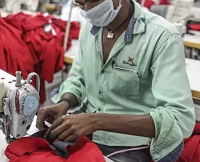 Single largest source of foreign exchange, Pakistan’s textile exports are back on a growth track, says a report by Dawn. Pakistan Bureau of Statistics’ recent figures reveal, from July to October 2020, Pakistan’s textile shipments surged 3.8 per cent to $4.8 billion from $4.6 billion a year ago. The fastest surge was in knitwear, home textiles and denim segments.
The factors that helped exports surge include US-China tensions and ongoing supply disruptions induced by the pandemic in India and Bangladesh, says MI Khurram, Chairman, Comfort Knitwear. These factors helped Pakistan grab additional export orders from Europe and America.
Government initiatives
To leverage its growth export potential, the government announced $5 billion investment across the textile chain that would double exports by 2025. It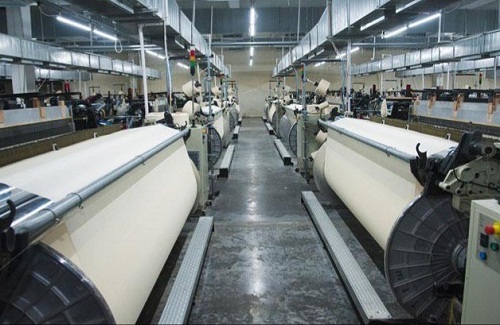 has also launched an energy package for the industry which not only eliminates peak electricity rates but also offers reduced tariffs on additional power consumption besides fixing power price at $0.07 a unit and gas tariff at $0.065mmbtu for the export industries.
The central bank too has lent a helping hand by reducing interest rates, approving refinancing of wages, deferring payments of the principal amount of loan and providing relief under the Export Financing Scheme (EFS) and the Long-Term Financing Facility (LTFF). Likewise, the State Bank has launched a long-term concessionary financing facility to boost investments in new capacity expansion and up-gradation of technology.
Quality issues impede US exports
Europe is the single largest market for Pakistan’s textiles as demand from the US remains subdued owing to rising infections. However, many manufacturers like Comfort Knitwear are planning to expand their production capacity in the US and increase market share. Until now, Pakistan has not been able to increase its unit prices in dollars due to product quality issues. Most textile exporters in the country are small to medium enterprises who do not have the capacity and wherewithal to improve product quality. Additionally, the cotton grown by them is of poor quality. Unless, Pakistan improves product quality, it will not be able to grow exports, points out Khurram.
Khurram Mukhtar, Chief Executive Officer, Sadeqat, affirms Pakistan is currently the most competitive textile exporting country in the world as it offers both cost and tariff advantages in European and American markets. He expects the demand for value-addition to grow in the country, and urges manufacturers to sustain their increased share in the international market.
Ensure policy support
To double its exports by 2025, Pakistan needs to ensure the current favorable policies are not rolled back in midway, Mukhtar says. However, many exporters advise the government and exporting community to control their optimism as resurgence of virus infections and raw material shortages may reverse the export gains in two to three months. Comparing the unprecedented growth in textile and clothing exports to a windfall, Mukhtar says, whether it will sustain for years or fizzle out within days will depend on how Pakistan directs the industry’s future.
India among world’s largest trousers exporters: Study
 Invented in Central Asia, trousers have become an important part of daily wear for both men and women. As per Textile Excellence, currently India is the 13th largest trouser exporter in the world after China, Bangladesh and Vietnam. In 2019, India exported $1,872.90 million worth of trousers to the world. Most of it to the US, the largest export market for Indian made trousers. India mostly exported cotton trousers to the US, which formed 52 per cent of its total trouser exports during the year.
Cotton woven trousers dominate export basket
In cotton, India mostly exported woven cotton trousers for men, which grew 13.40 per cent to $ 503.03 million during. On the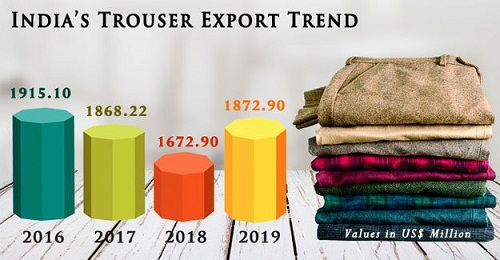 other hand, exports of knitted cotton trousers for men grew 15.23 per cent to $141.88 million in 2019 over the previous year. Export of women’s woven cotton trousers jumped 13.81 per cent to $228.09 million in 2019 over previous year, while exports of knit cotton trousers declined 8.01 per cent to $99.85 million.
Among other materials woven men’s trousers grew 17.47 per cent to $ 284.59 million while exports of knitted men’s trousers grew 15.56 per cent to $ 97.43 million. In women’s category, export of woven trousers made of other textile materials grew 12.16 per cent to $117.91 million in 2019 while knitted trousers grew 14.78 per cent to $75.95 million.
Trousers in synthetic fibers were the third most exported item in 2019 growing 8.89 per cent. In this segment, exports of woven trousers for women grew by 4.60 per cent to $137.64 million, while exports of knitted trousers grew 28.20 per cent to $23.05 million. For men, exports of synthetic fiber trousers grew 11.92 per cent to $99.81 million while that of knitted fiber trousers grew 7.72 per cent to $48.40 million in 2019.
Woolen trouser see miniscule growth
Exports of woolen trousers formed a miniscule portion of total trouser exports from in 2019. There exports declined 2.43 per cent to $15.27 million. In this segment, export of women’s woven trousers grew 44.57 per cent to $9.99 million while that of knitted trousers grew 800 per cent to $ 0.18 million. Exports of men’s woolen knitted trousers totaled $1.08 million in 2019 while knitted trousers totaled $4.02 million. Men’s trouser exports formed 63 per cent of the total trouser exports by India, while women’s trouser formed 37 per cent. Men’s trousers exports grew 13.91 per cent during the year while that of women grew 8.78 per cent.
US remains India’s largest export destination
The US was the largest market for Indian trousers during the year, with 25 per cent share of total exports. India’s trousers exports to the US grew 14 per cent during the year to $462.81 million; followed by UAE which grew at 12.23 per cent to $298.97 million. The country’s trouser imports of other textile materials grew by 15.18 per cent to $ 115.23 million.
UK was the third largest importer of trousers from India with import value of $140.38 million in 2019. However, import of woven men’s cotton trousers declined 15.54 per cent to $24.83 million.
India’s trouser exports to the Middle East countries like Saudi Arabia and Oman recorded significant growth in 2019. Saudi Arabia saw a 106.50 per cent growth to $77.2 million while Oman saw 4 per cent growth to $12.15 million.
US Cotton Trust Protocol welcomes first ten members
The US Cotton Trust Protocol welcomes its first ten US cotton textile manufacturers – Buhler Quality Yarns, Cap Yarns, CCW, Contempora Fabrics, Cotswold Industries Inc., Frontier Yarns, Hamrick Mills, Inman Mills, Parkdale Inc., Swisstex Direct as members. U.S. Cotton Trust Protocol membership enables these mills and manufacturers to prove that they are an approved supply chain partner for brands and retailers who are sourcing more sustainably grown cotton.
Mills and manufacturers who become members of the Trust Protocol have access to the Trust Protocol credit system to validate consumption of cotton and associated credits. The combination of a unique credit accounting system and the Permanent Bale Identification (PBI) system enables brands to have transparency throughout the supply chain to finished product.
The Trust Protocol has been invited to join Cotton 2040 and its CottonUp guide and also is on the Textile Exchange’s list of 36 preferred fibers and materials that more than 170 participating brands and retailers can select from as part of Textile Exchange’s Material Change Index program. In December the Trust Protocol also announced Gap Inc. joined as part of its integrated sustainability strategy and to help achieve its commitment to use only 100 per cent sustainably-sourced cotton by 2025.
Asian E-Tailing Summit features 40 business professionals
The fourth Asian E-tailing Summit (AES), organized by the Hong Kong Trade Development (HKTDC), from December 9 to 11, featured more than 40 business professionals from e-tailing service giants, online retail platforms and brand representatives. More than 11,000 viewers from 43 countries and regions joined the global live streaming of online webinars and presentations which examined the current business practices of small and medium-sized enterprises (SMEs) and shared global success stories and solutions, helping enterprises capture the opportunities brought by digitisation.
The summit kicked off with the keynote session, "Cross-border E-commerce in the New Digital Era", featuring heavyweight speakers from the United Arab Emirates, Thailand, Malaysia and Taiwan, including corporate representatives from FedEx, KPMG, Dubai South, eRomman, Priceza Co, SAP.
The second day of the summit featured webinars covering a range of topical issues in the e-tailing industry, including mobile commerce, personalised customer experiences and omnichannel retailing.
On the summit's final day, several e-commerce elites provided advisory services to companies interested in setting up their own e-commerce platforms. Jonathan York, Consulting Manager, Euromonitor International, analysed how companies can succeed in the Association of Southeast Asian Nations (ASEAN) market through e-commerce and explored the digital consumer mindset in the region. Frankie Ng, Hong Kong Lead, Shopify, shared how the brand uses a blend of technology and strategy to win in the increasingly competitive online environment, while Harrace Lau, Co-founder of eOneNet, introduced a 10-step internet success system to help companies turn around their online business and expand globally. And Fione Tan, President, 28Mall, helped business owners wishing to enter this market resolve problems relating to cross-border logistics, customs clearance and import duties, local customer services and last-mile deliveries.
Fibre innovation award to be granted to a cellulose fibre industry
For the first time ever, the innovation award “Cellulose Fibre Innovation of the Year” will be granted to the innovative cellulose fibre industry for the development of new technologies and applications. The election and award ceremony will take place online at the 2nd International Conference on Cellulose Fibres (CCF), February 02–03, 2021.
Cellulose fibres are the fastest growing fibre group in textiles, the largest investment sector in the bio-based economy, and a solution for avoiding microplastics. Producers and inventors along the entire value chain from feedstock to the final product joined the competition.
Out of twelve creative and promising inventions six have been finally nominated for the “Cellulose Fibre Innovation Award”. The selection was made by a jury consisting of nova institute employees and the advisory board of the conference. The audience will elect the three winners at the 2nd International Conference on Cellulose Fibres organized by nova-Institute on February 02, 2021.
India’s apparel inflation rate increases by 1.01 per cent in November
As per data released by the Office of Economic Advisor, Ministry of Commerce and Industry, based on the monthly whole price index (WPI), India's annual rate of inflation for textiles increased 1.48 per cent and for apparel 1.01 per cent in November 2020.
The official WPI for all commodities increased to 124.2 from previous month's 123.8, showing positive inflation for the fourth consecutive month since April this year. The index for manufactured products increased by 0.83 per cent to 121.3 from 120.3 while the index for ‘Manufacture of Wearing Apparel’ sub-group increased by 1.01 per cent to 139.6 from previous month's 138.2.
The index for ‘Manufacture of Textiles’ sub-group too rose by 1.48 per cent to 116.4. The index for primary articles decreased 0.79 per cent to 151.2 from previous month's 152.4. The index for fuel and power however increased 0.22 per cent to 91.3.
Texprocil elects new board members
At its 66th Annual General Meeting, Cotton Textile Export Promotion Council (Texprocil) elected MK Patodia and Sunil Patwari as new Chairman and Vice-chairman. The AGM was held in a hybrid virtual model with members attending online and offline. KV Srinivasan, outgoing Chairman said the entire world came under the grip of a pandemic similar to Spanish flu’ that affected about one-third of the global population, a hundred years ago. The onslaught of the COVID-19 has ripped through not only the Indian textile and clothing sector but almost all the sectors of the Indian economy, whether manufacturing or services.
A New World’ is taking shape where a thrust on technology is changing the way we think and do our businesses. The emergence of e-commerce and its growing market share is a case in point, he added.
Istanbul ITM 2021 to focus on capacity expansion and new technologies
To be held from June 22-26 in Istanabul, ITM 2021 exhibition will benefit companies that desire to expand their capacities and introduce new technologies. The exhibition will feature textile, yarn, knitting, weaving, dyeing, printing, finishing, and hosiery machineries, sub-industries, and chemicals. ITM 2021 will provide companies an opportunity to observe latest technological products in the international and domestic market. Machines produced for technical textiles will be the main attraction of the exhibition.
The Turkish textile industry succeeded in removing restrictions in June, thanks to both its textile production infrastructure and international exports capacity. This boosted its exports of textile and raw materials and encouraged companies to make new investments.
Many local companies enlarged their facilities while some of them made new investment decisions. For example, Çorlu, a leading textile machinery producer invested 40 million Turkish Lira in two new meltblown lines.
One of South Korea’s largest conglomerates has announced a $430 million investment Çerkezköy. These investments have managed to increase the the purchase of textile machinery by 37.1 per cent during the first nine months of 2020 amounting to over $1 billion.
Premier Vision Paris to hold digital edition in February
The upcoming edition of Premiere Vision Paris will be held digitally from February 15 to 19, 2020. It will feature exhibitors from across the world as well as trend analysis meetings, virtual forums, fashion webinars, networking tools and conferences.
Participants will find new features on the event’s recently revamped website, which will act as its central hub. It will integrate all PV events (Fabrics, Yarn, Leather, Accessories, Design and Manufacturing) during the course of the year. The website has also redesigned dedicated to individual exhibitors with new graphics and more information.
Première Vision’s September digital session attracted 19,500 visitors and 4,000 conference participants, as well as 1,675 exhibitors showcasing over 43,000 products on the show’s e-marketplace.
From November 30 to December 4, Première Vision staged its Digital Denim Week, which replaced the originally planned Denim Première Vision show. A few days earlier, on November 25-27, the organizer staged the inaugural edition of Première Vision Shenzhen, which is set to be held twice yearly as part of the Fashion Source textile events.
Ireland imports 60 per cent clothing and apparels from Asia
As per the Central Statistics Office, Ireland imported over 60 per cent of its clothing and apparels from Asia in 2019 - with almost 70 million women's T-shirts and jumpers being bought from the continent. Ireland imported more than 56 million ladies’ and girls’ T-shirts and over 30 million ladies’ and girls’ jumpers in 2019. Of these, 46 million and 23 million respectively were imported from Asia.
Almost €57 billion of goods were imported from Europe, of which more than €20billion came from the UK, our largest import partner. Asia accounted for €17.4 billion of Irish exports in 2019 - making it a larger export destination than any country in Europe, with €8.2 billion exported to China.
Ireland's largest trading partners in Asia are China and Japan, while it exported €1.7 billion to Africa and €700 million to South America in 2019. Almost a third, or €49billion worth, of all its exports in 2019 were medical and pharmaceutical products.











