


FW
Myanmar faces bleak future as garment orders dry up, factories remain closed
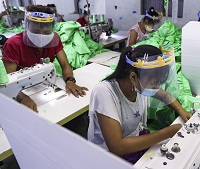 Before COVID-19, the Myanmar apparel sector employed over 700,000 workers in over 700 apparel factories. The sector created jobs faster than any other part of the economy, reports, International Labor Organization. However, pandemic-induced slowdown forced many factories to shut down and the recent military coup added more uncertainty to the sector. Thousands of workers employed in Myanmar’s garment factories are currently demonstrating against the military coup, reports Clean Clothes Campaign. Hundreds of protestors are engaged in a standoff with riot police as they march to Yangon University.
In a quandary
This has driven brands operating in the country into dilemma about whether to continue operating in the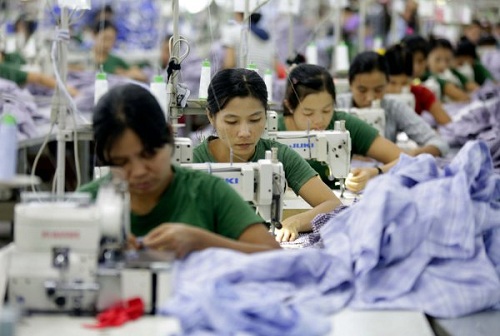 country or cut all ties with it. A representative for British multinational Marks & Spencer, The Fair Wear Foundation has urged member brands to ensure workers get due payments and have a safe work environment.
Swedish giant H&M is urging suppliers to ensure the safety of employees. The brand is also collaborating with UN agencies, humanitarian organizations, diplomatic representatives, human rights experts and other multinational companies to support positive developments in Myanmar. Myanmar fashion companies are also rethinking their expansion plans. Adopting a wait and watch policy, so far, they have exported over half of their apparels under the Everything But Arms framework. However, they are unlikely to review Myanmar’s eligibility under this act, says Politico
Political instability and strict visa norms discourage US investors
Meanwhile, Myanmar is focusing on the US market which benefits from some preferences under the US GSP or Generalized System of Preferences, program. The country has approved some of Myanmar’s individual and military-controlled companies for investments. One of these is Myanmar Economic Holdings which owns the Pyin Oo Lwin garment factory.
Peter Kucik, Sanctions Expert, Ferrari & Associates, believes Myanmar's garment industry holds great importance for Western policymakers and expects the US to adopt a more surgical approach towards the country this time. He says, policymakers should avoid taking any complex measures such as changing trade preferences. The political instability also prevents foreign high skilled and technical workers from entering the country. Further tightening of visa procedures threaten garment operations. The next few months are likely to be bleak for Myanmar as the country may fail to attract new investments. Its current projects may also face approval problems and the country may not bag new orders.
Surat textile traders support CAIT strike against irregularities in GST law
Surat Textile traders have supported Confederation of All India Traders’(CAIT) strike against irregular rules in the GST law on February 26.
According to these textile traders, with each passing day, GST laws are becoming more complicated. The GST Council is distorting the basic form of the GST law and made it into a failed tax system for the taxpayers in general. Instead of doing business, the traders are busy all day to resolve the GST issues arising out of the distorted system.
Devkishan Manghani, Advisor, Southern Gujarat Chamber of Commerce and Industry’s (SGCCI) textile trade committee said, the GST infrastructure has been revised more than 937 times in the last four years since it was first implemented in the country. The one nation, one tax slogan has completely failed. Every day, there are new notifications issued by the GST Council, which is confusing the entire trade.
PT Ban Brothers’ financial distress fuels concerns about Indonesia’s apparel sector
Indonesian clothing firm PT Pan Brothers distress is fuelling broader concerns about the nation’s apparel sector, which has been particularly vulnerable to faltering global demand during the pandemic. Supplier to brands like Ralph Lauren, Prada and Adidas, PT Pan Brothers’ dollar bonds slid to record lows of about 36.7 cents on the dollar after it postponed a new global debt offering and had to extend its loan in US currency. As per a Bloomsberg report, the company and its subsidiaries need to repay or refinance $310 million of offshore debt this year and next, consisting of the loan and a $171 million bond that will mature in January 2022
Constituting over 80 per cent of sales, the company’s exports stagnated in the first nine months of last year as the pandemic shut retail stores. The firm’s net profit rose 0.4 per cent in that period to $19.2 million, the slowest pace in three years, according to its latest financial report. To solve refinancing issues, Pan Brothers plans to sell a global bond in the second quarter. It will provide a corporate guarantee for the new notes and also use its own and the units’ assets as collateral, according to the offering prospectus.
Founded in 1980, the company which is based near Jakarta, produces clothes mainly for export. It said at the December meeting that it had 25 factories across three provinces in Indonesia that make 117 million clothing articles annually.
PETA launches new video exposing cruelties in fashion factories
PETA has launched a new video exposing the atrocities in animals in factories making garments from cashmere, leather, down and silk. The video exposes the cruelties of fashion factories across the world. It depicts animals being abused by hard-pressed workers in the interest of supplying demands for a lucrative industry. It portrays society’s treatment of animals as inherently antifeminist.
The hard-to-watch footage takes the viewer through farms and factories across the world, where animals are often hit, kicked, prodded and maimed into submission, and ultimately killed for their furs, skins and feathers. The video portrays no differentiation between conventional animal products and those which are purported to be ‘humanely’ sourced.
It targets Urban Outfitters, Inc., whose brands include the titular UO as well as Anthropologie and Free People. Animal advocates claim the group already sells luxurious, animal-free textiles, particularly their woolen knitwear, and thus have no need for the animal-derived products they continue to retail.
JD Sports Fashion to build distribution centre in EU
To avoid paying post-Brexit tariffs, British sportswear retailer JD Sports Fashion plans to build a distribution centre within the European Union. The centre would also help the retailer create around 1,000 jobs, says a report by Business of Fashion.
The end of Brexit transition on December 31 has affected many UK retailers like Marks & Spencer and ASOS who faced tariffs on items not made in the UK. They had to pay tariffs for sourcing products from the Far East and exporting them to Europe. JD needs to build an additional distribution centre in Europe to complement its existing complex in Rochdale, northern England. It also needs to 1,000 people in Europe. This alongwith post-Brexit tariffs, additional paperworks and red tape is costing the group millions of pounds.
JD Sports Fashion is a sports-fashion retail company based in Bury, England with shops throughout the United Kingdom. It is listed on the London Stock Exchange and is a constituent of the FTSE 1000 Index
India, EU to sign interim trade agreement during May summit
India and the European Union plan to sign an interim trade agreement during the India-EU summit scheduled for May 8 in Portugal. The two sides also plan to sign an investment pact, which would help India attract more interest from investors in the region. Commerce Minister Piyush Goyal and Executive Vice-President and Commissioner for Trade for the EU, Vladis Dombrovskis had urged experts to consider the feasibility of resuming work on trade and investment agreements; new areas of cooperation (regulatory aspects and resilient value chains); as well as enhancing collaboration on WTO reform”.
The two sides had open and constructive exchanges on a broad range of issues with the aim of enhancing EU-India trade and investment relations. Their discussion will help in the preparation of the upcoming EU-India Leaders’ Meeting.’ The decision to hold this meeting was taken during the 15th EU-India Summit held on July 15, 2020. Both sides confirmed their interest in resuming negotiations for ambitious, comprehensive and mutually beneficial trade and investment agreements once their respective approaches and positions are close enough.
The meeting also focused on the various key policy developments and market access issues. The EU side provided an update on the ongoing review of the Generalized Scheme of Preferences, which expires at end of 2023, and on the work towards EU Carbon Border Adjustment Mechanism under the European Green Deal.
US’ denim apparel imports decline 25 per cent in 2020
As per Office of Textiles and Apparels stats, US import of denim apparels declined nearly 25 per cent to $2.8 billion in 2020 compared to $3.73 billion the previous year, as the pandemic severely curbed demand. Suppliers who showed resilienc despite COVID and benefitted from the general flight from China included Bangladesh, whose shipments to the US declined by 3.98 percent to $561.3 million and a 20 percent market share. The same was true of Vietnam, whose imports to the US declined 1.08 per cent to $368.19 million. Imports from Pakistan declined 2.8 percent o $251.41 million. Only Cambodia’s imports increased 13.41 per cent to $143 million.
The only other Top 10 supplier that showed strength was Lesotho, with its shipments dipping 1.79 percent to $56.39 million. Other African countries that continued to demonstrate potential as a denim sourcing alternative were Madagascar, with imports increasing by 10.99 percent to $34.4 million; Ethiopia, gaining 21.37 percent to $22.99 million, and Tanzania, with a 5.48 percent increase to $13.85 million.
EEB urges European Commission to look at business model of RMG, textiles sector
The European Environmental Bureau (EEB) has urged the European Commission to ensure the forthcoming Textile Strategy recognizes pressures and impact linked to clothing, footwear and household textiles in Europe is the result of a business model based on the sale of ever-more new products made from finite virgin resources.
EEB has urged the commission to maintain economic growth in the global textile and clothing industry through the extraction and exploitation of resources, from raw materials to labour. It should also address the textile industry’s growth in material use to protect the life-sustaining earth functions people rely on and to remain within a safe operating space for humanity. Additionally, policymakers should set the textile sector on a path to a fair and sustainable transition.
The EEB states, the Textile Strategy is an opportunity to set an overarching framework that ties together the various new and existing legal instruments affecting a textile product, from production to end-of-life.
These instruments should be based on the principles of absolute resource-use reduction, achieving a toxic-free environment, absolute reduction in climate and environmental impact, and the respect of fundamental human rights, it said.
New recycling technologies, zero fossil fuels to help fashion curtail polyester use
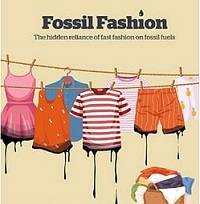 Global fashion industry’s addiction to synthetic fibers has doubled the use of polyester in the last 20 years. As per a Changing Markets Foundation report, polyester will account for 85 per cent of global use of synthetic fibers by 2030. Titled ‘Fossil Fashion: The Hidden Reliance of Fashion on Fossil Fuels’, the report was released in collaboration with the Plastic Soup Foundation, the Clean Clothes Campaign, Zero Waste Alliance Ukraine, No Plastic in my Sea and WeMove.EU. The report attributes the rise in polyester use to anexplosion of cheap, low-quality clothing across the globe. As brands launch almost 20 collections per year and apparel purchases have increased by 60 per cent in the last 15 years, global fashion production is likely to leap to 102 million tons in 2030.
Fast fashion addiction causes 87% loss of clothes
Another reason for the huge rise in fashion production is the addiction to synthetic fashion and its consumption of cheap clothes, which leads to 87 per cent clothes being dumped in landfills.
Dumped clothes often release tiny microfibers that are invisible to the human eye. Non-biodegradable, these microfibers are found everywhere, from the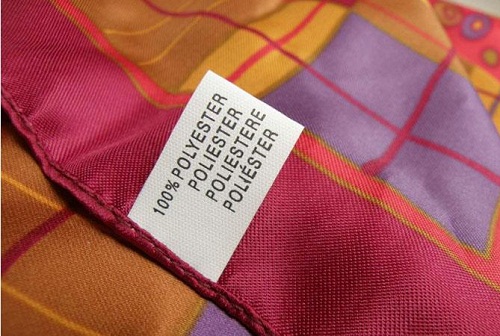 Arctic Ocean to food chains. They are also present in 80 per cent of tap water and are found in the placentas of unborn babies. They are not only harmful for sea creatures but also disrupt human lung development.
A detailed plan to reduce fashion consumption
The fashion industry has failed to reverse the negative effects of microfibers despite launching many green labels and initiatives. Hence, the new textile strategy, to be launched later this year by the European Commission, needs to include a detailed plan to slow down this consumption rate, urges Changing Markets Foundation.
Changing Markets Foundation states, the fashion industry can achieve this by distancing itself from the use of fossil fuels, increasing the quality of materials and being more responsible for the end-of-life of their products. It can also invest in viable fiber to fiber recycling technologies and separate collected, reused, and repaired materials.
To expose irresponsible corporate practices and create a more sustainable economy, Changing Markets Foundation has partnered with non-governmental organizations (NGOs) like the Plastic Soup Foundation, an Amsterdam-based NGO focused on stopping plastic pollution at the source and Zero Waste Alliance Ukraine, a public association that unites Ukrainian zero waste initiatives. An independent and values-based organization, WeMove.EU also aims to transform Europe in the name of community, future generations and the planet while another NGO No Plastic in my Sea aims to tackle plastic pollution in the marine world.
Common shared goals can boost circularity in European fashion industry
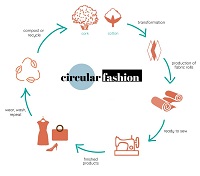 Though experts believe that a circular European apparel industry has the capacity to lessen the impact of textile waste it produces, the idea has not been adopted by mainstream producers. As per a GreenBiz report, the European fashion industry fails to invest in circular projects. According to Conor Hartman, COO and Vice President-Business Development, Circ, very few brands invest in sustainability and technological solutions for a circular economy and support laws for them.
Some fashion companies are slowly incorporating sustainability into their operation, says Lauren Phipps, Senior Analyst, GreenBiz. Prominent amongst them is Levi’s which launched its first resale offering known as SecondHand and H&M launched its first in-store garment-to-garment recycling system known as Loop.
Collaboration between supply chain players
According to Karla Magruder, Founder, Accelerating Ciruclarity, though people across the textile supply chain are individually involved in recycling, they do not necessarily work towards the same goal. If they are made to work together, they can help the industry tackle some of its sustainability challenges.
One of these includes ensuring newly launched recyclable products are actually recycled at their end-of-life and easily made into a new product. Home textiles company Coyuchi ensures this by confirming each of its supply chain links understands their role in the industry.
Boosting circular fashion principals across products
Fashion Technology Company Circ aims to recycle 10 billion garments by 2030. The company produces 100 billion clothing items each year, notes Hartman. Its recent $8million Series A funding round was led by Patagonia and joined by Marubeni America, Card Sound Capital and Alante Capital. The company’s technology can give textile waste made from cotton or polyester or poly-cotton blends, a new life. In 2021, it aims to produce garments across the world using this technology.
France recently banned textile landfilling of unsold inventory by retailers and brands. Hartman believes, if these retailers can be made to work together, they can bring about a great change in the industry. In November last year, the Massachusetts Department of Environmental Protection proposed to ban textiles from disposal in the sale. The European Union also plans to launch a new textile strategy to introduce durable, reusable, repairable, recyclable and energy-efficient products. This will boost fashion companies’ adoption of circular fashion principals across their products.











