FW
European Commission manifesto focuses on circular economy at the global level
"Moving away from its ‘take-make-waste model, the European Commission is motivating brands to recycle and reuse materials and products. These brands are also being influenced by their consumer perceptions who strongly emphasise on sustainability. A fashion industry report published in May 2019 revealed, two-thirds of consumers view sustainability as being very important with around one-third favouring brands adopting positive environmental and social practices."
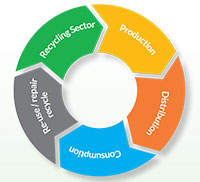 Moving away from its ‘take-make-waste model, the European Commission is motivating brands to recycle and reuse materials and products. These brands are also being influenced by their consumer perceptions who strongly emphasise on sustainability. A fashion industry report published in May 2019 revealed, two-thirds of consumers view sustainability as being very important with around one-third favouring brands adopting positive environmental and social practices.
Greenpeace says, around 10 per cent of the 3,500 chemical substances used to turn raw materials into textiles are hazardous to the environment. Production and consumption of clothes constitutes about 6.7 per cent of the global climate impact, while aviation and shipping account for 4.5 per cent of global carbon dioxide emissions. In 2017, the industry committed to lessening its environmental impact by boosting the volume of collected or resold used garments and increasing the share of garments made from recycled post-consumer textile fibres.
However, an annual assessment by the Global Fashion Agenda (GFA), the Sustainable Apparel Coalition (SAC) and the Boston Consulting Group notes that progress on sustainability in fashion has slowed over the past year. Sustainability is still not a key consideration in purchase decisions as brands are lured by the inexpensive options offered by fast fashion.
Manifesto to develop European vision for textiles
At the recent Copenhagen Fashion Summit, held on May 14, 2019, industry leaders presented a manifesto urging policymakers to co-develop a European vision for textiles in a circular economy. The manifesto is a product of collaboration between the European Apparel and Textile Confederation (Euratex), the Federation of the European Sporting Goods Industry (FESI), the International Apparel Federation (IAF), the Sustainable Apparel Coalition (SAC), and Global Fashion Agenda (GFA).
The manifesto suggests, though a large part of the industry is committed to promoting a circular economy, systems and tools required for this are currently inadequate in the country. The manifesto sets out some points to reframe the issue, such as considering the circular economy for textiles as a global issue and not a regional one and requesting that the whole industry be part of the discussion.
Innovations, designs to boost circular economy
Industry leaders say, for a circular economy to function, the industry needs to use new technological innovations that help separate fibres for reuse and up-cycling. It also requires better design and materials. A major part of the product’s environmental impact can be determined at the design stage. However, for this the industry needs to collaborate with textile and fiber makers to determine if the clothing is fit for recycling.
The manifesto demands policies tailored to SMEs and multinational fashion brands, as well as regulations to “nudge” consumers into rethinking how they use and dispose of textiles. Some industry leaders, such as H&M, have taken this matter into their own hands. They have installed a miniaturised version of their recycling technology at their stores to show how their used clothing can be recycled.
While there is no law subject to waste-stream legislation in the same way as, the European Commission’s moves in this direction, need to be considered seriously and a new EU waste law targeting such products frame in the near future.
AATCC unveils 1st edition of AJOR
AATCC has unveiled the first edition of the AATCC Journal of Research(AJOR): a compilation of 12 original research and review papers from the 14th Asian Textile Conference (ATC-14), which was organised by the Institute of Textiles and Clothing, The Hong Kong Polytechnic University, and the Federation of Asian Professional Textile Associations in Hong Kong, June 27–30, 2017.
Dr. Chi-wai Kan, Associate Professor in the Institute of Textiles and Clothing, The Hong Kong Polytechnic University, was Guest Editor for this issue.
The following articles are included in this special issue:
• Hand Value Evaluation by Judge Gender and Education Background Influence on Woolen Fabric Fused with Interlinings for a Suit
• A Review of Chitosan Textile Applications
• Facile Fabrication of Microspheres and Microcapsules from a Recombinant Spider Egg case Silk Protein for Drug Delivery
• Properties of Modacrylic Fibers Prepared from Poly (acrylonitrile-co-vinylchloride) - Experimental and Theoretical Studies on Coagulation and Diffusion during Wet Spinning
• Effect of Curing Conditions on Electrical Properties of Screen-Printed Fabric Antenna for UHF RFID Tags
• Preparation of Para-Aramid Aerogel Fiber through Physical Gelation of Aramid Dispersion Liquid and Supercritical Drying
• Structure Control for Preparing High-Ionic Conductive Hybrid Nanofiber
• Fibers Made of Recombinant Spidroins - A Brief Review
• Laccase-Catalysed Biomimetic Coloration of Wool Fabrics with Phenols
• The Application of Hollow Segmented Pie Bicomponent Spunbond Hydro-Entangled Microfiber Nonwovens for Microfiber Synthetic Leather Apparel
• Influence of Woven Fabric Structural and Material Parameters on Dielectric Properties
• Electrostatic Filtration Performance of Conductive Fibrous Filters
Indian government to raise minimum wages in textiles by 40 per cent
Prime Minister Narendra Modi, has proposed a 40 per cent increase in wages of textile workers in some of the most remote areas of the country. The new government is studying to raise the country's minimum wage. Prime Minister, Narendra Modi, re-elected in the last elections, is planning to raise it up to 30 or 40 per cent in some states of India. The minimum wage of the country is granted by each state, although it must always be above the quota set by the central government.
The measure will be included in a new labor law proposed by the government after the previous bill in this regard had to be paralyzed due to the proximity of elections. Labor Minister, Santosh Gangawar, has confirmed that the new law will also have an article referring to the minimum monthly payment, according to Just-style.
Currently, the minimum wage established for the whole country is $4.90 per day, with a variable plus based on inflation. However, as it is a decentralized regulation, Delhi, for example, has a minimum wage of $7.90 a day, while other states, such as Chhattisgarh, maintain the same criteria as the one set by the central government.
Egyptian company announces major investment deal for textile industry
During ITMA 2019, Cotton & Textile Industries Holding of Egypt announced a major investment deal to facilitate the country’s textile industry. The investment program, facilitated by Brussels-based Werner International, will leverage the prestige of Egyptian cotton to restore Egypt’s textile industry to prominence. The investment is supported by Egypt’s President Abdul Fatah Al-Sisi and the Minister of Public Enterprises Hisham Tawfik.
The total investment of approximately $1.25 billion will be used to modernise spinning, weaving, knitting, dyeing, finishing, printing and cut-and-sew manufacturing. The investment will occur in phases and includes approximately 780,000 new spindles and 1,250 weaving machines. As a part of the investment, Egypt will construct a new state-of-the-art spinning mill for fine and extra-fine counts that will feature more than 180,000 spindles under one roof. The program will have a major impact on the competitiveness and the success of the Egyptian textile industry in the future.
KappAhl’s Q3 sales decline by 3.3 per cent
Sales of KappAhl have slumped by 3.3 per cent in Q3 due to a decrease in the women’s wear turnover. KappAhl is a leading fashion chain in the Nordic region with 380 KappAhl and Newbie stores, including Shop Online, in Sweden, Norway, Finland, Poland and UK. Notably, sales for 2017/2018 totaled SEK 4.8 billion and the company has approximately 4,000 employees in ten countries. For Q3 (March-May), net sales of the brand was SEK 1,200 million compared to SEK 1,242 million achieved during the same period of last fiscal. Similarly the gross margin was down by 3.7 per cent for third quarter and profit after tax too saw a huge fall as it was SEK 6 million compared to SEK 94 million.
It is pertinent to mention here that selling and administrative expenses increased for the quarter, SEK 724 million compared to SEK 680 million.
Inventories at the end of the period were SEK 801 million while in the same quarter of last fiscal it was SEK 692 million. The company claims that the increase in inventories compared with the same period in the previous year is due to poorer sales in the quarter compared with the previous year and to a higher dollar exchange rate, but mainly consists of summer goods that are still in season.
Economic Times to organise India Licensing Expo 2019
The Economic Times is organising ‘India Licensing Expo 2019’ – India’s largest expo for textile manufacturers and fashion labels from July 08-09, 2019 at Bombay Exhibition Centre in Mumbai. The Economic Times India Licensing Expo 2019 will showcase over 500 global fashion brands and over 3,000textile manufacturers and designers who will come together to explore business, learning and opportunities. Global brands like Femina, Warner Bros., Chota Bheem will also exhibit at the conference.
Apart from this The Economic Times is also organising a leadership forum Labels Conference where customers will know how to launch their own fashion brands from industry leaders like Roberto Bré, CEO Europe & Eastern Operations, Marie Claire – Paris, Anurag Kashayap – Film Maker, Writer and Director, Palash Sen – Singer & composer, Varija Bajaj MD AND CEO, Varija Collections, Rahul Sarangi – Global Head, Content & Business, The Viral Fever (TVF).
The Economic Times Labels Awards extends a credible platform to recognise exceptional work excellence in the Fashion and Lifestyle industry. The awards acknowledge the best in each sphere of internet marketers, animation, VFX and comics character.
The Textile Association (India) is Supporting Association and Journal of the Textile Association (JTA) is a Media Partner.
Seminar at HFW for Spring/Summer to discuss latest trends in fashion e-commerce
A seminar at the 26th Hong Kong Fashion Week (HFW) for Spring/Summer titled "New Retail Era: 'Fashion x E-commerce' Strategies", will see industry leaders come together to discuss latest trends in fashion e-commerce and examine how the industry can identify new opportunities amid the global economic uncertainties stemming from the current trade conflict.
Joining the discussion will be Alin Dobrea, Head of Brand Partnerships at Zalora; Eddie Lee, Regional CEO, Taiwan, Hong Kong and Southeast Asia, ECMS Express; Edwin Wong, Founder & CEO, Cloudbreakr; and Raymond Yeung, Senior Sales Manager, Publications & E-Commerce Department at the HKTDC.
To be organised by the Hong Kong Trade Development Council (HKTDC), the 26th Hong Kong Fashion Week for Spring/Summer will be held at the Hong Kong Convention and Exhibition Centre (HKCEC) from July 8-11, 2019.
H&M Q2 net sales increase 11 per cent
H&M Group’s net sales increased 11 per cent to SEK 57,474 m (51,984) in Q2. In local currencies, net sales increased 6 per cent compared with the corresponding quarter last year.
The group’s gross profit was SEK 31,825 m (29,164). This corresponds to a gross margin of 55.4 per cent (56.1). Its profit after financial items amounted to SEK 5,934 m (6,012). The group’s profit after tax amounted to SEK 4,569 m (4,638), corresponding to SEK 2.76 (2.80) per share. As customer satisfaction and sales increase, the group has intensified its transformation work even further, which had a dampening effect on earnings development.
In April, H&M became the first big fashion brand in the world to provide detailed information concerning the factory and material for individual garments to help customers make more sustainable choices. It also launched its online store in Mexico during the quarter.
IFDC to select final line up of global modest designers at TFW 2019
Islamic Fashion & Design Council (IFDC) will select the final lineup of global modest designers at Torino Fashion Week 2019 (TFW 2019). The event will be held from June 27 to July 3, 2019 in the historical city of Torino.
Vogue and La Stampa, lead media partners of TFW2019 have noted the final line-up namely Chantique (Dubai), Alice Giani Margi (Italy), Luya Moda (UK), and Coèga Sunwear (Dubai) who are set to showcase their winning blend of great fashion style and modest-enriched pieces. These modest designers will focus on a range of priorities, including sustainability, ethics, culture, value and tradition, and not at the very least great style at the forefront. The dynamic modest collections, ranging from street wear, ready-to-wear, right up to red carpet looks are being lined up and are sure to dazzle the global fashion industry and the attending leading media this year, while the key highlight and attendance will be at the IFDC Awards - where the best designer will be awarded with a free spot to headline at TFW2020.
Participation in the showcases offers a unique take on designs which are ready to be taken to the larger scale in the important industrial city of Torino, where brands are catapulted to new heights. With media coverage both nationally and internationally, the buzz increases year by year.
Accessories Vision to offer access to Chinese and other international suppliers
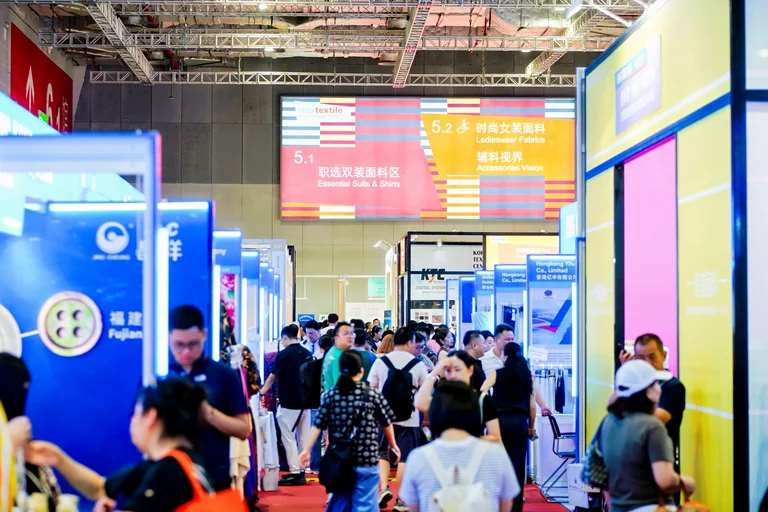
The product zone of Accessories Vision, to be held from September 25-27 in Shanghai, offers visitors an access to Chinese and international suppliers. Besides other products, the zone also includes options essential for smart branding, such as eco-friendly tags and labels.
Big names like 3M, Avery Dennison, Ideal Fastener and Shimada Shoji will return to the exhibiton alongwith key members of Button & Garment Accessories Industry Chamber New exhibitors include Huashengda Zipper (Cam), from Cambodia and Prime Fastener from South Africa. Other highlighted exhibitors include Hong Kong Bright Zipper & Machinery, Monica Crystal Accessories, U.R.Label & Printing and Wai Hung Weaving Factory, 3M, Mitchell and Mainetti.