FW
Surge in cotton prices, growing demand boost yarn prices in India
A surge in cotton prices along with growing demand from domestic and international market has led to a sharp rise in Indian cotton yarn prices. As per a SRTEPC report, prices of 30s combed yarn used by the hosiery sector have rised by 30-40 per cent by export merchants in Gujarat over the last few weeks. Dealers can buy at least two months of production from a number of spinning mills, says Anand Poppat, a Rajkot-based dealer of uncooked cotton, yarn and spinning waste.
The Trading Economics Website also indicates a gain of over 13 per cent as cotton prices rose almost 10 per cent in February .Global cotton prices are rising due to higher imports from China. The rise in Indian cotton prices has come despite the country carrying over record stocks of cotton from last season, says Ashwin Chandran, Chairman, Southern India Mills Association (SIMA).
As the textile sector started working at close to optimum capability, demand for yarn elevated since December 2020. This resulted in greater yarn production, however prices have elevated, primarily, as cotton prices gained. For instance, the 40s depend warp yarn topped Rs 300 a kg however has now dropped to Rs 275-285. Hosiery yarn prices are nonetheless decrease. Besides home demand, which has resulted in panic shopping, export shopping has additionally pushed up yarn prices.
Worldwide cotton market to reach $46.56 billion by 2021
As per a report ‘Global Cotton Market and Volume by Consumption, Production, Export, Import, Countries, Companies,’ Forecast by ResearchAndMarkets.com, the worldwide cotton market is expected to reach $46.56 billion by 2027, with a CAGR of 2.74 per cent from 2020 to 2027.
The report states, Cotton is a labor-intensive cash crop mass-produced across the globe. It majorly supports the global textile mills market and the global apparel manufacturing market. It is also a very political crop since its importance is in the world exchange of many evolving countries. It has many other uses, across many different industries like in woven fabrics, clothing, bed sheets and towels, home decor, cottonseed oil, pharmaceuticals, etc.
Asian countries dominate cotton production and they are also one of the biggest consumers of cotton. For years, China, Bangladesh and Vietnam have been major importers of cotton while exporters include the United States, Brazil and India.
C.L.A.S.S. launches Manifesto for Responsible Fashion
Italian hub supporting sustainable fashion, C.L.A.S.S. has launched its Manifesto for Responsible Fashion and kicked off a Call To Action of C.L.A.S.S. Icon 2021 contest. Launched in 2020, the annual competition rewards a visionary creative who is able to combine design, responsible innovation and communication, and capable of raising contemporary consumer awareness about the new values of sustainable fashion.
The contest was initiated by Giusy Bettoni, Founder, C.L.A.S.S., during the Smart Voices panel “C.L.A.S.S. Icon: Award and Manifesto for Responsible Fashion,” moderated by the journalist Diana de Marsanich, and featuring fashion designer Gilberto Calzolari, winner of the CLASS Icon Award 2020, and Federico Poletti, marketing and communication director of White Show.
From February 15 to April 15, candidates can enter the contest by sending an email with a description and objectives of their brand, the sustainability values they adopted and their strategy, together with a designer's profile, a photo-video story of their latest collection, and any previously won awards.
The competition sums up the values C.L.A.S.S. has been supporting since its inception in 2007. These include: importance of a company to behave ethically, follow transparent production standards, offer traceable and healthy products and guarantee respect for people and the environment while being committed to circular economy, safeguarding the oceans and lowering the use of water, energy and resources.
Coats teams up with Spanish design university ESNE
World’s leading industrial thread company Coats has teamed up with ESNE, the largest design and technology university in Spain, to enhance industry learning of fashion design degree students.
The company will create dedicated Coats spaces on the ESNE campus in Madrid. The Clothing and Pattern Making Workshop and Prototyping room will provide students access to a wide range of Coats products and enable them to develop their collections. The room will also have a separate display area showcasing samples of latest product launches and innovative design processes.
In this space, students will be able to learn about all aspects of manufacturing threads, yarns, zips and trims. Coats will also host a series of training courses, webinars, workshops and masterclasses, for both students and teachers.
Coats and ESNE are also planning to collaborate on a research project which involves creating digital tools that facilitate access to training and knowledge in the textile and fashion design sectors. Competitions are also planned for students to demonstrate how they have used Coats solutions and materials in the most innovative way.
UN Committee recommends Bangladesh’s graduation from LDC
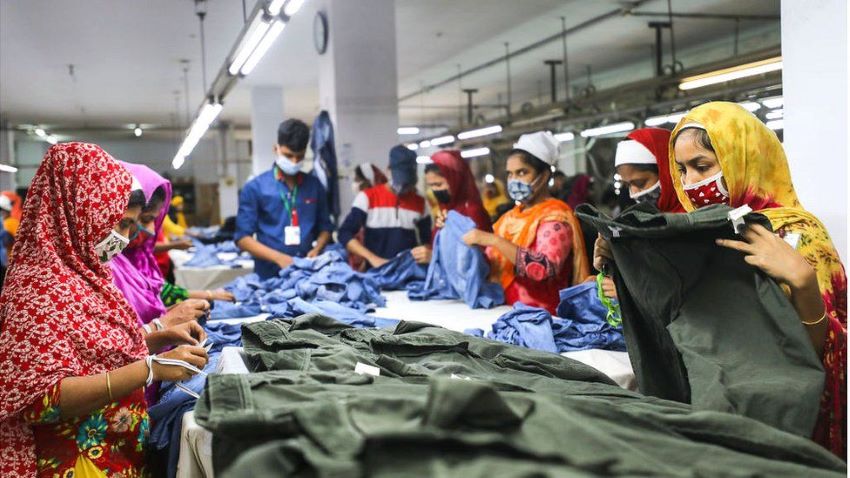
Last week, the United Nations’ Committee for Development Policy recommended Bangladesh graduation from least-developed-country category that it has held for most of the 50 years since it became independent. The UN Committee said, Bangladesh’s exports have risen by around 80 per cent in dollar terms in the past decade, driven by its booming garment industry. It has a young demographic structure, a continued competitive edge in terms of wage levels, strong and rising female labor-force participation especially relative to the rest of South Asia.
However, the growth in Bangladesh’s exports is below Vietnam’s and Cambodia. Hence, Bangladesh needs to move towards exporting higher-value items. Its export industry is still overwhelmingly focused on garment manufacturing. The country’s economic complexity, ranked by Harvard University’s Growth Lab, is 108 out of the 133 countries measured. That is actually lower than it was in 1995.
Bangladesh also isn’t a member of the Association of Southeast Asian Nations, or the Regional Comprehensive Economic Partnership or the Comprehensive and Progressive Trans-Pacific Partnership. Diversifying its manufacturing exports would require greater participation in intra-Asian supply chains—and probably a closer economic relationship with its neighbors to the east.
Peru terminates anti-dumping investigations against Chinese fabric
On February 28, 2021, the Peruvian National Competition and Intellectual Property Protection Agency’s Committee on Dumping, Subsidies and Non-tariff trade barriers issued a notice stating that since the 100 per cent polyester fabric originating in China did not cause material damage to Peru's domestic industry, the anti-dumping investigation against Chinese polyester fabric would be terminated and anti-dumping duties would not be imposed on it.
The products involved are 100 per cent polyester fabrics of taffeta, white or dyed with a width of less than 1.8 meters and a unit weight of between 80g/sq m and 200g/ sq m..
On February 6, 2020, Peru issued notice No. 010-2020/CDB-INDECOPI in response to the Peruvian company TecnologaTextil S.A. and decided to launch an anti-dumping investigation into 100% polyester fabrics originating in China. The dumping investigation period was from January 2019 to December 2019, and the injury investigation period was from January 2016 to December 2019.
Uniqlo’s same-store sales rise by 0.4% in February 2021
In February, Uniqlo’ssame-store sales rose by 0.4 per cent year-on-year while its total sales rose by 1.3 per cent.
As per Fashion Network, the company’s same-store sales rose on the back of strong sales of products designed to satisfy stay-at-home demand and buoyant sales of Spring outerwear and items manufactured using our Cut and Sew process.
The company is still battling against some pandemic headwinds and by the end of the month, a total of five stores remained temporarily closed and 172 stores were operating shorter working hours. Meanwhile, following its signing of Roger Federer as a global ambassador several years ago and other initiatives, Uniqlo is continuing to deepen its tennis links and has just announced that it has included a sponsorship deal with The Japan Tennis Association.
The retailer will supply Japan's players at this year's premier men's and women's international team tennis events. The teamwear provision starts with the World Group I for the Davis Cup on March 5 and 6, in Islamabad, Pakistan. The women's team will wear Uniqlo in a Billie Jean King Cup playoff in Miki, Hyogo Prefecture, Japan, on April 16 and 17.
Shima Seiki launches first remote system for shifting work patterns
Shima Seiki has launched its first remote system, Apex Fiz- a platform created in response to the shifting work patterns induced by the global pandemic.
Shima Seiki’s high-tech flat knitting machines are programmed via the company’s ‘SDS-ONE Apex Series’ software, which designers also use to design and develop knitwear. Until now designers had to have access to an actual SDS-ONE Apex design system – accessing the design element of the software remotely just wasn’t possible.
Without the ability to travel, and with trade shows and yarn fairs cancelled, designers have been unable to make the necessary trips to view yarn innovations and collections with the tactility they so crucially need.
Whilst shade cards can still be requested from spinners, the waste produced by ordering shade cards that end up being surplus to requirement – not to mention the vast amounts of space needed to store them whilst working from home- means designers have far less access to yarn and trend inspiration. Combine this with the delays many factories are facing in sampling lead times, and the result is a severe lack of access to yarn and fabrics to integrate into designed collections.
Techtextil North America, Texprocess Americas to return in May
After a 2020 postponement, co-located trade shows Techtextil North America and Texprocess Americas will return in-person May 17-19, 2022 in Atlanta, but will shift their cycle permanently going forward.
Beginning in 2023, this major North American event for sewn products and technology will pivot to an odd-year cycle with the next shows taking place from May 10-13, 2023. The change is in response to moves made by parent shows Techtextil and Texprocess Frankfurt, which switched their sequence to an even-year schedule starting in 2022.
To keep the industry connected and informed between shows, the organizers have been producing a monthly virtual webinar series that runs through April 2021, with speakers and subjects addressing current industry topics across technical textiles, nonwoven and sewn products. The next sessions include Smart Textiles (March 25) and High Performance Fibers (April 29). Attendees who missed the earlier sessions—including talks on 3D printing, sewing technologies, sustainability and “The Factory of the Future”—can register to view the recordings.
ICAC revises cotton consumption forecast to 249.5 million tonne
International Cotton Advisory Committee (ICAC) has revised the 2020/21 cotton consumption forecast upward this month from 24.2 million tonne to 24.5 million tonne. While the projected 7 per cent year-over-year increase isn’t nearly enough to offset the losses caused by the pandemic, it’s expected to outpace production, thus drawing stocks down by the end of the season. Stock levels are expected to drop to 21.1 million tonne by the end of 2020/21, which would represent a 1 per cent decrease from the previous season.
The Secretariat is projecting an increase in global trade. Both China and Pakistan are forecast to increase imports, the former benefitting from the price gap between domestic and foreign cotton and the latter due to a decrease in domestic production. This month, the Secretariat’s price projection for the year-end 2020/21 average of the A Index is 75.7 cents per pound.